Ask questions across claims linked to experiments, exact results, limitations, and sources.Know what falsifiable science actually supports before you trust the answer.
Press Enter ↵ to search evidence
Explore by Goal
"Just like a single cell, the character of our lives is determined not by our genes but by our responses to the environmental signals that propel life."
- Bruce H. Lipton
Quick Explanation
Copied
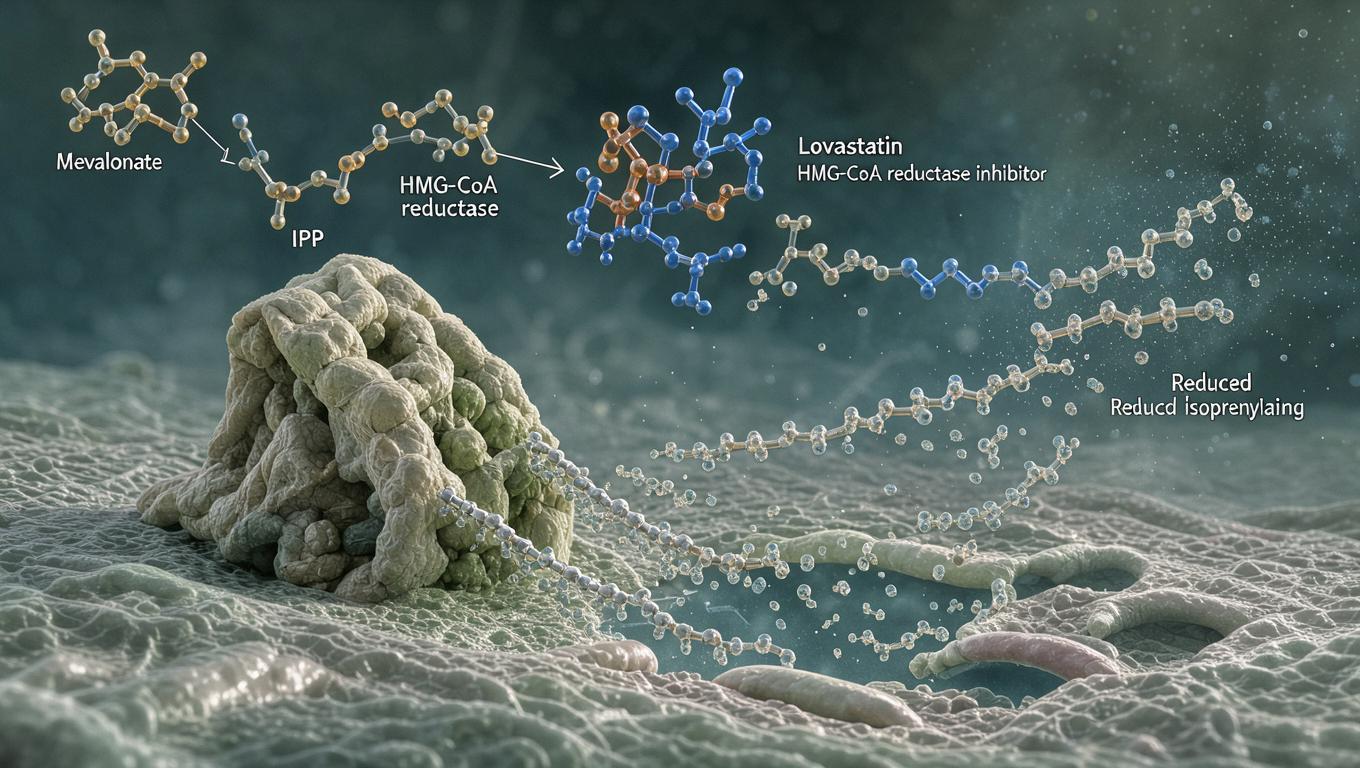
Lovastatin potently inhibits proliferation of two ER-negative breast cancer cell lines via isoprenoid depletion (mevalonate/GGPP rescue of 92–98%), disrupting RhoA, E2F1/Rb, and AKT signaling while suppressing glycolysis, TCA cycle activity, and lipid biosynthesis . However, it remains an in vitro study of only two cell lines with unvalidated clinical extrapolation.
The study's strongest evidence comes from rescue experiments: co-exposure with mevalonate or GGPP restored proliferation to 92–98% of control, while FPP only partially rescued (67%), pinpointing geranylgeranylation—not farnesylation—as the critical mechanism . IC50 values (acid: 5–8 μg/mL; lactone: 7–9 μg/mL) are modest—20 μM lovastatin/24h approaches clinically achievable exposures per an ovarian cancer parallel study .
Proteomic and Metabolic Signature
2D-GE proteomics (n=4/group) identified 74 changed proteins in MDAMB231 and 42 in MDAMB468, validated by Western blot. Key hits: GDI-2 up (stabilizing inactive RhoA), membrane-bound RhoA down (acid > lactone), MCM7 to 28% of control, MSH2 down, prohibitin up, PTEN up/DJ-1 down/pAkt down/NDRG1 up . NMR metabonomics (n=3) showed dramatic metabolic collapse in MDAMB468:
Critical Appraisal and Blind Spots
Strengths: Dual orthogonal platforms (proteomics + NMR metabonomics) cross-validate; rescue experiments are mechanistically decisive; directionality is coherent across all three signaling axes.
Weaknesses: Only two ER-negative lines studied—no ER-positive, normal breast, or in vivo validation. Metabonomics was performed only in MDAMB468, not in the more sensitive MDAMB231, creating a cell-line asymmetry in the integrated dataset . The 2D-GE platform has limited dynamic range and misses low-abundance and heavily modified proteins. The mechanistic link between DJ-1 regulation and pAkt suppression is explicitly speculative—authors call it a hypothesis requiring further evaluation. Findings in cardiomyocytes show lovastatin causes both mevalonate-dependent apoptosis AND mevalonate-independent oncosis , raising the possibility that some observed breast cancer effects also involve mevalonate-independent mechanisms the paper does not test. Additionally, later TNBC work found lovastatin IC50 of 7.97 μM (MDA-MB-231) consistent with this paper, but linked the effect to MNRR1 inhibition—another mechanism this 2010 study could not have detected .
What would change this conclusion: Failure of mevalonate/GGPP to rescue in a broader panel, absence of RhoA/GDI-2 changes on independent validation, or null in vivo xenograft results would falsify the central mechanism. No raw proteomics data deposition was described, limiting independent reanalysis.
Feedback:
Updated: November 17, 2026
BGPT Paper Review
Study Novelty
70%
First combined 2D-GE proteomics + NMR metabonomics dissection of lovastatin in ER-negative breast cancer; identified GDI-2/DJ-1/SCP-2 as novel lovastatin targets within a well-precedented mevalonate mechanism.
Scientific Quality
70%
Well-controlled, orthogonal validation, clear statistics; but only two cell lines, 2D-GE's limited dynamic range, no raw data deposition, metabonomics asymmetry across lines, and no in vivo work cap quality.
Study Generality
60%
Findings apply to two ER-negative TNBC lines; PTEN/Rb-status dependence suggests generality across breast subtypes is untested.
Study Usefulness
70%
Provides a mechanistic map for statin repurposing in TNBC and biomarker candidates (DJ-1, NDRG1, GDI-2); guides combination therapy design.
Study Reproducibility
60%
Detailed methods and reagents listed; no raw dataset deposition described; Western blot and 2D-GE protocols are replicable from the text.
Explanatory Depth
70%
Connects upstream isoprenoid depletion to specific signaling axes and metabolite flux changes; several causal links (DJ-1→pAkt) remain explicitly hypothesized.
We'll email you the results when your analysis is finished.
Hypothesis Graveyard
Statins kill cancer cells purely via cholesterol depletion — falsified here and elsewhere because mevalonate/GGPP (not cholesterol) fully rescues proliferation.
All statin cytotoxicity is mevalonate-dependent — contradicted by cardiomyocyte oncosis that resists mevalonate rescue, suggesting partial non-HMGCR mechanisms may also operate in cancer cells.

 Explore by Goal
 Quick Explanation
 Long Explanation
 Top Data Sources
 Ask a Follow-Up
 Key Insight
 Keep Exploring
 Hypothesis Graveyard
 Potential Experiments
 Discussion
