Analyze how experimental results and claims are presented, scoped, and limited in a paper.Know what the science actually supports before you trust the answer.
Press Enter ↵ to analyze
Explore by Goal
"The nitrogen in our DNA, the calcium in our teeth, the iron in our blood, the carbon in our apple pies were made in the interiors of collapsing stars. We are made of starstuff."
- Carl Sagan
Quick Explanation
Copied
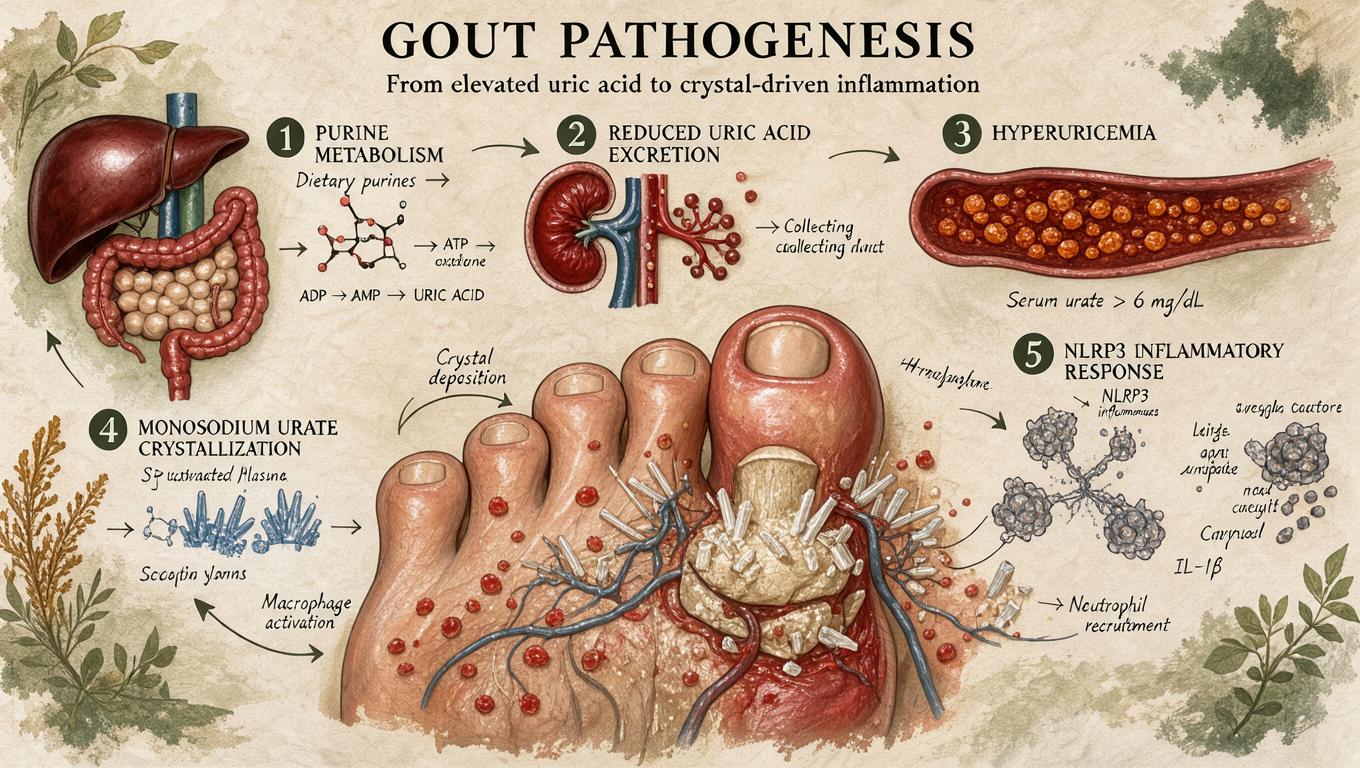
This 2017 narrative review makes a well-sourced but not definitively causal case that hyperuricemia sits at the metabolic syndrome web's center, with the strongest mechanistic thread being fructose-driven urate production inhibiting AMPK . Supporting epidemiology is consistent—higher urate predicts incident MetS ~1.6–2 fold—but most human interventional evidence remains small or unreplicated.
Long Explanation
What the Review Claims, and How Strongly the Evidence Supports It
The review argues gout is "both an inflammatory and a metabolic disease," positioning intracellular urate as an inhibitor of AMPK through AMP deaminase and fructokinase, thereby promoting gluconeogenesis, lipogenesis, inflammation, and hypertension . The mechanistic synthesis is intellectually strong, but the authors correctly flag that many key links (e.g., FMD findings) are inconsistent: their own unpublished data suggest impaired endothelial function in gout (p=0.03), while Brook et al. found no difference .
The epidemiologic backbone is well corroborated by independent cohorts: in 9,689 adults, baseline urate independently predicted incident MetS (men upper third OR 1.60; women ≥4.6 mg/dL OR >2.0) , and even normal-range urate quartiles show graded MetS odds, stronger in women (AUC 0.768 vs 0.664) . A lactate–urate interaction study adds a dose-response dimension (highest tertiles of both: OR 6.02 vs lowest) .
The strongest counterevidence the review does not fully confront comes from diabetic cohorts: among 1,405 patients with type 2 diabetes, gout patients had worse risk profiles (TG 2.6 vs 1.9 mmol/L; HDL 1.05 vs 1.24; nephropathy 55% vs 26%) yet no significant increase in cardiovascular events (35% vs 27%, p=0.201), suggesting urate/gout may be a marker rather than a causal driver of cardiometabolic outcomes . Similarly, a 221,117-person cohort found the diabetes→gout association reversed after comorbidity adjustment (men adjusted HR 0.61), arguing diabetes itself is not causal .
Where the review is strongest: its fructose biochemistry (fructose-1-P as a phosphate sink disinhibiting urate synthesis) builds on a well-established mechanistic literature . Blind spots: reliance on abstract-only vascular data; allopurinol trials (Feig, Takir) are small with drug effects that may be urate-independent, as the authors themselves concede; sex-specific effects are underexplored despite strong evidence that hyperuricemia dominates gout risk in both sexes (HR ~9.3–9.7) . Falsification would require large RCTs showing urate-lowering fails to improve MetS outcomes—partially addressed by the 2020 ACR guideline, which still recommends against treating asymptomatic hyperuricemia pending such data . Conclusion: association is robust; causation is plausible but unproven—confidence moderate.
Feedback:
Updated: October 30, 2026
BGPT Paper Review
Study Novelty
60%
The urate-fructose-AMPK synthesis was emerging but not consolidated in 2017; the framing of gout as a metabolic (not merely inflammatory) disease was a timely integrative contribution rather than a paradigm shift.
Scientific Quality
70%
Well-structured, NIH/Rheumatology Foundation-funded narrative review with honest disclosure of conflicts (Horizon, Ironwood, SOBI, Takeda) and self-cited unpublished data presented only in abstract form—a transparency plus but a rigor weakness. No systematic search methodology.
Study Generality
80%
Connects gout to five major metabolic syndrome domains with implications spanning rheumatology, cardiology, endocrinology, and hepatology.
Study Usefulness
70%
Useful conceptual map for researchers designing ULT-outcome trials and clinicians weighing comorbidity context, though it cannot yet guide treating asymptomatic hyperuricemia.
Study Reproducibility
50%
As a narrative review with no systematic protocol, no data deposit, and one unpublished cited dataset, reproducibility of its synthesis is inherently limited.
Explanatory Depth
70%
The AMPK/AMPD/fructokinase feed-forward model provides genuine mechanistic depth, but key steps rest on rodent and in-vitro data with unvalidated human translation.

 Explore by Goal
 Quick Explanation
 Long Explanation
 Top Data Sources
 Ask a Follow-Up
 Key Insight
 Keep Exploring
 DataGen
 Discussion
