Check your hypothesis against versioned claims, exact reported results, and stated falsification criteria.Know what falsifiable science actually supports before you trust the answer.
Press Enter ↵ to search evidence
Explore by Goal
"An expert is a person who has made all the mistakes that can be made in a very narrow field."
- Niels Bohr
BGPT Odds of True
22%
80% Confidence
The hypothesis asserts a specific rate-limiting causal mechanism (depression-driven cognitive-control loss) that no supplied study has measured in sub-Saharan older adults. Only an unvalidated conceptual syndemic framework exists. Partial support (syndemic plausibility, moderator biology elsewhere) yields a low-moderate estimate.
Hypothesis Novelty
82%
No supplied study links cognitive control, self-directed ageism, depression, and pension structures in a single tested causal model for sub-Saharan Africa; the combination is original, though each component is familiar.
Quick Answer
Copied
The hypothesis is a plausible but empirically untested three-step causal chain. The self-directed ageism–depression syndemic framework for African older adults is explicitly conceptual and unvalidated [1], and no supplied evidence demonstrates that depression-related loss of cognitive control is the rate-limiting mechanism, nor that non-contributory pensions interrupt the cycle before cognitive entrenchment. Only indirect, mostly non-African evidence (e.g., a moderator linking depression to mortality risk) exists [2].
Long Answer
Verdict: a layered causal conjecture, not an established mechanism
The hypothesis bundles three distinct claims that must each hold for the whole to be true: (1) a self-directed ageism–depression syndemic exists and can become self-sustaining in sub-Saharan African older adults; (2) depression-related loss of cognitive control is the rate-limiting step locking the loop; (3) structural transfers (non-contributory pensions) can interrupt the loop upstream of cognitive entrenchment. The supplied evidence supports only the first claim, and only as an untested framework.
Claim 1 — syndemic framing: A 2025 conceptual analysis proposes that self-directed ageism and depression may be mutually reinforcing among older African adults, shaped by poverty, gender inequality, institutional neglect, and cultural narratives; the authors explicitly call for empirical testing, and the framework draws heavily on Global North theory without examining religion, ethnicity, disability, or sexual orientation [1]. It generated no original data, so
We'll email you the results when your analysis is finished.
Hypothesis Graveyard
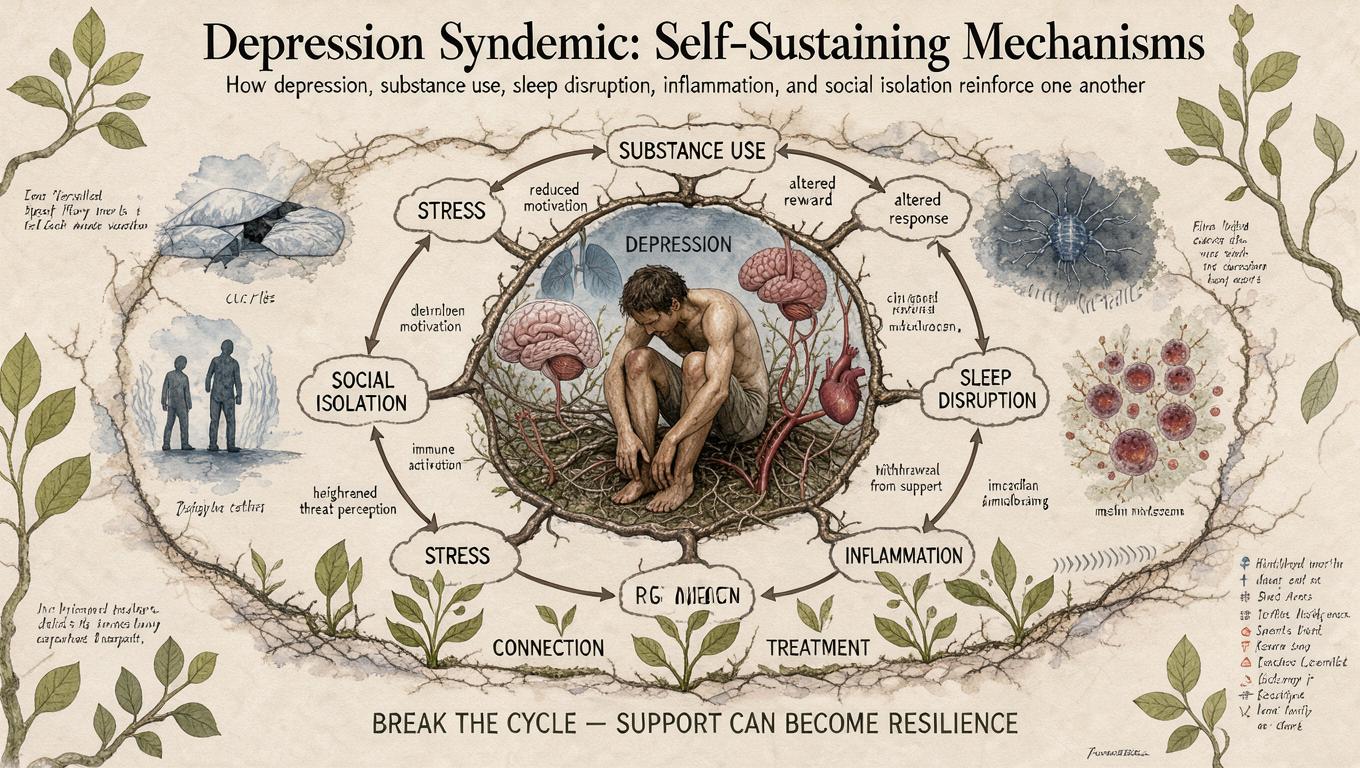
Treating depression alone will break syndemic cycles: the TB–depression syndemic literature shows integrated, not single-condition, care is required; purely clinical depression treatment is unlikely to interrupt structurally anchored loops.
Klotho-like biological moderators are the primary rate-limiter: the klotho–depression interaction (HR 1.59 vs 0.94) proves moderators matter, but it is US-based observational data and cannot identify rate-limiting steps in SSA cognitive-control dynamics.
The TB–depression syndemic template transfers directly: it establishes syndemic loops and integrated structural care but involves infectious-disease comorbidity, not cognitive control or ageism.
Science Art
Science Movie
Make a narrated HD Science movie for this answer ($64 per minute)

 Explore by Goal

 Hypothesis Novelty
 Quick Answer
 Long Answer
 Top Data Sources
 Ask a Follow-Up
 Key Insight
 Keep Exploring
 Hypothesis Graveyard
 Discussion
