Analyze how experimental results and claims are presented, scoped, and limited in a paper.Know what the science actually supports before you trust the answer.
Press Enter ↵ to analyze
Explore by Goal
"The art and science of asking questions is the source of all knowledge."
- Thomas Berger
Quick Explanation
Copied
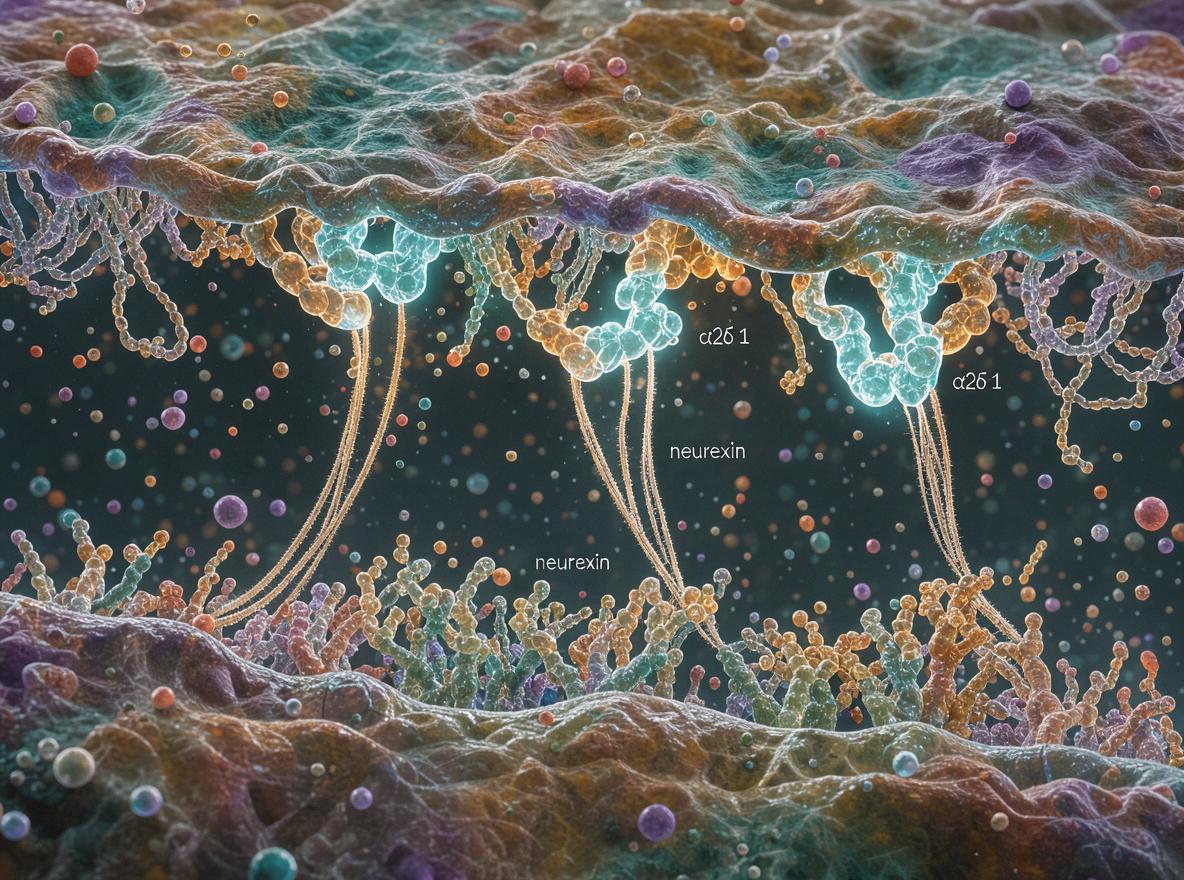
This FASEB Journal study shows that extracellular α2δ-1 acts as an outside-in signaling platform: pregabalin and the neurexin-1α ectodomain acutely shrink the readily releasable pool (RRP) of synaptic vesicles without reducing presynaptic Ca2+ influx, mimicking increased intracellular calcium buffering. Evidence is strong within its reductionist autaptic microculture system (30 μM pregabalin cut EPSCs ~50%, n=9; NRX1α ectodomain bound α2δ-1 with IC50 ~140 nM), but the transduction pathway to the RRP remains unidentified and in vivo generalization is untested .
Long Explanation
Core evidence: an extracellular lever on vesicle release
In autaptic single-cell microcultures (SCMs) from rat superior cervical ganglion neurons, phasic transmission was dominated by N-type Ca2+ channels (ω-conotoxin-GVIA reduced EPSCs >80%; nifedipine only ~15%). Acute 30 μM pregabalin halved EPSCs (n=9), an effect blocked by the endogenous α2δ-1 ligand l-isoleucine, and was purely presynaptic — nicotinic currents from acetylcholine puffs were unchanged .
The decisive experiment: simultaneous SyGCaMP6f imaging showed pregabalin's calcium-entry reduction was non-significant (P=.15, n=9), yet its RRP reduction matched near-complete ω-conotoxin block. On the dose-response plot for ω-conotoxin (y=1−e^(−3.2x)), pregabalin fell off the empirical curve — arguing it weakens channel–vesicle coupling like raised intracellular buffer, not channel blockade. Consistently, 10 mM EGTA or 5 mM BAPTA dialysis reduced the RRP to a similar degree without occluding pregabalin, and pregabalin left spontaneous and asynchronous release untouched .
α2δ-1 as a dose-dependent signaling platform
Loss- and gain-of-function bracket the mechanism: shRNA knockdown collapsed synaptic strength ~2.5-fold with abolished sustained release, while twofold overexpression enlarged EPSCs and the RRP and sensitized synapses to both pregabalin (IC50 dropping 11→5 μM after 48 h exposure, reversible with washout τ≈50 min — arguing an extracellular site) and NRX1α(L31-T1431) ectodomain, which bound α2δ-1 at IC50 ≈140 nM and reduced strength ~20% (n=8). Pregabalin and NRX1α ectodomain actions were mutually exclusive, implying a shared binding site .
Critical assessment, blind spots, and contested ground
Contested interaction: Dolphin's critical review reports that carefully controlled co-immunoprecipitations failed to find a specific neurexin 1α–α2δ interaction (every tested protein pulled down nonspecifically), directly challenging the NRX1α–α2δ-1 ligand model used here . However, 2026 nanobody-trap work confirmed direct Nrxn1α binding to α2δ-1/-3 via multiple LNS domains, α2δ toggling between α1 and Nrxn1α, and enhanced binding when stalk O-glycosylation was removed — mechanistically reconciling the two positions .
Blind spots: the transduction pathway from α2δ-1 to the RRP is unknown (RIM/RIM-BP candidates remain speculative); the glia-free SCM environment deliberately washes out endogenous amino acids, easing drug access in ways intact tissue may not permit; small n (5–9 per condition, single species, single neuron type) and the authors' own caveat that α2δ-1–N-type channel pairing may be cell-type specific limit generalization. Whether the outside-in RRP mechanism operates in nociceptive DRG synapses — the clinically relevant setting for gabapentinoids — is asserted by inference, not demonstrated . What would change the conclusion: an in vivo experiment showing pregabalin's analgesic effect is dissociable from Ca2+ entry reduction, or a failure of NRX1α ectodomain to occlude pregabalin at native synapses.
Feedback:
Updated: November 02, 2026
BGPT Paper Review
Study Novelty
80%
First demonstration of an acute, extracellular (outside-in) regulator of RRP size in stable synapses via α2δ-1 binding of both a drug and a candidate endogenous ligand; prior work covered only intracellular RRP regulation or developmental extracellular effects.
Scientific Quality
80%
Rigorous pharmacological dissection with simultaneous Ca2+ imaging, appropriate controls (vehicle, l-isoleucine competition, nicotinic puffs), and bidirectional expression tests. Weaknesses: small n per condition, no in vivo validation, statistical reliance on paired t-tests/ANOVA without effect-size reporting, and one binding assay with only two replicates.
Study Generality
70%
The outside-in framework generalizes conceptually to any synapse expressing α2δ isoforms, but the specific N-type channel pairing was shown only in sympathetic neurons; CNS applicability is inferred, not shown.
Study Usefulness
90%
Directly reframes gabapentinoid pharmacology as RRP-coupling modulation rather than channel blockade, with clear implications for neuropathic pain mechanisms and for designing α2δ-targeted synapse therapeutics.
Study Reproducibility
80%
Detailed methods (Addgene plasmids, culture protocols, drug sources, analysis software) support replication; radioligand binding had only two replicates and no data/code sharing statement is present.
Explanatory Depth
70%
Strong mechanistic dissociation (RRP vs calcium influx; buffer-mimicry) but the molecular transduction from extracellular α2δ-1 binding to vesicle priming/docking is explicitly left unresolved.
Parsing the FASEB paper's reported dose-response and manipulation data to model α2δ-1 ligand occupancy and predict RRP sensitivity under varying extracellular amino acid concentrations.
Get emailed when your analysis is done!
We'll email you the results when your analysis is finished.
Hypothesis Graveyard
'Gabapentinoids reduce neurotransmission mainly by decreasing presynaptic calcium entry' — falsified here: 30 μM pregabalin's Ca2+ entry reduction was non-significant (P=.15) while RRP shrank to near ω-CTX-block levels, falling off the empirical influx–RRP relationship.
'Neurexin and α2δ form no real complex; reported binding is co-IP artefact' — weakened by 2026 nanobody-trap evidence showing direct, competitive, glycosylation-dependent Nrxn1α–α2δ binding, though it may be transient rather than stable in situ.

 Explore by Goal
 Quick Explanation
 Long Explanation
 Top Data Sources
 Ask a Follow-Up
 Key Insight
 Keep Exploring
 Analysis
 Hypothesis Graveyard
 Potential Experiments
 Discussion
