Ask questions across claims linked to experiments, exact results, limitations, and sources.Know what falsifiable science actually supports before you trust the answer.
Press Enter ↵ to search evidence
Explore by Goal
"The biology of mind bridges the sciences – concerned with the natural world – and the humanities – concerned with the meaning of human experience."
- Eric Kandel
Quick Explanation
Copied
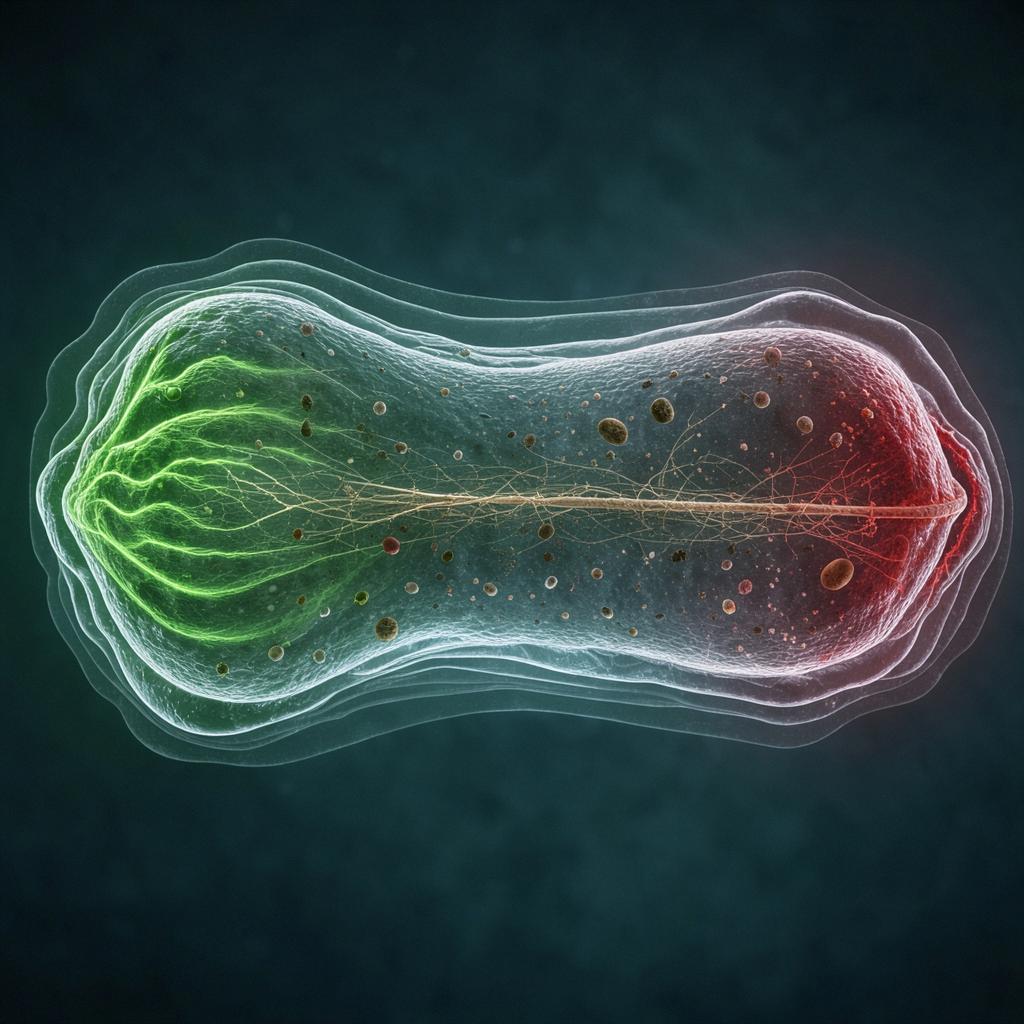
This Bulletin of Mathematical Biology paper by Buttenschön, Liu, and Edelstein-Keshet extends 1D wave-pinning theory to dynamically growing/shrinking cells with Kelvin-Voigt mechanics, analytically proving invariant regions and steady-state counts, and numerically revealing dilution-induced oscillations, size-dependent loss of polarity, and rich Rac–Rho motility behaviors .
Long Explanation
What the Paper Claims and How Well It Supports It
The paper generalizes the 1D wave-pinning model of Mori et al. (2008) to a cell whose length L(t) changes, using a correct mass balance on a deforming domain (Crampin-style reaction–transport–diffusion equation) mapped onto the fixed interval [-1, 1]. The transformation introduces a dilution term −(Ṙ/R)·u and a time-dependent diffusion coefficient D/R²(t), and eliminates advection — a clean, pedagogically valuable result derived in the appendices .
The strongest analytical contributions are: (1) proof that the region Ω = {L > 0, G ≥ 0, G ≤ GT/L} is invariant under the coupled mechanics–signaling ODE flow; (2) a Descartes-rule argument that the reduced system has 1 or 3 positive steady states under sharp-switch approximation; and (3) full linear stability plus AUTO bifurcation analysis showing tristability in the contractile (Rho) case and stable limit cycles (Hopf bifurcations) only in the protrusive (Rac) case — the basis of the paper's headline "dilution-induced oscillations" result .
Full spatiotemporal simulations (finite differences, ROWMAP stiff integrator, tolerance 10⁻⁶) then show: polarity is lost if the cell grows or shrinks too much (both extremes exit the wave-pinning regime); soft cells depolarize because mechanical restoration is slower than signaling collapse; Rac fronts drive motion, Rho contraction can generate push-based "squeezing" motility; and the mutually antagonistic Rac–Rho model yields metastable bipolar states, stalling, and delayed motility onset depending only on initial conditions .
Reported parameter ranges only — no simulated values. The wide spans (e.g., μ and Fmax spanning two orders of magnitude) signal substantial parameter uncertainty inherited from 3D literature sources.
Critical Assessment: Strengths, Blind Spots, and Falsifiability
Strengths: rare combination of rigorous analysis (invariant region, Descartes rule, stability classification) with accessible numerics; honest acknowledgment that the force law F(G) = ±FmaxGm/(Gcm+Gm) is "simply one case we chose to analyze"; and a constant-volume variant (Appendix D) tested to check robustness of the dilution assumption. The rest-length vs. end-force equivalence is proven, unifying with Zmurchok et al. (2018).
Blind spots and limitations the authors partially acknowledge: (a) the 1D transect geometry limits contact with real cell shape — 2D extension is deferred as future work; (b) the proportional membrane/cytosol scaling assumption is only exact in confined channels; (c) no experimental validation whatsoever — every "dilution-induced oscillation" and depolarization threshold is a model prediction awaiting testing (e.g., against micropatterned or confinement experiments of the kind in Holmes et al. 2012); (d) mechanical parameters are borrowed from 3D multicellular models (Drasdo, Palsson), an under-justified transfer to a single-cell 1D problem; (e) parameters such as Hill coefficients n up to 25 and 1000-fold diffusion ratios were chosen partly for mathematical convenience ("sufficiently large regime in which oscillations are possible"), which risks tuning the model toward interesting behavior; (f) no public code/data repository is stated, though the methods (ROWMAP, N = 2¹⁰ grid, f2py wrappers) are described in enough detail to reimplement; (g) the two-GTPase uniform analysis is admittedly preliminary (nine possible equilibria, only "preliminary exploration"), so conclusions there are weaker than the single-GTPase results.
Confidence note: the analytical claims are internally consistent and standard-method based (moderate-to-strong confidence); the biological relevance of specific parameter regimes and the transient dynamics emphasized in Fig. 9 remain genuinely uncertain until validated. The paper itself flags transient dynamics — not just asymptotics — as an open, urgent problem. Falsification would require experiments showing wave-pinning persistence across large size excursions, or absence of size-triggered depolarization in soft cells.
Feedback:
Updated: November 17, 2026
BGPT Paper Review
Study Novelty
80%
First full coupling of spatially distributed (non-uniform) GTPase wave-pinning dynamics with deforming-domain dilution and viscoelastic mechanics; dilution-induced Rac oscillations and size-triggered depolarization are genuinely new in this minimal framework, though built on well-established prior scaffolding (Mori 2008, Holmes & Edelstein-Keshet 2016, Zmurchok 2018).
Scientific Quality
80%
Rigorous proofs (invariant region, Descartes rule, stability), proper bifurcation software (AUTO), and a robustness appendix. Deductions for zero experimental validation, parameters borrowed from 3D models, and Hill coefficients chosen partly to enlarge the oscillatory regime.
Study Generality
70%
The dilution-coupled wave-pinning framework applies broadly to polarity systems and growing domains, but restriction to 1D geometry and single/mutual-inhibition GTPase kinetics narrows direct biological generality until 2D/3D extensions exist.
Study Usefulness
80%
Provides a reusable minimal framework, exact transformations, and testable predictions (depolarization at size extremes, oscillation regimes, stiffness thresholds) that experimental cell-polarity groups and computational modelers can directly use; no code repository limits immediate reuse.
Study Reproducibility
70%
Methods are detailed (ROWMAP integrator, N=2^10 grid, tolerance 10^-6, full parameter tables), and numerical tools are public; however, no deposited code or dataset, and some parameter choices span wide unspecified ranges.
Explanatory Depth
90%
Deep mechanistic explanation: dilution term derived from first principles, steady states characterized in closed form under sharp-switch limits, Hopf bifurcations classified, and behavioral regimes mapped in two-parameter bifurcation diagrams.
We'll email you the results when your analysis is finished.
Hypothesis Graveyard
Dilution alone (without mechanics) explains polarity loss — refuted by the paper's own shrinking-domain simulations, where both growth and shrinkage independently exit the wave-pinning regime via the bifurcation structure, not dilution per se.
A nonlinear spring is required for oscillations (Dierkes et al. 2014) — superseded here: linear Kelvin-Voigt mechanics plus saturating GTPase-dependent forces suffice to generate Hopf bifurcations.

 Explore by Goal
 Quick Explanation
 Long Explanation
 Top Data Sources
 Ask a Follow-Up
 Key Insight
 Keep Exploring
 Hypothesis Graveyard
 Potential Experiments
 Discussion
