Check each claim against its linked experiments, results, and falsification criteria.Know what the science actually supports before you trust the answer.
Press Enter ↵ to check claims
Explore by Goal
"The aim of science is not to open the door to infinite wisdom, but to set a limit to infinite error."
- Bertolt Brecht
Quick Explanation
Copied
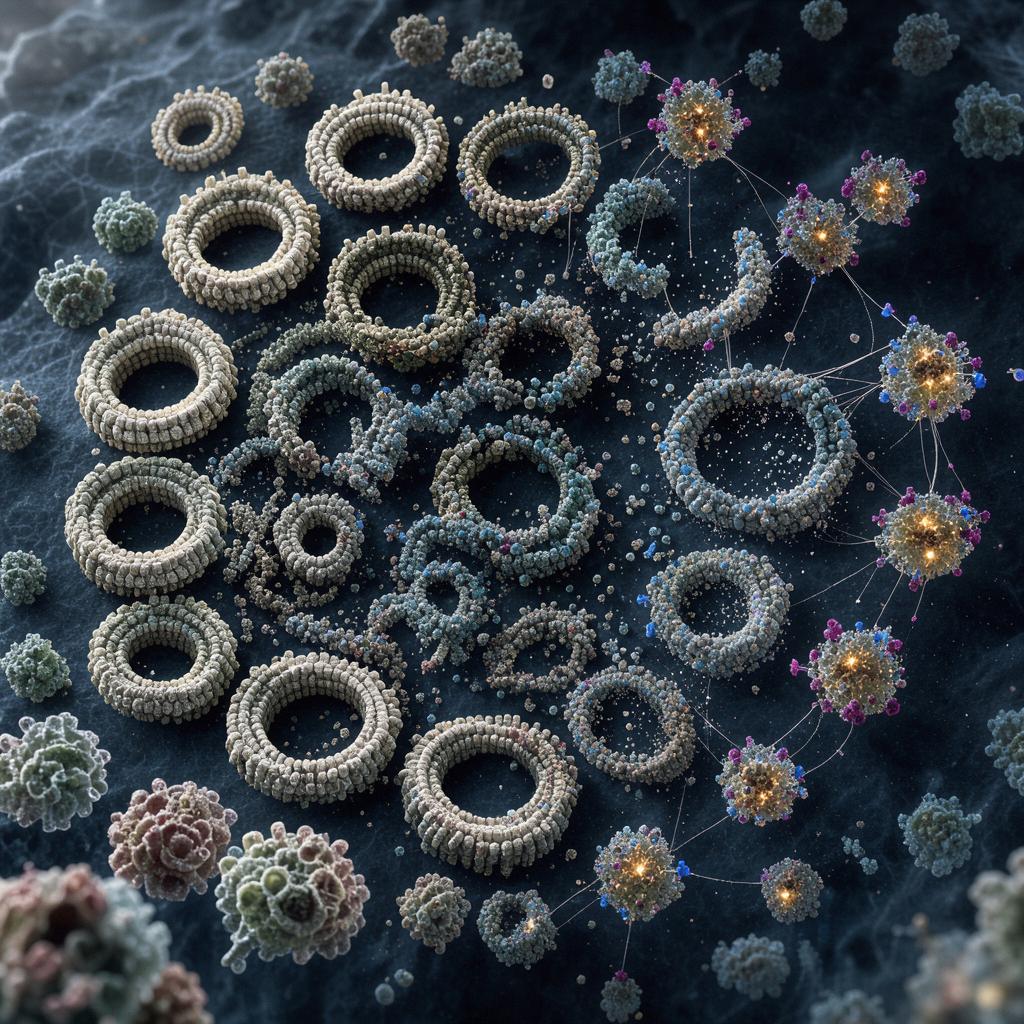
This 2021 review by Devi, Pelletier, Prosser and Steinmetz effectively synthesizes how super-resolution microscopy (SIM, STED, SMLM, ExM) and proximity-labeling proteomics (BioID) resolved the sub-diffraction architecture and >7000-interaction networks of centrosomes, cilia, and centriolar satellites . Its 2024-2026 citation record validates the core predictions but exposes an underestimated gap: satellites function as translation hubs, not merely cargo carriers .
Long Explanation
What the review establishes — with reported numbers
Devi et al. argue that two technological barriers — the diffraction-limited size of centrosomes and their insoluble, single-copy nature — historically blocked molecular dissection of centrosomes, primary cilia, and centriolar satellites, and that super-resolution imaging plus proximity labeling (BioID) circumvented both . The strongest quantitative content is the reported resolution hierarchy (3D-SIM axial 100 nm/lateral 300 nm; STED 130/50 nm; SMLM 50/20 nm; ExM ~70 nm lateral from a conventional microscope) and the BioID 10 nm labeling radius, with first-generation BioID requiring ~18 h labeling versus 10 min for TurboID — a temporal-resolution limit the review itself flags as its main methodological weakness .
Axial value for conventional microscopy is the 500-800 nm range midpoint as stated in Box 1; ExM axial was not reported. Bars are lower-is-better resolution limits, not biological measurements.
Interaction-mapping scale and what it actually proves
The two landmark datasets the review anchors on are a 58-bait centrosome BioID map (>1700 unique proteins, >7000 proximity interactions) and a 22-bait satellite interactome (2113 interactions among 660 proteins, ~40% overlap with the centrosome interactome) . A critical reader must note the review's own caveat: biotinylation marks proximity, not physical binding — a proximity partner may be a direct interactor, an indirect one, or merely nearby . The 18-h labeling window also smears dynamic, cell-cycle-dependent interactions, which the review acknowledges and proposes TurboID/AirID to fix. Subsequent work confirms both the value and the smearing problem: 2024-2025 proximity-labeling studies in human cells and Drosophila refined the satellite landscape far beyond cargo trafficking, showing satellites concentrate nascent translation of centrosomal/ciliary mRNAs , assemble hierarchically from PCM1 , and exist even in C. elegans as condensate-like SAS-1/SSNA-1 foci .
Critique: strengths, blind spots, and confidence
Strengths. The review is honest about method limits (proximity ≠ binding; ExM artifacts; BioID temporal smearing), declares no conflicts of interest, and correctly predicted that faster enzymes (TurboID, AirID) and cross-species application would drive the next wave — validated by the 2024-2026 literature .
Blind spots. First, the review frames satellites mainly as trafficking modules; the translation-hub and sequestration-of-degradation-factor functions now look equally central . Second, it under-weights cell-type and species heterogeneity: much of the cited interactome work used a handful of lines (RPE1, HeLa, U2OS), while subsequent work shows satellite localization differs drastically between vertebrates and Drosophila . Third, classical structural insights (e.g., BBS4-PCM1-dynein transport and the PCM1-centric satellite definition ) are presented somewhat teleologically; alternative models — satellites as phase-separated condensates whose apparent 'transport' reflects condensate dynamics — were only beginning to be tested and are now supported .
Falsification and confidence. The central technological thesis (super-resolution + proximity labeling resolves these organelles) would be weakened if newer direct-interaction methods (crosslinking MS, cryo-ET) showed BioID maps systematically misassign compartment membership. I rate the review's factual synthesis high-confidence; its functional framing of satellites as primarily trafficking is now only moderate-confidence given the translation-hub evidence. What would change this assessment: a cell-type-resolved TurboID atlas showing trafficking, not translation, dominates satellite output in primary ciliated cells.
Feedback:
Updated: October 31, 2026
BGPT Paper Review
Study Novelty
70%
A technology-synthesis review rather than new data; its synthesis of BioID and super-resolution application to centrosomes was timely in 2021 but built on well-established methods (BioID since 2012, SMLM since 2006). Novelty lies in the integrated framing of the centrosome-cilium-satellite nexus, not in concepts themselves.
Scientific Quality
90%
Clearly written, self-critical about method limits (proximity vs binding, labeling timescales), declared no conflicts, and cited primary validation for claims. Weaknesses: it is a narrative review with no systematic search method stated, and some framing (satellites as trafficking hubs) was later partially superseded.
Study Generality
80%
Covers organelle biology relevant across cell types, species, and diseases (ciliopathies, microcephaly, cancer), and the methodological framework generalizes to any insoluble, small, single-copy organelle. Limited by reliance on a few cell lines and mostly vertebrate models.
Study Usefulness
90%
Serves as a practical entry map for researchers choosing imaging or proximity-labeling strategies, with concrete reported parameters (resolution limits, bait numbers, interactome sizes) and explicit future directions that proved predictive.
Study Reproducibility
70%
As a review it reports methods from primary studies with enough specificity (bait lists, labeling radius, resolution figures) to guide protocol selection, but it presents no primary data or code, and no systematic literature-search methodology.
We'll email you the results when your analysis is finished.
Hypothesis Graveyard
Satellites are static cargo warehouses that shuttle pre-assembled proteins to centrosomes — superseded by evidence that satellites concentrate mRNAs and nascent polypeptides for cotranslational assembly.
BioID interactome edges represent direct physical binding — superseded because biotin-5'-AMP diffusion means edges only mark adjacency; physical contacts require orthogonal validation such as co-IP or FRET.

 Explore by Goal
 Quick Explanation
 Long Explanation
 Top Data Sources
 Ask a Follow-Up
 Key Insight
 Keep Exploring
 Hypothesis Graveyard
 Potential Experiments
 Discussion
