Assemble tables from exact reported values and versioned claims, with provenance back to every source paper.Know what falsifiable science actually supports before you trust the answer.
Press Enter ↵ to search evidence
Explore by Goal
"The aim of science is not to open the door to infinite wisdom, but to set a limit to infinite error."
- Bertolt Brecht
Long Analysis Plan
Copied
GBM-Space Atlas Data Inventory
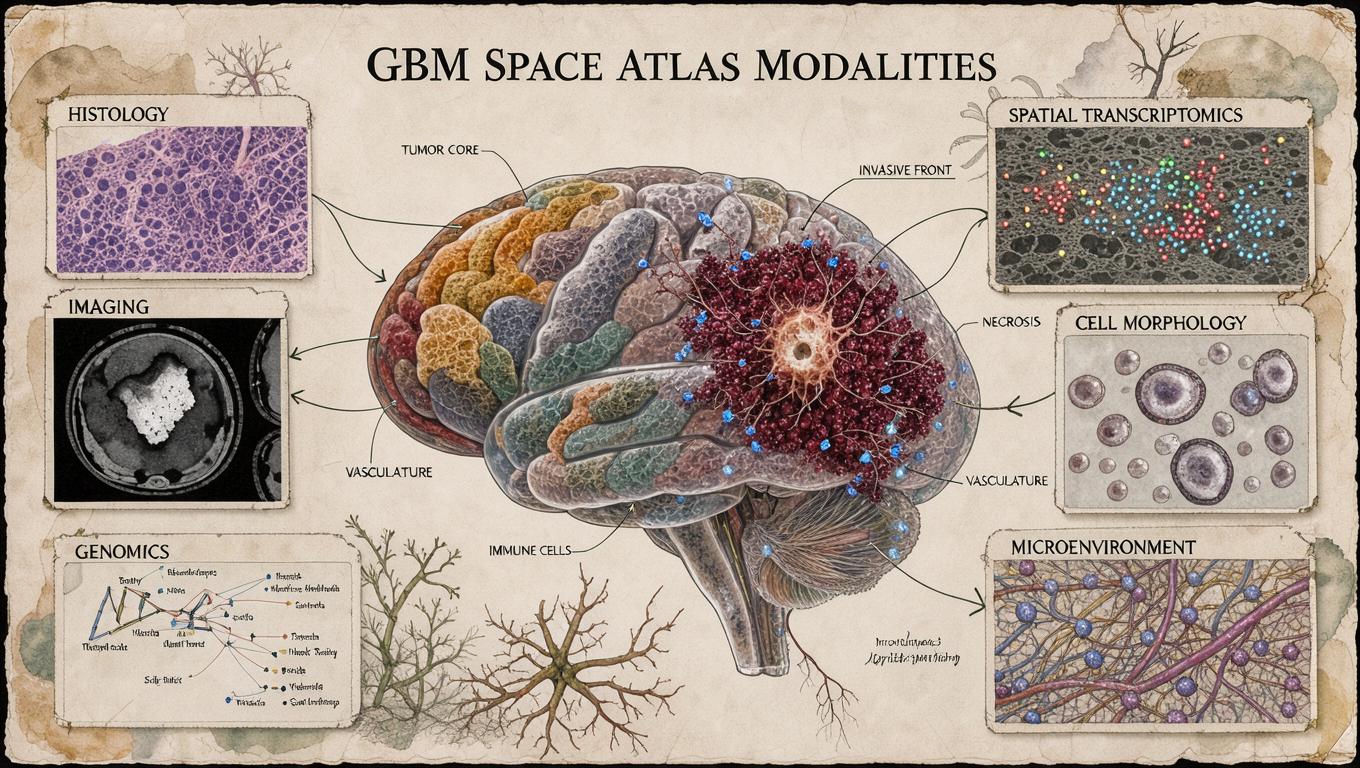
The following inventory compiles the modalities, sections, nuclei/cells counts, and tumor-site compartments reported for the GBM-Space atlas and companion datasets, as described in the spatial vascular/BTB remodeling analysis .
PLVAP/CAV1/MFSD2A sites (no THSD1/FLT4/MFSD2A panel)
Localization support
GSE162631 (bulk regional)
4 paired patients
4 patients (core + peripheral pairs)
Tumor core vs peripheral tissue
External replication
Ivy GAP / GSE107559 ASTR122
10 tumors (8 complete)
8 complete LE/IT/CT tumors
LE, IT, CT anatomical regions
Anatomical replication
GSE131928 (single-cell malignant states)
20 adult tumors (16 for trajectories)
4,873 malignant cells
OPC/NPC/AC/MES malignant states
Malignant-state architecture
Notes on tumor sites: The spatial cohort partitions sections across three histopathology-annotated compartments — leading edge (LE), infiltrative tumor (IT), and cellular tumor (CT) — with donor-level complete-triad analysis restricted to 4 donors having all three compartments . External validation sites include paired core/peripheral regions (GSE162631), anatomical LE/IT/CT (Ivy GAP), and malignant-state (OPC/NPC/AC/MES) classifications (GSE131928) .
Data access: Processed GBM-Space data via https://www.gbmspace.org/; Xenium S2/S6 files at Zenodo (DOI: 10.5281/zenodo.17622242); GEO accessions GSE162631, GSE107559, GSE131928 .
Limitations: Cross-sectional design; modest donor numbers (6 spatial donors, 12 snRNA tumors); Xenium panel did not measure THSD1/FLT4/MFSD2A; no direct BTB permeability assay. Counts are as reported by the authors and not independently verified.
Compiling an annotated inventory table of GBM-Space atlas modalities, section counts, nuclei/cell totals, and tumor compartments for reproducible downstream analysis.
Get emailed when your analysis is done!
We'll email you the results when your analysis is finished.
Science Art
Science Movie
Make a narrated HD Science movie for this answer ($64 per minute)

 Explore by Goal
 Long Analysis Plan
 Top Data Sources
 Ask a Follow-Up
 Keep Exploring
 Analysis
 Science Movie
 Discussion
