Check a paper's claims against linked experiments, exact results, stated scope, and limitations.Know what falsifiable science actually supports before you trust the answer.
Press Enter ↵ to search evidence
Explore by Goal
"The art and science of asking questions is the source of all knowledge."
- Thomas Berger
Quick Explanation
Copied
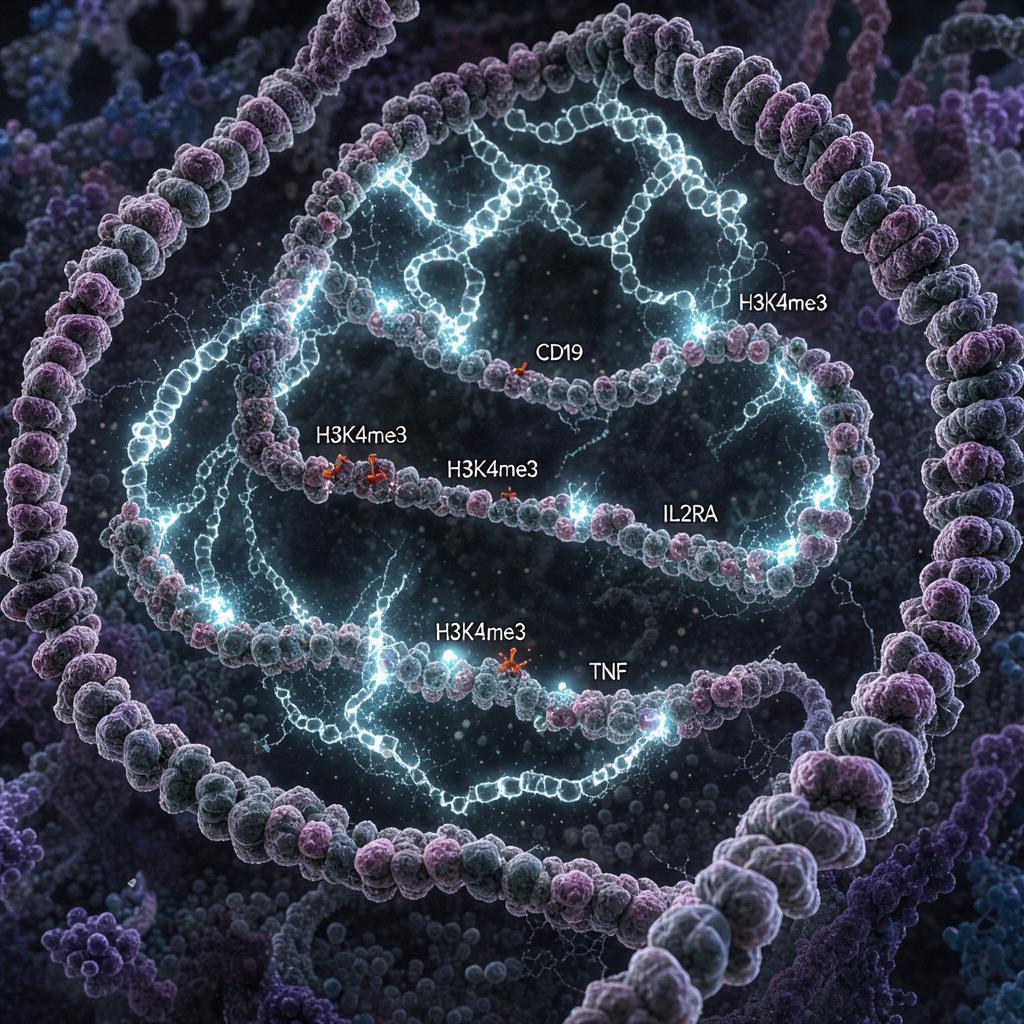
This 2019 Frontiers review by Fanucchi, Mhlanga and colleagues synthesizes evidence that 3D chromatin topology and immune-gene priming lncRNAs (IPLs), exemplified by UMLILO, direct the WDR5/MLL1 complex to deposit H3K4me3 at innate immune gene promoters, thereby linking nuclear architecture to trained immunity . It is a well-sourced, forward-looking hypothesis paper, but the HSC/IPL transmission mechanism remains speculative and lacks direct causal data.
Long Explanation
Evidence Basis of the Review's Core Model
The review builds its central model on two empirical pillars. First, hematopoietic stem cells (HSCs) are reprogrammable: BCG vaccination expands and myeloid-polarizes multipotent progenitors, yielding macrophages epigenetically primed to control M. tuberculosis , and β-glucan expands progenitors with IL-1β/GM-CSF signaling changes that protect against secondary LPS challenge and chemotherapy-induced myelosuppression . Second, the authors' own primary work identified immune-gene priming lncRNAs (IPLs), including UMLILO, which acts in cis to guide WDR5/MLL1 across ELR+ CXCL chemokine promoters (IL-8, CXCL1, CXCL2, CXCL3) for H3K4me3 deposition before transcriptional activation, with β-glucan-induced, NFAT-mediated IPL upregulation .
Where the Model Is Strong vs. Speculative
Reported and well-supported: the H3K4me3-primed, transcriptionally silent state of trained monocytes is documented in independent datasets . Author interpretation (flagged as speculation in the paper itself): whether IPLs mediate HSC-to-progeny transmission of epigenetic memory, and whether IFNγ-dependent alveolar macrophage memory uses IPL-like lncRNAs, is explicitly presented as conjecture, not data. BGPT inference: the review's therapeutic framing (IPLs as drug targets, biomarkers of training) is premature given IPLs are expressed at only a few copies per cell and lncRNA-chromatin mapping assays are vulnerable to widespread probe-derived DNA off-targeting artifacts that can inflate apparent RNA-chromatin contacts .
Critical Limitations and Blind Spots
Causality gap in HSCs: the HSC-IPL hypothesis (Figure 3) is untested; no IPL perturbation in HSCs/MPPs exists in the cited literature.
Cross-species extrapolation: human monocyte ex vivo training data are blended with murine BCG/β-glucan in vivo data without weighting the species differences.
Correlation vs. causation for H3K4me3: the review itself notes it is unclear whether epigenetic marks are causal to chromatin states or consequential, yet the therapeutic argument assumes causality.
Methodological fragility: UMLILO's chromatin contacts were mapped before the field recognized probe-DNA off-targeting; the mechanism is most credible at the well-validated cis-local promoter level, less so for distal contacts.
Conflicts of interest: authors declare no commercial conflicts; funding was public (SA MRC, DST, CSIR, CZI). Consistent with a hypothesis-generating review, no new experiments were performed.
What would change this conclusion: IPL knockdown/CRISPRi in human HSCs failing to reduce H3K4me3 priming in progeny macrophages, or rigorous re-mapping of UMLILO contacts with modern artifact-controlled assays, would substantially weaken the model.
Author Reviews:
Feedback:
Updated: November 22, 2026
BGPT Paper Review
Study Novelty
80%
First review to explicitly connect 3D chromatin topology, IPL lncRNAs (UMLILO), and WDR5/MLL1-mediated H3K4me3 priming to trained immunity, extending the authors' 2018 Nat Genet discovery into the HSC-memory framework; genuinely new synthesis for 2019 though built on the authors' own primary work.
Scientific Quality
70%
Well-referenced (29 citations) narrative review by leaders in the field, but the central HSC-IPL transmission model is self-acknowledged speculation; no new data; some cited lncRNA-chromatin methods are now known to be artifact-prone.
Study Generality
70%
Mechanistic framework (TAD-positioned lncRNAs guiding histone modifiers) generalizes across trained immunity, vaccine design, and inflammation, but detailed claims center on one lncRNA (UMLILO) and the CXCL locus.
Study Usefulness
70%
Useful conceptual roadmap for epigenetic memory studies and vaccine/immunomodulation research; IPL biomarker and therapeutic proposals are actionable directions, though far from clinical translation.
Study Reproducibility
60%
No new data or protocols; reproducibility depends entirely on the cited primary studies, which are strong (Cell, Nat Genet, Science), but lncRNA-chromatin mapping assays have recognized artifact risks.
Explanatory Depth
70%
Provides a coherent molecular chain (NFAT → IPL transcription → WDR5/MLL1 recruitment → H3K4me3 → robust secondary transcription), but the causal link at the HSC level and the correlation/causation status of H3K4me3 remain unresolved.
Building an interactive knowledge graph linking BCG/β-glucan stimuli, NFAT signaling, IPL lncRNAs, WDR5/MLL1, H3K4me3 priming, and trained macrophage outcomes from the cited studies.
Get emailed when your analysis is done!
We'll email you the results when your analysis is finished.
Hypothesis Graveyard
H3K4me3 accumulation is a passive consequence of transcription factor binding rather than an instructive priming mark — undermined by Lauberth 2013 showing H3K4me3-TAF3 interactions drive PIC assembly and by UMLILO knockdown reducing subsequent transcription.
Epigenetic memory of trained immunity resides solely in short-lived circulating monocytes — falsified by BCG HSC reprogramming and β-glucan progenitor training studies showing durable, progeny-transmitted priming.

 Explore by Goal
 Quick Explanation
 Long Explanation
 Top Data Sources
 Ask a Follow-Up
 Key Insight
 Keep Exploring
 Analysis
 Hypothesis Graveyard
 Potential Experiments
 Discussion
