Go beyond summaries to locate specific, verifiable claims and sources within research.Know what falsifiable science actually supports before you trust the answer.
Press Enter ↵ to search paper
Explore by Goal
"One never notices what has been done; one can only see what remains to be done."
- Marie Curie
Quick Explanation
Copied
This exploratory qualitative study of six Philippine STEM physics teachers identifies three interconnected constraints on teaching scientific creativity—time, congested/rigid curriculum, and teacher-centered pedagogy with pen-and-paper assessment—via ~30-minute semi-structured interviews and thematic analysis with member checking and literature triangulation . The themes are credible as teacher perceptions, but the six-teacher, teacher-only, self-report design and absence of student creativity measures limit generalizability. Verdict: useful context-sensitive qualitative contribution; confirmatory quantitative work is required before causal or systemic conclusions.
Long Explanation
What the study actually shows (and does not)
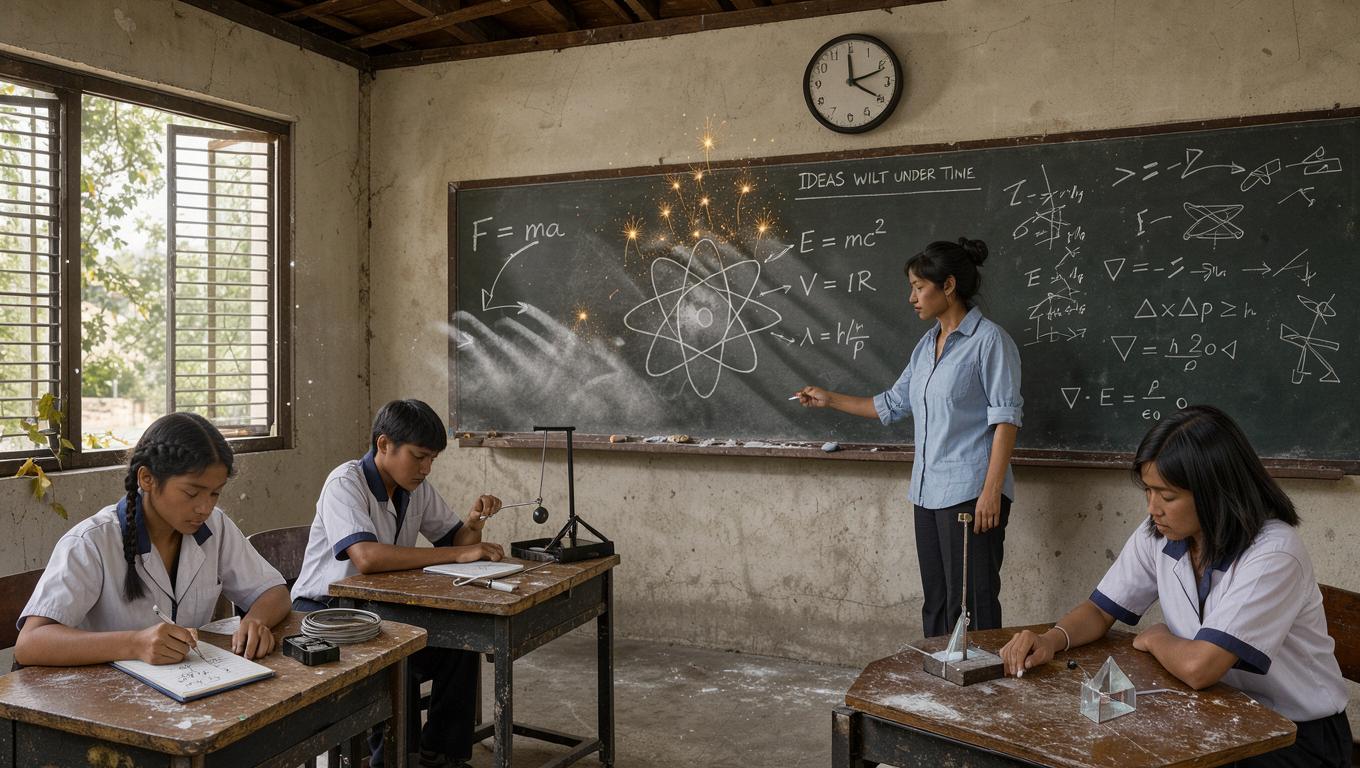
The paper is an exploratory, generic qualitative inquiry in which six purposively sampled Philippine senior-high STEM physics teachers (3 public, 3 private; 4–14 years experience) were interviewed for ~30 minutes each. Manual thematic analysis, supported by member checking, peer validation, and literature triangulation, produced three themes: (1) time constraints (limited periods, class suspensions, competing administrative demands), (2) curriculum constraints (congested scope, fixed MELCs-driven outcomes, weak interdisciplinary integration, poor laboratory resources), and (3) pedagogical/assessment constraints (lecture-dominated transmission, pen-and-paper recall-focused testing, grade-oriented culture) . Notably, the authors themselves transparently report the small sample, interview-only data, teacher-only perspective, and physics-specific focus as limitations—an honesty that strengthens internal credibility of the descriptive claims.
The motivating context is empirical: PISA 2022 placed Filipino students at 14 points in creative thinking versus an OECD average of 33 .
Critical assessment
Strengths. The design is internally coherent: inclusion criteria are explicit, saturation reasoning is stated, expert validation of the interview guide, member checking, and peer review of coding are reported, and verbatim teacher quotes substantiate each theme . The recursive feedback-loop interpretation—that rigid curricula pressure coverage, which induces teacher-centered pedagogy, which suppresses creative questioning—is a genuinely useful systemic framing consistent with prior literature the authors cite on high-stakes testing and creativity reform.
Weaknesses and blind spots. (1) Single-perspective data: all claims derive from teacher self-report; no student data, classroom observations, or documents triangulate whether creativity instruction is actually absent. (2) No outcome measure: students' scientific creativity was never measured, so the causal chain from constraints to low creativity is asserted, not demonstrated—despite the PISA framing implying it. (3) Saturation claim with n=6 is fragile; heterogeneity across public/private and 4–14 years experience is described but never analyzed. (4) Instrument unreported: the interview guide itself is not published, impeding replication; data are available only "upon reasonable request." (5) Confirmation risk: the literature review was used to "substantiate" themes post hoc, which flirts with HARKing—the triangulation supports, but cannot validate, teacher narratives. (6) Reference hygiene: reference [30] (TIMSS 2019) appears mis-extracted, suggesting citation-curation sloppiness. (7) Disclosure of ChatGPT for language editing is present and appropriate.
What would change the conclusion: a larger, stratified teacher survey or mixed-methods study with classroom observation and direct creativity assessment that fails to find time/curriculum/assessment constraints, or a controlled intervention showing creativity gains despite unchanged constraints . Confidence in the descriptive findings: moderate; in the systemic causal interpretation: low.
Deeper exploration
Feedback:
Updated: November 26, 2026
BGPT Paper Review
Study Novelty
40%
Time/curriculum/assessment barriers to creativity teaching are well documented globally; the novelty is the Philippine K-12 physics context and the recursive constraint-loop framing, both modest extensions of prior Asian-context findings.
Scientific Quality
50%
Transparent limitations, member checking, peer validation, and expert-validated guide are strengths. However, n=6, teacher-only self-report, unpublished instrument, post hoc literature triangulation (HARKing risk), a mis-extracted reference, and no student/outcome data cap quality at moderate.
Study Generality
30%
Findings are specific to Philippine K-12 STEM physics; the paper itself acknowledges limited generalizability, though the constraint taxonomy is transferable as a heuristic.
Study Usefulness
50%
Directly actionable for Philippine curriculum planners and professional-development designers; provides teacher-voiced evidence of systemic barriers and concrete recommendations, but no effect estimates to prioritize among them.
Study Reproducibility
40%
Methods narrative is reasonably detailed (interview length, coding steps, validation), but the interview guide is unpublished and data are available only on request, preventing independent replication.
Explanatory Depth
30%
The recursive feedback-loop model is a plausible systems-level interpretation, but it remains descriptive; no mechanisms linking constraints to measured student creativity are tested.
We'll email you the results when your analysis is finished.
Hypothesis Graveyard
'Teachers lack awareness of creativity pedagogy.' Falsified by the data: interviewed teachers explicitly described inquiry, discovery, and design-based methods they would use if constraints were lifted.
'Spiral progression alone causes low creativity.' Weakened: the paper shows creativity constraints predate/exceed spiral-progression issues; congested MELCs and assessment practices persist independently of the spiral structure.

 Explore by Goal
 Quick Explanation
 Long Explanation
 Top Data Sources
 Ask a Follow-Up
 Key Insight
 Keep Exploring
 Hypothesis Graveyard
 Potential Experiments
 Discussion
