Go beyond summaries to locate specific, verifiable claims and sources within research.Know what falsifiable science actually supports before you trust the answer.
Press Enter ↵ to search paper
Explore by Goal
"Science is not only a disciple of reason but, also, one of romance and passion."
- Stephen Hawking
Quick Answer
Copied
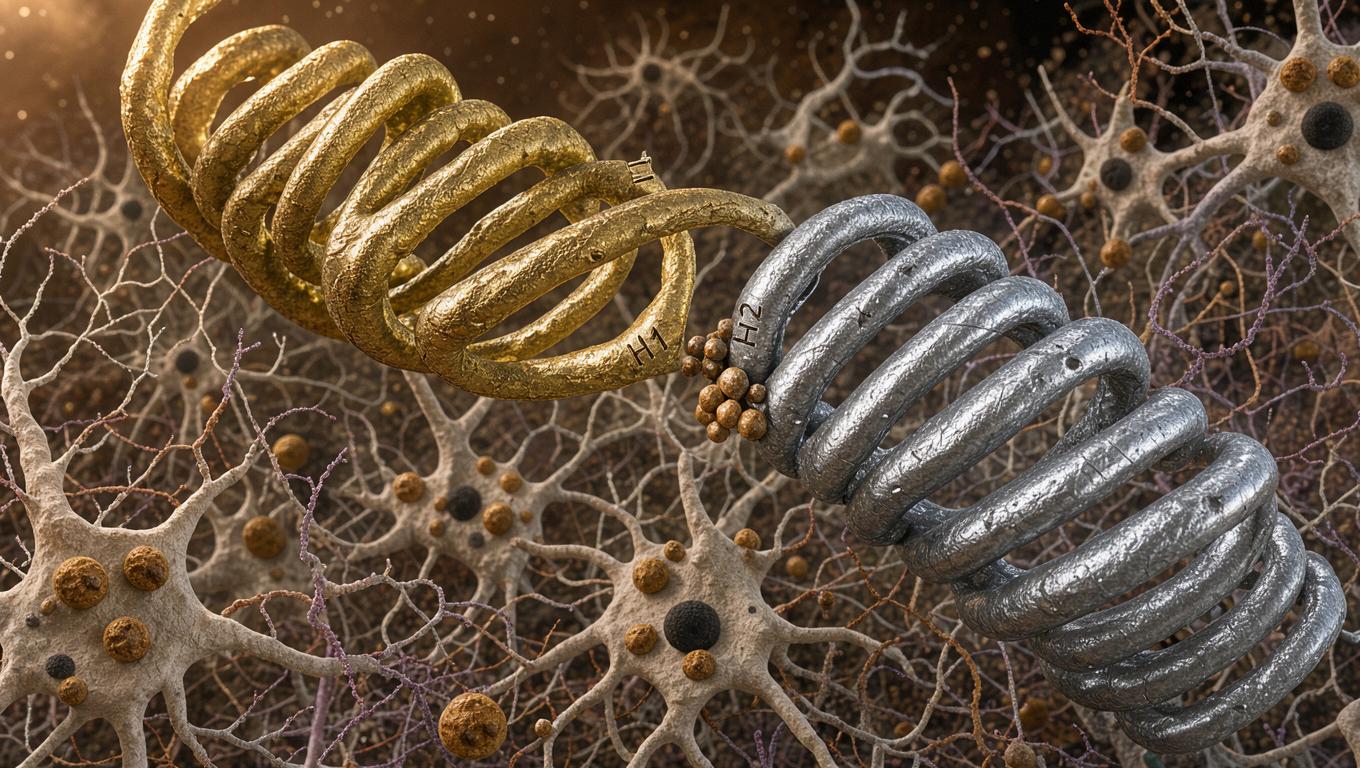
Labbé et al. report that the rare MAPT H1G haplotype increases DLB risk with OR 3.30 (P=.0017) in clinical cases, replicated pathologically at OR 2.26 (P=.035) and combined-series OR 2.16 (P=.005), with H2 showing nominal protection (OR 0.75) . However, H1G was not detected at genome-wide significance in the subsequent large DLB GWAS of 1,743 cases , and the causal variant on H1G remains unidentified .
Long Answer
Quantitative Findings
The study genotyped six MAPT haplotype-tagging SNPs (rs1467967, rs242557, rs3785883, rs2471738, rs8070723, rs7521) in 431 clinical DLB, 347 pathologically confirmed high-likelihood DLB cases, and 1,049 controls, all unrelated non-Hispanic Caucasians of European descent . H1G frequency was 3.3% in clinical DLB vs 1.0% in controls (OR 3.30, 95% CI 1.34–8.12, P=.0017), with pathologic replication at 2.6% vs 1.0% (OR 2.26, 95% CI 0.88–5.81, P=.035) and combined series OR 2.16 (95% CI 1.03–4.49, P=.005). Adjustment for MAPT p.A152T did not abolish the signal (clinical OR 3.23, P=.0021), supporting independence of these two MAPT signals .
Null Pathology Association
In 667 Lewy body disease cases, H1G showed no significant association with Lewy body counts across five brain regions (all P>.14) or NFT counts across fourteen regions (all P>.080) after Bonferroni correction (P<.0025 threshold) . This suggests H1G may influence disease susceptibility rather than gross pathological burden, or the study is underpowered given H1G's ~3% case frequency.
Contextual Evidence and Limitations
The subsequent two-stage DLB GWAS with 1,743 cases and 4,454 controls confirmed APOE (OR 2.4), SNCA (OR 0.73), and GBA (OR 2.55) but did not report MAPT H1G at genome-wide significance, suggesting the H1G effect may be modest, population-specific, or require larger cohorts . MAPT-AS1 lncRNA regulation of MAPT expression offers one mechanistic avenue for how H1 subhaplotypes might modulate tau biology in synucleinopathies . Key limitations: rare haplotype underpowering, single-institution cohorts, ancestry restriction, and no public genotype deposition. The later 2025 East Asian GWAS found DHTKD1 but again not MAPT H1G, consistent with ancestry-restricted effects .
Feedback:
Updated: November 25, 2026
BGPT Paper Review
Study Novelty
70%
First report of H1G as DLB-specific risk subhaplotype; builds incrementally on established MAPT H1/H2 neurodegeneration genetics without identifying the causal variant.
Scientific Quality
80%
Strong methodological rigor: two-phase design with pathologic replication, Bonferroni correction, 100% call rate, HWE checks, p.A152T independence testing, and transparent limitation discussion. Weaknesses: small rare-haplotype sample, single-institution, no external cohort replication.
Study Generality
60%
Findings restricted to European-descent Mayo Clinic populations; MAPT locus biology is broadly relevant to synucleinopathies but H1G frequency and effect may not generalize to other ancestries.
Study Usefulness
70%
Nominates a concrete fine-mapping target and integrates clinical with pathologic confirmation, guiding future functional and meta-analytic studies in DLB genetics.
Study Reproducibility
70%
Clear SNP panel, genotyping platform, statistical models, and correction thresholds reported; supplementary data available; however, genotype data not publicly deposited.
Explanatory Depth
70%
Proposes MAPT expression and 4R/3R splicing mechanisms consistent with prior H1 literature, but provides no direct functional data to confirm the mechanism or identify the causal variant.
We'll email you the results when your analysis is finished.
Hypothesis Graveyard
H1G risk is mediated by linkage disequilibrium with p.A152T—falsified by the authors' covariate adjustment showing OR 3.23 (P=.0021) after accounting for rs143624519.
H2 protective effect operates through reduced tau/NFT pathology burden—unsupported by null NFT count associations across 14 brain regions after Bonferroni correction in 667 LBD cases.

 Explore by Goal
 Quick Answer
 Long Answer
 Top Data Sources
 Ask a Follow-Up
 Key Insight
 Keep Exploring
 Hypothesis Graveyard
 Potential Experiments
 Discussion
