Check a paper's claims against linked experiments, exact results, stated scope, and limitations.Know what falsifiable science actually supports before you trust the answer.
Press Enter ↵ to search evidence
Explore by Goal
"The scientific man does not aim at an immediate result. He does not expect that his advanced ideas will be readily taken up. His work is like that of the planter - for the future. His duty is to lay the foundation for those who are to come, and point the way."
- Nikola Tesla
Quick Explanation
Copied
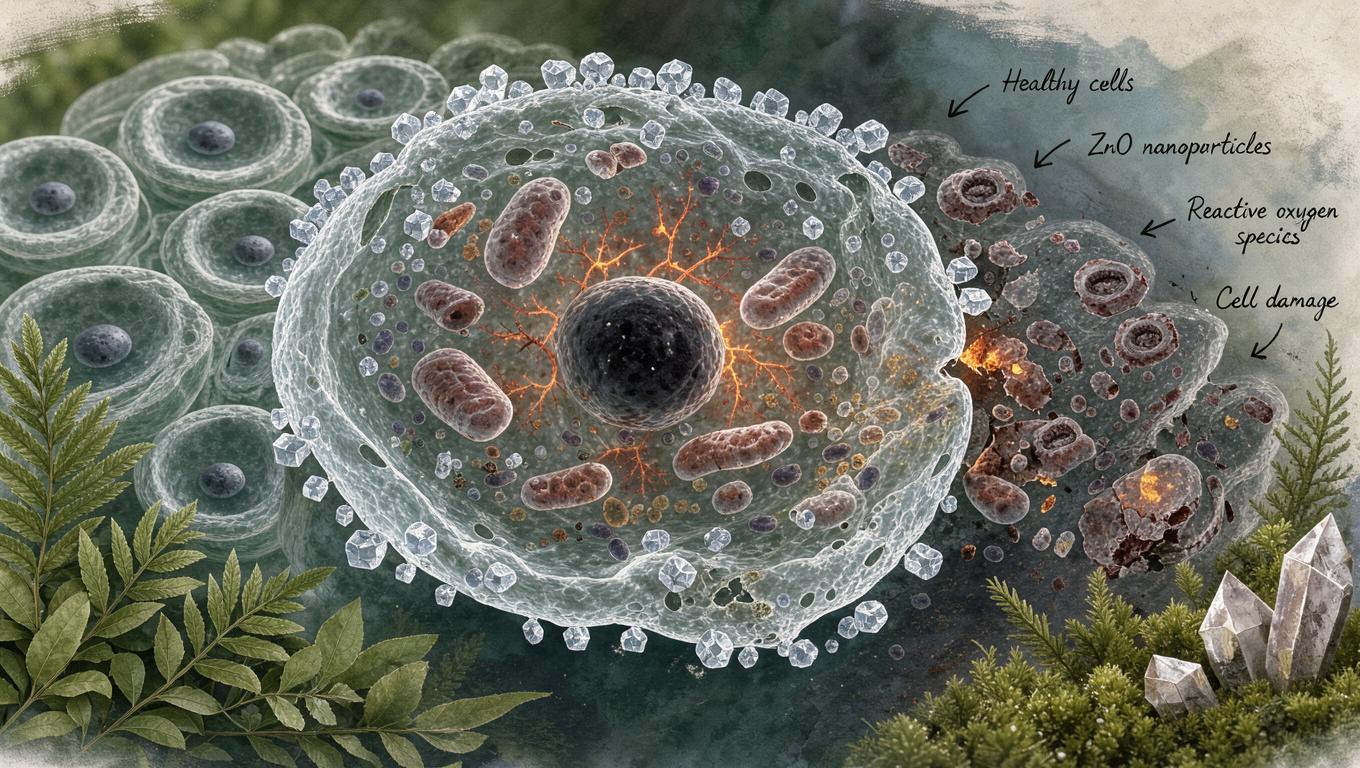
Johnson et al. (2014) present the first combined in vitro/in vivo demonstration that ZnO nanoparticles kill immune cells via Zn2+ release → ROS → autophagic (non-apoptotic) death, with splenocyte depletion in mice after intranasal exposure . Key caveats: single high-dose bolus in vivo, inhibitor-based autophagy inference (no genetic autophagy loss-of-function), and small n (3-6 per group).
Long Explanation
Evidence Behind the Mechanistic Chain
The paper builds a linear causal chain: NP dissolution → Zn2+ uptake → ROS → autophagy → death. Quantitative support is strongest for the ion-release step: peak Zn2+ release from 50 mg/mL (617 μM) ZO NPs in DMEM reached 20–37% of total available zinc (FluoZin-3 assay), within the range where Zn2+ alone killed cells (125 μM killed splenocytes in 24 h; 250 μM left only ~17% live SupT1 cells) . Chelation (EDTA) abolished toxicity and CaCl2 blocked uptake — a clean loss-of-function-style confirmation that dissolved Zn2+, not particles, is the proximal toxin.
The cell-death identification relies on inhibitor exclusion: zVAD-FMK (apoptosis/pyroptosis), Necrostatin-1 (necroptosis), and an AIF inhibitor all failed to rescue, while 3-MA blocked both LC3A upregulation and death in SupT1 cells and primary human CD4+/CD8+ T-cells; GSH blocked ROS, LC3A induction, and death, placing ROS upstream of autophagy .
External Validation and Context
The dissolution-driven mechanism fits a broader literature: a subsequent review of ~16 in vitro/in vivo studies concluded Zn2+ dissolution drives oxidative stress, inflammation, and genotoxicity across immune and epithelial models, with solubility the dominant toxicity variable . Surface modification (e.g., BSA via EDC/NHS) can reduce cytotoxicity while paradoxically raising ROS, supporting the paper's proposal that reducing ion release could ameliorate toxicity .
Critical Blind Spots
Autophagy as executioner vs. survival response: 3-MA rescue plus LC3A upregulation is consistent with autophagic death but does not exclude autophagy as a stress response; no ATG knockdown, no LC3-II/LC3-I immunoblot, no flux (bafilomycin) assay. LC3A (not the canonical LC3B) was used, unusual for this field.
Aggregation dosimetry: aggregates grew from 210 nm (DI water) to 4449 nm (DMEM) to 540 nm (DMEM+FBS) , so mass-based dose-response curves confound particle number, surface area, and dissolved ion fraction.
In vivo relevance: single intranasal bolus (1–5 mg/kg, n=5–6, 48 h endpoint) is far above realistic occupational exposure, and the authors themselves flag the need for chronic, low-dose inhalation models.
Not all ZnO formulations behave identically: coated variants differ in toxicity (e.g., coated NM-111 was more toxic than uncoated NM-110 in fish cells ), limiting generalization from the single forced-hydrolysis formulation used here.
What Would Change the Conclusion
If ATG5/ATG7-deficient immune cells survived ZnO NP exposure, autophagy would be demoted to bystander; if chronic low-dose inhalation studies failed to deplete splenocytes, the systemic-immunotoxicity implication would weaken. Confidence: moderate — the in vitro mechanistic chain is well-controlled, the in vivo extension is preliminary.
Author Reviews:
Feedback:
Updated: November 21, 2026
BGPT Paper Review
Study Novelty
80%
First in vitro + in vivo demonstration that ZnO NP immunotoxicity proceeds via Zn2+ → ROS → autophagic death, and the first report of splenocyte depletion after intranasal ZnO NP exposure; prior work (Yu et al. 2013) had shown autophagic ZnO death only in epithelial cells.
Scientific Quality
70%
Well-controlled inhibitor panel, verified inhibitor activity, endotoxin controlled (≤0.1 EU/ml), physicochemical characterization included; but autophagy reliance on 3-MA and LC3A (no LC3-II blots, flux assays, or ATG genetics), small n, missing data noted as 'data not shown', and a supraphysiologic in vivo bolus model lower the score.
Study Generality
70%
Demonstrates a dissolution-based toxicity paradigm potentially applicable to soluble metal-oxide NPs broadly (CdTe, CuO, Nd2O3 analogies cited), but confined to one ZnO formulation, mouse splenocytes, and human T-cells; occupational/chronic extrapolation untested.
Study Usefulness
80%
Directly informs nanosafety (chelation/uptake-blocking strategies, iron doping or coating to reduce dissolution) and flags systemic immune risk from inhaled ZnO NPs, a widely produced nanomaterial in sunscreens and consumer goods.
Study Reproducibility
70%
NP synthesis, characterization, FluoZin-3 assay protocols, inhibitor concentrations, and animal dosing are described in enough detail to replicate; however, key inhibition data in several cell types are only 'data not shown', and no raw data repository is provided.
Explanatory Depth
80%
Establishes a complete, ordered mechanistic cascade (dissolution → uptake → ROS → autophagy → death) with directionality tested via GSH/LC3A epistasis; stops short of identifying the molecular sensor linking ROS to autophagy or the Zn2+ transporter involved.
Analyzing reported Zn2+ thresholds, aggregate sizes, and inhibitor rescue outcomes to model dose-response curves and identify which cell subsets are most vulnerable to dissolution-driven ZnO nanoparticle immunotoxicity.
Get emailed when your analysis is done!
We'll email you the results when your analysis is finished.
Hypothesis Graveyard
Apoptosis is the canonical ZnO NP death pathway (dominant literature view pre-2014, based on mitochondrial depolarization and caspase-3 upregulation reports): falsified here by zVAD-FMK insensitivity, absent 200-bp laddering, AIF-inhibitor failure, and the fact that free Zn2+ directly inhibits caspase-3 enzymatically.
Particle-surface contact toxicity drives immune cell death (extracellular mechanism hypothesis): weakened because EDTA chelation alone fully abolishes death and intracellular FluoZin-3 shows Zn2+ uptake correlates with killing, although low NP uptake in T-cells keeps a partial extracellular contribution possible.

 Explore by Goal
 Quick Explanation
 Long Explanation
 Top Data Sources
 Ask a Follow-Up
 Key Insight
 Keep Exploring
 Analysis
 Hypothesis Graveyard
 Potential Experiments
 Discussion
