From immune response findings to trial results, every claim traces back to its paper.Know what the science actually supports before you trust the answer.
Press Enter ↵ to search immunology
Explore by Goal
"If the brain were so simple we could understand it, we would be so simple we couldn't."
- Lyall Watson
Quick Analysis Plan
Copied
The evidence map combines strong structural (NEK7-NLRP3 cryo-EM at 3.8 Å) and mechanistic (rotenone→ROS→pSer727 STAT3→mitochondrial complex I rescue) strands, but critically lacks direct experimental evidence linking STAT3 Ser727 phosphorylation to NLRP3 mitochondrial translocation specifically. The proposed connection is inferential, not demonstrated.
Long Analysis Plan
What the Evidence Map Actually Demonstrates
The map contains three distinct mechanistic strands, but the central proposed link—STAT3 Ser727 phosphorylation driving NLRP3 mitochondrial translocation—is not directly demonstrated in any single experiment. Rather, it is an inferred convergence from two separately validated pathways:
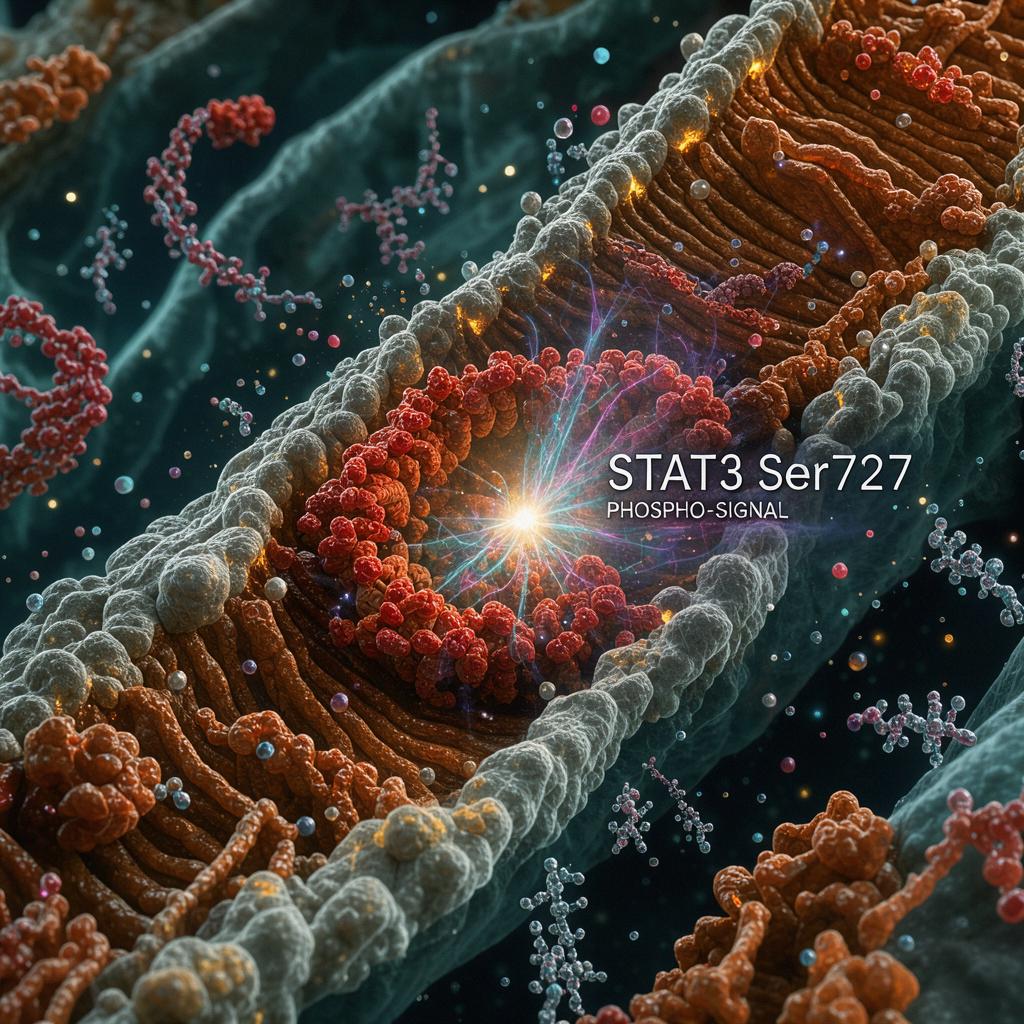
Strand 1 — STAT3 Ser727 mitochondrial recruitment under ROS stress: Rotenone (0.5–2.5 µM) triggers dose- and time-dependent Ser727 phosphorylation of STAT3 in HeLa and HEK293 cells (n=3 replicates); pS727 STAT3 colocalizes with Tom20-positive mitochondria; NAC co-treatment suppresses both pS727 and mitochondrial STAT3 accumulation; and mitochondria-targeted WT STAT3 (but not the S727A mutant) reduces rotenone-induced ROS and rescues complex I activity (P<0.001)
Strand 2 — NEK7-licensed NLRP3 activation: A 3.8 Å cryo-EM structure (PDB 6NPY) reveals two NEK7–NLRP3 interfaces with Kd = 78.9 ± 38.5 nM; interface mutations (NEK7 Q129A/R131A/R136A; S260A/D261A/E265A) disrupt inflammasome activation in iBMDMs
Strand 3 — NLRP3 deubiquitination by BRCC3: BRCC3 removes K48 and K63 ubiquitin chains from NLRP3 (G5 inhibitor IC50 = 0.2 mM for blocking IL-1β secretion), identifying deubiquitination as a critical regulatory node
Critical Blind Spots and Missing Evidence
The decisive missing experiment is: does STAT3 Ser727 phosphorylation (or its absence via S727A) alter NLRP3 translocation to mitochondria, NEK7 binding, or ASC speck formation? None of the eight evidence units from the rotenone study measure any NLRP3 readout. Similarly, the NEK7 structural study does not measure STAT3. The map bridges these strands by inference, not observation.
Additional concerns: (1) No primary human macrophage data—all work uses immortalized lines (HeLa, HEK293, iBMDMs); (2) randomization and blinding are not reported in any study; (3) the mitochondrial fraction purity is not characterized in the STAT3 study; (4) the rotenone dose (0.5–2.5 µM) is pharmacological and may exceed physiological relevance; (5) NAC has broad redox effects beyond ROS scavenging, complicating causal attribution
What Would Disprove or Strengthen the Map
The map would be weakened if: STAT3 S727A knock-in macrophages showed normal NLRP3 mitochondrial translocation and inflammasome activation; or if NLRP3 activation proceeded normally in STAT3-null cells. It would be strengthened by: co-immunoprecipitation of STAT3 with NLRP3 or NEK7 on mitochondria; NLRP3 translocation defects in STAT3 S727A-expressing macrophages; or proximity ligation/CLSM showing pS727 STAT3 physically adjacent to NLRP3 at the mitochondrial membrane during activation.
Confidence Assessment
Confidence that rotenone→ROS→pS727 STAT3→mitochondria is real in HeLa/HEK293: moderate-high (multiple independent readouts, pharmacological rescue, genetic mutants). Confidence that STAT3 Ser727 regulates NLRP3 mitochondrial translocation: low-uncertain (no direct evidence in this map; connection is speculative). Confidence in NEK7-NLRP3 structural model: high (cryo-EM + mutagenesis + biophysics convergence).
We'll email you the results when your analysis is finished.
Hypothesis Graveyard
ROS is a universal direct activator of NLRP3: This has been substantially weakened by multiple reviews showing that ROS scavengers and mitochondria-targeted antioxidants do not uniformly block NLRP3 activation across all stimuli, while K+ efflux is more consistently required.
NLRP3 activation requires direct mitochondrial translocation as an obligate step: Some NLRP3 activators (e.g., particulates, osmotic stress via TRP channels) may activate NLRP3 without requiring mitochondrial accumulation, suggesting mitochondrial translocation is stimulus-dependent rather than universal.

 Explore by Goal
 Quick Analysis Plan
 Long Analysis Plan
 Top Data Sources
 Ask a Follow-Up
 Key Insight
 Keep Exploring
 Hypothesis Graveyard
 Potential Experiments
 Discussion
