| TMAO | Dietary choline/carnitine/phosphatidylcholine → microbial TMA lyases (cntA/B, cutC/D, yeaW/X) → TMA → hepatic FMO3 oxidation | Platelet hyperreactivity via enhanced IP3-mediated Ca2+ release; pro-thrombotic state; MAPK (p38/ERK/JNK), NF-κB, NLRP3 inflammasome activation; ROS; reduced NO bioavailability; endothelial dysfunction | n≈4,007 cohort: highest vs lowest TMAO quartile HR 1.64 for incident MI/stroke over 3 years (p<0.001); red-meat crossover diet (n=113) raised TMAO vs white/non-meat | Strong (mechanistic + cohort) |
| TMAO precursors (choline, carnitine, betaine) | Dietary; plasma choline (r=0.28, p<0.0001) and carnitine (r=0.21, p=0.0002) correlate with plasma TMAO in healthy adults | Substrate supply for microbial TMA production; fish is a major direct TMAO source, complicating biomarker interpretation | KarMeN study (n=297): diet explained only 0.7–24.8% of TMAO variance; fish consumers showed stronger choline-TMAO correlation (r=0.52) | Moderate (cross-sectional) |
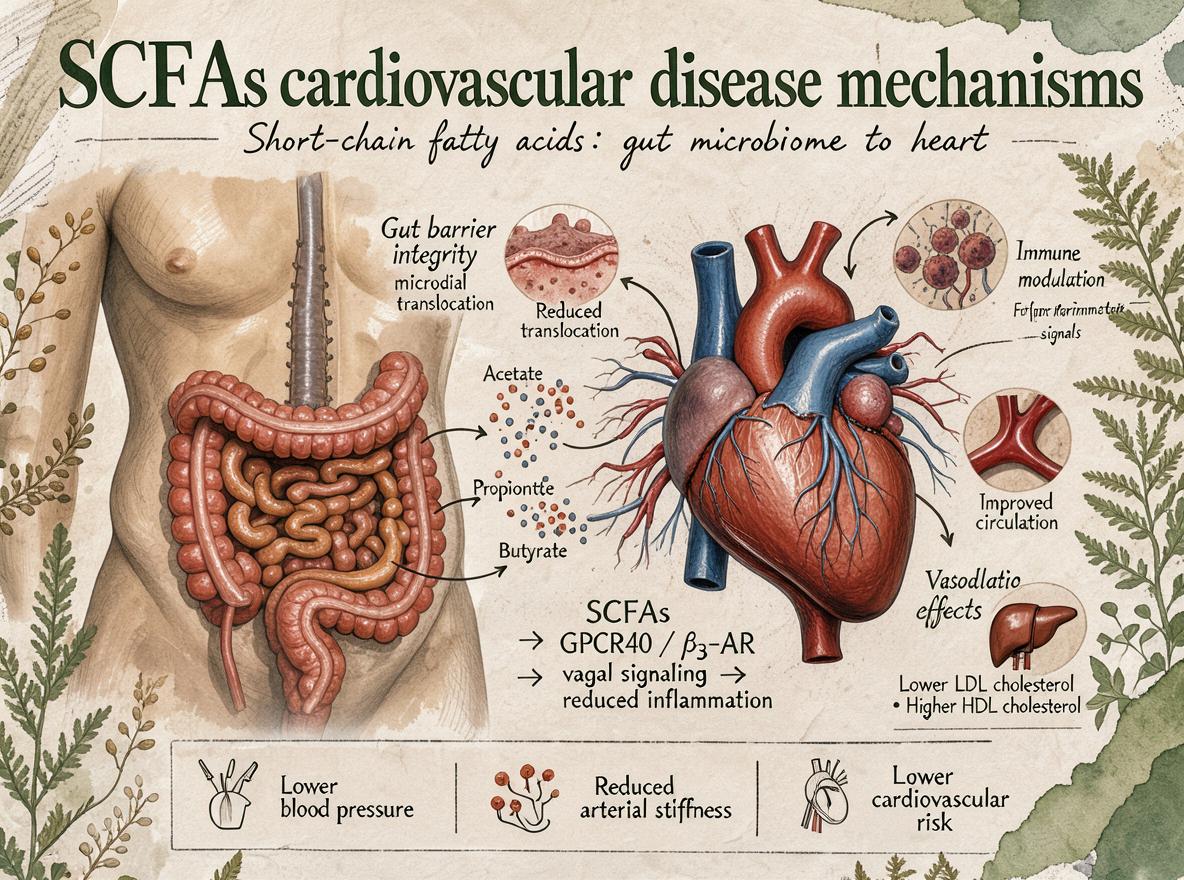
| SCFAs (propionate, butyrate, valerate) | Microbial fiber fermentation (e.g., inulin increases fecal propionic, butyric, valeric acids) | Suppression of pro-inflammatory M1 macrophages (↓iNOS, ↓TNF-α) and promotion of anti-inflammatory M2 macrophages (↑Arg-1, ↑IL-10, ↑CD206) via attenuation of TLR4-MyD88-NF-κB signaling | Mouse ALD model (n=60): all SCFA–macrophage correlations significant (p≤0.0043); in vitro propionate/butyrate/valerate shifted M1/M2 polarization (p≤0.0191). No supplied human CVD outcome data | Moderate (preclinical only) |
| Bile acids | Hepatic/ microbial conversion; FXR is the key nuclear receptor | Supplied records show only FXR hepatic mRNA trends in a porcine diet model (near-significant, p=0.06) — no CVD mechanism data | Gap: no quantitative CVD evidence in supplied sources | Insufficient |
| AAA derivatives (e.g., indoxyl sulfate) | Tryptophan fermentation products | One completed trial (NCT06877585) examined fecal microbiota/metabolite associations with indoxyl sulfate; results not in supplied records | Gap: no quantitative CVD evidence in supplied sources | Insufficient |

 Explore by Goal
 Long Analysis Plan
 Top Data Sources
 Ask a Follow-Up
 Keep Exploring
 Analysis
 Science Movie
 Discussion
