Analyze how experimental results and claims are presented, scoped, and limited in a paper.Know what the science actually supports before you trust the answer.
Press Enter ↵ to analyze
Explore by Goal
"The most beautiful experience we can have is the mysterious. It is the fundamental emotion that stands at the cradle of true art and true science."
- Albert Einstein
Quick Explanation
Copied
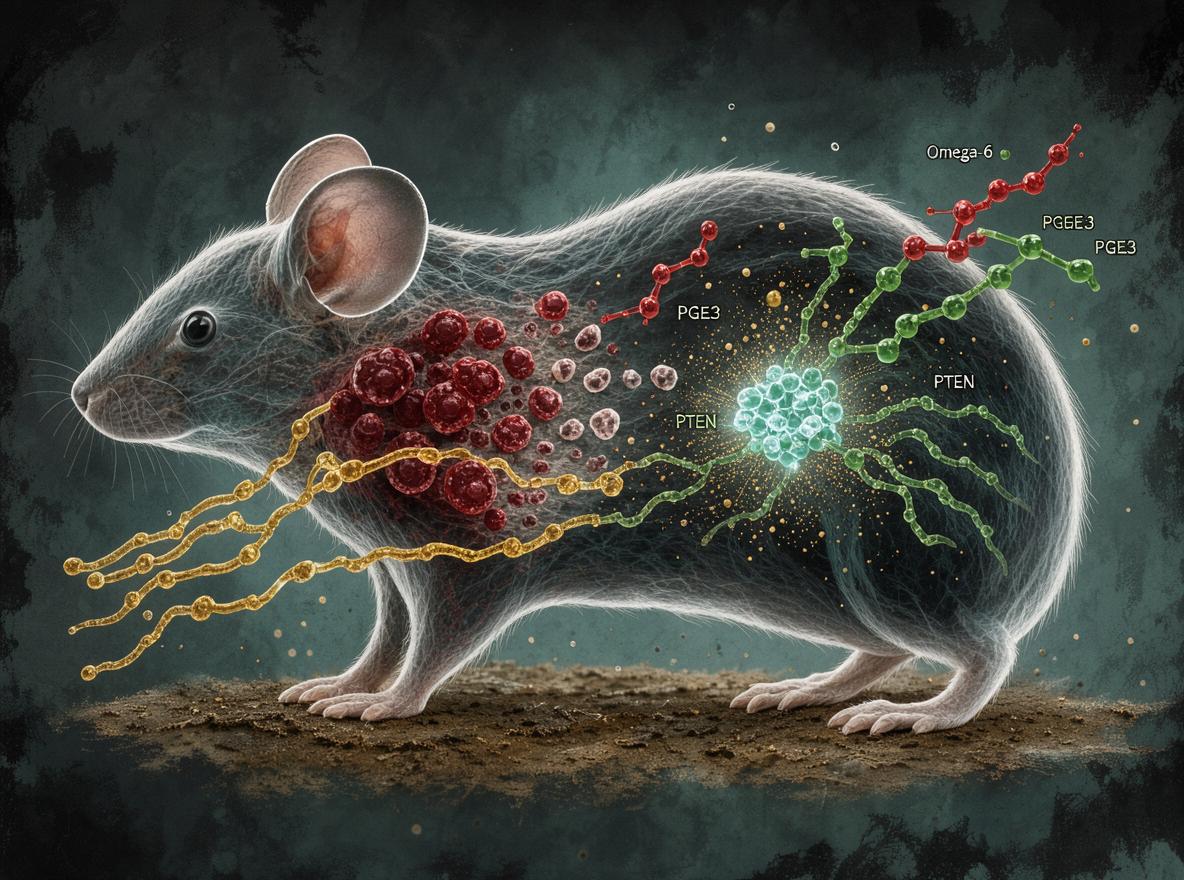
The 2006 PNAS paper reports that fat-1 transgenic mice—endogenously converting omega-6 to omega-3 fatty acids—show 30% melanoma incidence versus 100% in WT littermates, with suppressed growth via a PGE3→PTEN→Akt pathway confirmed by lipidomics and in vitro B16 assays [10.1073/pnas.0605394103]. The mechanistic chain is coherent but limited by n=10/group, a single tumor model, and pharmacologic in vitro doses that may not translate to humans.
Long Explanation
Central Finding: Endogenous Omega-3 Shift Suppresses Melanoma
Using fat-1 transgenic mice carrying a C. elegans desaturase, the authors isolate tissue fatty acid composition from dietary confounders. Only 70% of fat-1 mice (n=10) developed palpable B16-F0 melanoma tumors by days 7–10, versus 100% of WT by day 3, and fat-1 tumors grew markedly slower [10.1073/pnas.0605394103].
Lipid Environment and Mechanistic Chain
Tumor n-6/n-3 ratios were 27:1 (WT) vs 4.6:1 (fat-1); stroma ratios 9:1 vs 0.7:1. Fat-1 tumors showed 16–32-fold PTEN upregulation and near-absent Akt. In vitro, PGE3 (not PGE2) inhibited B16 growth 30–40%, induced apoptosis, and upregulated PTEN; indomethacin blocked EPA's inhibition, confirming COX dependency [10.1073/pnas.0605394103].
Strengths and Blind Spots
The fat-1 model elegantly eliminates dietary confounding, and LC-MS/MS lipidomics directly quantifies the eicosanoid shift. However, n=10 per group limits power; a single tumor type in one background restricts generalizability; and in vitro PGE3 concentrations may not reflect the in vivo microenvironment. Critically, no enzymatically-dead fat-1 control rules out non-lipid transgene effects, and whether PGE3's PTEN upregulation is direct or indirect is unresolved [10.1073/pnas.0605394103].
What Would Change the Conclusion
Human trials linking dietary omega-3 to tissue PGE3/PTEN and reduced melanoma would strengthen translation. Conversely, restored tumor growth in fat-1/PTEN-haploinsufficient mice would challenge the mechanism.
Author reviews:
Feedback:
Updated: November 02, 2026
BGPT Paper Review
Study Novelty
90%
First demonstration that endogenous tissue omega-3 enrichment via fat-1 suppresses melanoma through a specific PGE3-PTEN axis, directly linking lipid composition to a defined tumor suppressor pathway.
Scientific Quality
80%
Elegant genetic model, rigorous lipidomics, and coherent in vivo/in vitro chain. Reduced for small n=10/group, single tumor model, missing enzymatically-dead fat-1 control, and no deposited data.
Study Generality
70%
The omega-6/omega-3-eicosanoid-tumor suppressor framework generalizes broadly, but evidence is limited to melanoma in one mouse strain.
Study Usefulness
80%
Provides mechanistic rationale for omega-3 interventions in cancer prevention and identifies PGE3-PTEN as a testable axis in nutritional oncology.
Study Reproducibility
70%
Methods are well-described (GC, LC-MS/MS, Western blot, RT-PCR); no data repository deposited; transgenic model requires specialized facilities.
Explanatory Depth
80%
Multi-level mechanistic chain from fatty acid substrate through COX-derived PGE3 to PTEN to Akt/caspase signaling, supported at tissue and cellular levels.
We'll email you the results when your analysis is finished.
Hypothesis Graveyard
Omega-3 suppresses tumors solely through reduced PGE2: The PGE3-vs-PGE2 asymmetry (PGE3 directly upregulates PTEN; PGE2 does not) refutes a simple subtraction model.
PTEN upregulation is secondary to reduced tumor burden: In vitro data show PGE3 directly upregulates PTEN in B16 cells independent of microenvironment, supporting direct causality.
Science Art
Science Movie
Make a narrated HD Science movie for this answer ($32 per minute)

 Explore by Goal
 Quick Explanation
 Long Explanation
 Top Data Sources
 Ask a Follow-Up
 Key Insight
 Keep Exploring
 Hypothesis Graveyard
 Discussion
