Check whether claims match experiments, exact reported results, and stated limitations.Know what the science actually supports before you trust the answer.
Press Enter ↵ to review paper
Explore by Goal
"Study hard what interests you the most in the most undisciplined, irreverent and original manner possible."
- Richard Feynman
Quick Explanation
Copied
This Nature study of ~905,000 UKB + All of Us participants quantifies germline and somatic DNA-repeat instability genome-wide, finds strong genetic modifiers (MSH3, FAN1, ATAD5, PMS2, MSH2) with locus- and tissue-specific—even opposite—effects, and reports a novel dominant, low-penetrance disorder: highly expanded GLS 5′-UTR repeats associate with stage 5 CKD (OR 14.0, 95% CI 5.7–34.3) and liver disease (OR 3.0), replicated in AoU. Strengths: massive scale, replication, released code/summary stats. Key caveats: short-read sizing limits, blood-only somatic measurement, and residual PCR-stutter artifacts.
Long Explanation
What the paper actually shows
Using short-read WGS from 490,416 UKB and 414,830 AoU participants, the authors scanned 356,131 polymorphic STRs, estimating germline mutation rates from identity-by-descent tracts and somatic expansion in blood from in-repeat reads after filtering PCR-stutter artifacts via base-quality signatures .
Key quantitative findings: three loci (CA10 n=137,673; TCF4 n=42,004; ATXN8OS n=7,736) account for 97% of CAG expansions ≥45 units; germline per-locus mutation rates span 8.2×10⁻⁵–9.5×10⁻⁴ per generation; repeat interruptions stabilize alleles dramatically (135-fold for TCF4, 3.7-fold for GLS); somatic expansion with age is detectable for 4/15 CAG repeats, with TCF4 alleles ≥25 units expanding in >1% of blood cells by ~55 years .
GWAS of TCF4 somatic-expansion phenotypes in 48,448 individuals identified seven modifier loci—MSH3 (P=2×10⁻⁵²), FAN1 (8.5×10⁻²⁹), ATAD5, PMS2, GADD45A—mostly DNA-repair genes consistent with prior HD modifier work . Critically, modifier effects were heterogeneous: MSH3 haplotypes that decreased TCF4 blood expansion appeared to increase HTT blood/brain expansion, reinforcing tissue- and locus-specific mismatch-repair regulation. Polygenic scores shifted AAAG somatic expansion rates fourfold between top and bottom 5% of individuals, and smoking raised expansion of one AAAG locus 1.33-fold but not another—gene-by-environment specificity the paper itself flags as mechanistically unresolved .
The GLS discovery — strongest translational yield
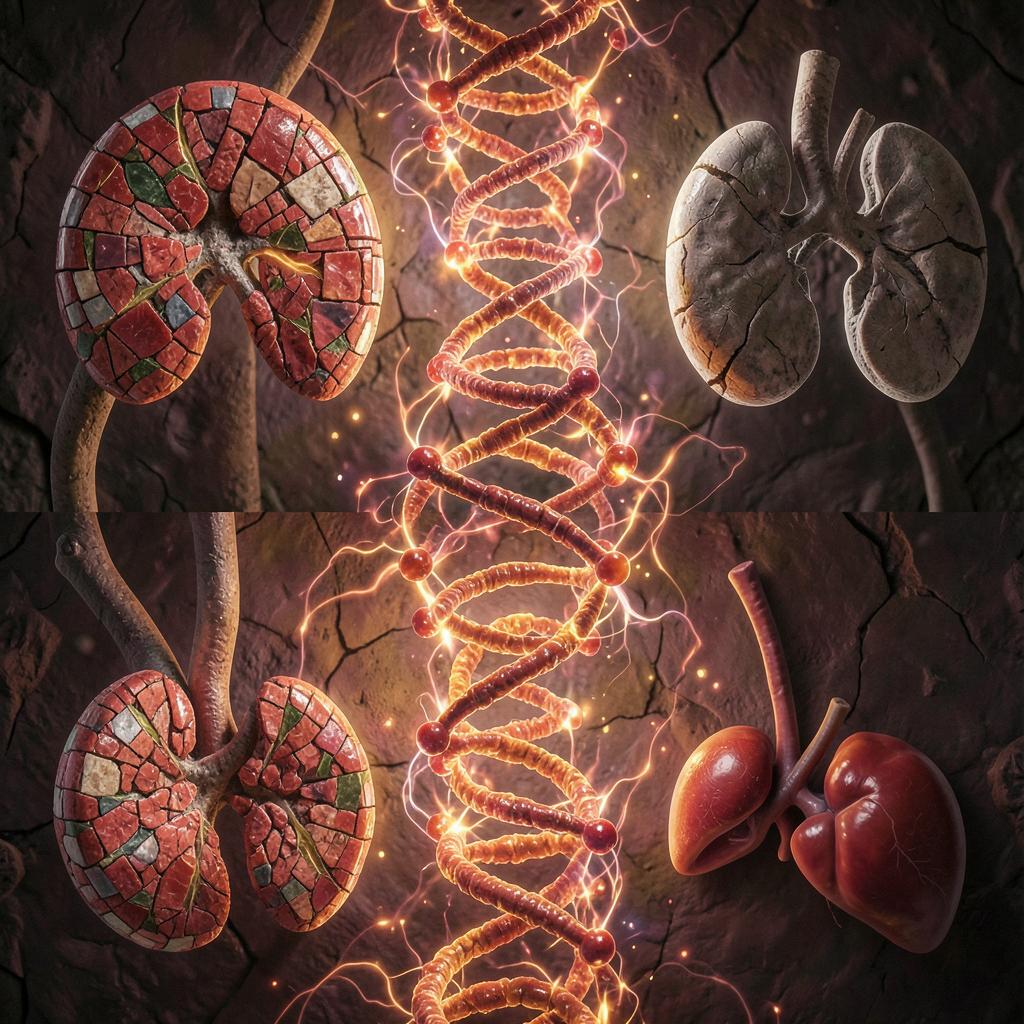
139 UKB individuals (0.03%) carried long GLS 5′-UTR CAG repeats; highly expanded alleles (~100+ units, 98/139) showed elevated GGT (P=3.4×10⁻¹⁵) and cystatin C (P=7.3×10⁻⁷), increased stage 5 CKD risk (OR 14.0, 95% CI 5.7–34.3) and liver disease (OR 3.0, 1.5–5.9), replicated in AoU. GLS SNP/indel loss-of-function variants did NOT associate with these biomarkers, arguing for a mechanism distinct from glutaminase deficiency (authors propose RNA toxicity). This is a genuinely new dominant, low-penetrance repeat disorder—but effect sizes rest on very few carriers (<150 in UKB), and the 95% CI on the CKD OR is wide .
Blind spots and counterpoints
Blood-only somatic readout: the paper explicitly cautions that blood instability poorly predicts brain expansion status—clinically the most relevant tissue for most repeat disorders remains unmeasured.
Short-read constraints: long-allele lengths are inferred from IRR counts plus imputation, not directly sized; long-read validation covered only 1,027 AoU participants (28 long TCF4 alleles). Residual PCR stutter cannot be fully excluded despite quality-score filtering.
Ancestry generalizability: TCF4 GWAS restricted to European-ancestry long-allele carriers; ADGRE2 frequencies are European-specific (~49%).
GLS causality: association is strong and replicated but mechanistic proof (RNA toxicity) remains hypothetical; low-penetrance estimates need longitudinal follow-up.
Falsification paths: independent WGS cohorts failing to reproduce age-related somatic expansion at TCF4/GLS/DMPK/ATN1, non-replication of modifier loci, or loss of GLS-CKD associations after stricter ancestry/length controls would undermine core claims. The released summary statistics (GWAS Catalog GCST90704615–42, Zenodo 17419996) make such tests feasible .
Confidence: high for descriptive instability maps and modifier-locus identification (massive n, replication); moderate for GLS disease causality (small carrier counts, observational design); unknown for cross-tissue applicability.
Feedback:
Updated: October 23, 2026
BGPT Paper Review
Study Novelty
90%
First biobank-scale (>900k participants) joint germline+somatic map of 356k STRs; discovery of a new dominant low-penetrance GLS repeat disorder and demonstration that the same DNA-repair modifier haplotypes act in opposite directions on different repeats is novel.
Scientific Quality
90%
Nature-caliber methods with explicit artifact control (PCR-stutter base-quality filtering), IBD-based germline rate validation, AoU replication, long-read corroboration on a subset, and transparent limitations. Main weaknesses: short-read length inference, blood-only phenotyping, few GLS carriers, ancestry restrictions.
Study Generality
80%
Establishes a generalizable framework for population-scale repeat-instability analysis spanning 2–6 bp motifs and tissue-specific modifier biology; mechanistic depth (chromatin/transcription basis of tissue specificity) remains unproven.
Study Usefulness
90%
Released code, GWAS summary stats, and identified blood-unstable STRs enable biomarker development for expansion-targeting therapies; GLS-CKD/liver findings have direct diagnostic relevance for rare expanded-allele carriers.
Study Reproducibility
80%
Code (GitHub + Zenodo), summary statistics (GWAS Catalog, Broad mirror), and documented pipelines (samtools, BOLT-LMM, SHAPEIT5, METAL) support reproduction; underlying UKB/AoU individual-level data remain access-controlled.
Explanatory Depth
80%
Quantifies mutation-rate dependence on allele length, interruption stabilization, MutSβ loop-length affinity as explanation for MSH2 vs MSH3 motif preferences, and proposes RNA-toxicity for GLS—strong but with explicitly acknowledged untested mechanisms.
We'll email you the results when your analysis is finished.
Hypothesis Graveyard
'Blood somatic expansion mirrors brain expansion across repeats' — directly weakened: MSH3 haplotypes show opposite effects on TCF4 blood vs HTT brain expansion, and blood-unstable repeats are preferentially highly blood-expressed genes.
'GLS expansion acts via glutaminase loss-of-function' — falsified within the paper: GLS SNP/indel pLoF variants do not associate with the kidney/liver biomarker effects seen only with highly expanded repeats.

 Explore by Goal
 Quick Explanation
 Long Explanation
 Top Data Sources
 Ask a Follow-Up
 Key Insight
 Keep Exploring
 Hypothesis Graveyard
 Potential Experiments
 Discussion
