Check a paper's claims against linked experiments, exact results, stated scope, and limitations.Know what falsifiable science actually supports before you trust the answer.
Press Enter ↵ to search evidence
Explore by Goal
"Look deep into nature, and then you will understand everything better."
- Albert Einstein
Quick Explanation
Copied
BinderFlow (bioRxiv, Sep 2025) is a well-engineered, open-source batch-parallelized pipeline for de novo protein binder design that adds real-time monitoring (BFmonitor) and two refinement strategies, at a modest ~18% GPU-time cost versus a linear workflow on a PD-L1 benchmark (14.2 h vs 12 h for 24 in silico hits) [10.1101/2025.09.10.675490]. Its value lies in democratizing infrastructure, but it is purely in silico, validated on one target, and remains reliant on AF2IG metrics whose link to experimental binding the authors themselves call poorly understood [10.1101/2025.09.10.675490].
Long Explanation
What BinderFlow actually delivers
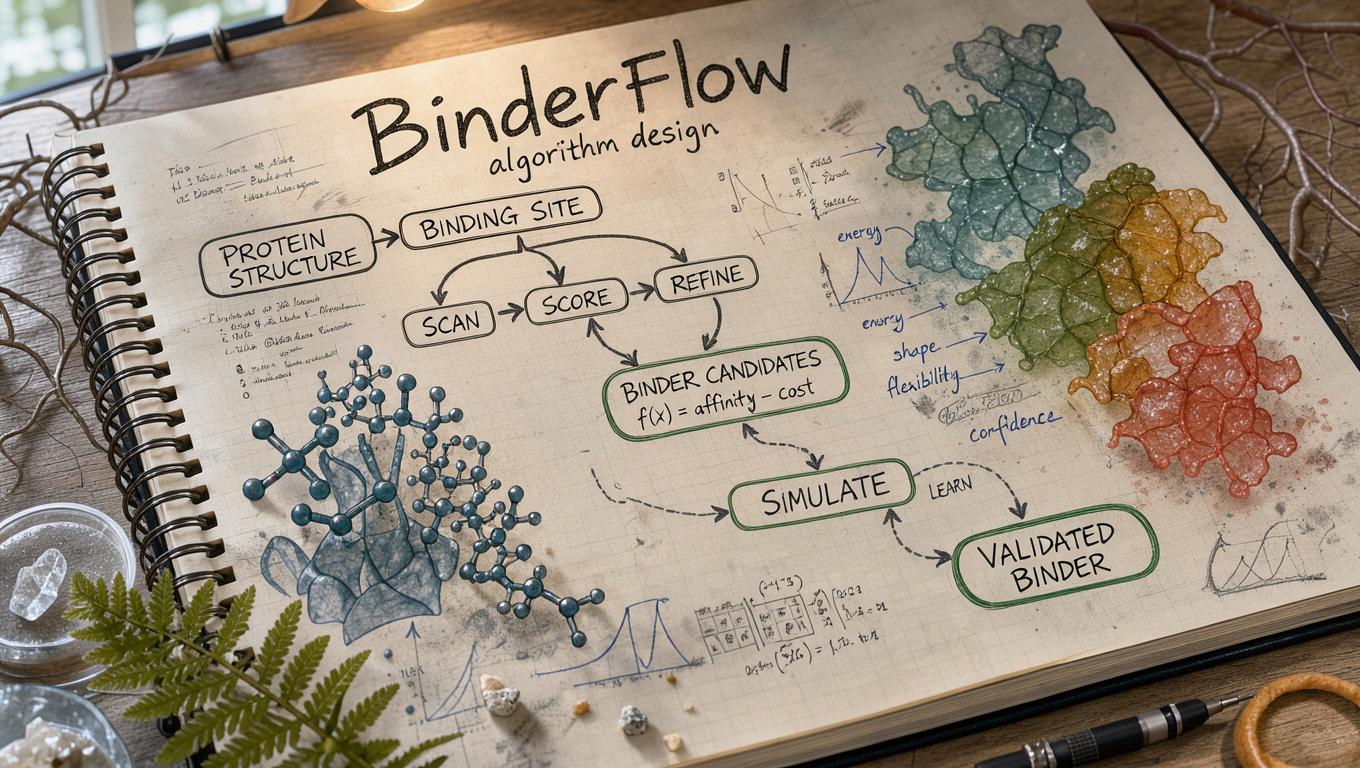
BinderFlow splits a binder-design campaign (RFdiffusion backbones → backbone filtering → ProteinMPNN sequences → AF2IG scoring + PyRosetta metrics) into small, independently scheduled 10-design batches that run end-to-end per GPU on SLURM systems, appending scores to a live .csv that feeds BFmonitor, a Dash/Plotly dashboard for filtering hits (pLDDT_binder > 80, PAE_interaction < 10), structural preview, and codon-optimized DNA order generation via CodonTransformer [10.1101/2025.09.10.675490]. Code is public at github.com/cryoEM-CNIO/BinderFlow; the authors declare no competing interests [10.1101/2025.09.10.675490].
Benchmark: an honest, self-critical efficiency claim
The authors report that batching costs efficiency: AF2IG scoring slowed from 36.1 s to 134.3 s per design when recomputed per batch, mitigated to 51.3 s by caching intermediate matrices on disk; total wall time to 24 hits was 14.2 h (BinderFlow) vs 12 h (linear) — an 18% gap they show is likely smaller in real campaigns where linear runs over- or under-shoot the needed design count [10.1101/2025.09.10.675490]. This transparency is a strength: the tool trades modest GPU throughput for parallelizability, idle-GPU opportunism, and live stopping rules.
Refinement strategies: promising but not experimentally tested
Two modular refinements — Partial Diffusion (noise-seeded from a validated backbone) and Sequence Diversity (massive pMPNN resampling of a fixed backbone) — shift metric distributions toward hit thresholds, with Sequence Diversity gains correlating with shape complementarity rather than sequence identity to the seed [10.1101/2025.09.10.675490]. Critically, all refinement evidence is in silico; the authors concede that the relationship between computational confidence metrics and experimental binder success "remains poorly understood" [10.1101/2025.09.10.675490]. No wet-lab binding data (SPR, BLI, expression yields) are reported for any design, so claims that these strategies "improve binder affinity and specificity" are hypotheses, not demonstrated outcomes.
Positioning against competing accessibility tools
BinderFlow enters a crowded niche: Prosculpt offers a comparable YAML-configured open pipeline (RFdiffusion + ProteinMPNN + AF2/Boltz2/AF3 scoring) with a broader design-scope demo (oligomers) [10.64898/2026.06.25.732351], and ProteinMCP wraps 38 design tools in agentic AI workflows [10.64898/2026.03.11.711149]. BinderFlow's differentiators are its batch-stop-on-hits logic, live dashboard, and low-priority HPC coexistence — engineering contributions rather than scientific ones. Notably, models like BoltzGen pursue a different axis entirely (unified all-atom generative design validated across 26 targets with wet-lab campaigns) [10.1101/2025.11.20.689494], meaning modular pipelines around RFdiffusion may face architectural obsolescence as single-model alternatives mature.
Critical assessment
Strengths: open code, honest benchmarking including its own inefficiencies, modular swap-in design, realistic consumer-GPU focus (RTX 2080Ti/4090Ti) [10.1101/2025.09.10.675490]. Weaknesses: single-target validation (PD-L1 only), zero experimental validation, no comparison to other pipelines (e.g., BindCraft is cited but not benchmarked), and hit-definition thresholds inherited from prior work rather than independently calibrated [10.1101/2025.09.10.675490]. What would change the assessment: multi-target benchmarks with paired experimental hit-rate data showing BinderFlow's live monitoring actually reduces wasted compute in practice, and demonstration that Partial Diffusion/Sequence Diversity refinements translate to measured affinity gains.
Feedback:
Updated: November 22, 2026
BGPT Paper Review
Study Novelty
50%
A workflow-engineering contribution reassembling established tools (RFdiffusion, ProteinMPNN, AF2IG) into a batch-parallel pipeline; conceptually similar open pipelines (Prosculpt) already exist, though live hit-threshold stopping and BFmonitor add incremental novelty.
Scientific Quality
70%
Transparent benchmarking including self-reported inefficiencies and public code are strengths. Major deductions: single-target (PD-L1) validation, entirely in silico evidence, no wet-lab confirmation of refinement strategies, and no head-to-head benchmarking against competing pipelines like BindCraft despite citing them.
Study Generality
70%
The modular architecture generalizes across binder-design targets and software swaps, but empirical evidence covers only one target and the paper offers no cross-target data supporting claimed generality.
Study Usefulness
80%
Highly practical for structural-biology labs with GPUs but without protein-design expertise: automated handoffs, low-priority HPC coexistence, live monitoring, and one-click DNA order export address real workflow bottlenecks in a rapidly growing field.
Study Reproducibility
80%
Code fully open-source (github.com/cryoEM-CNIO/BinderFlow), methods detail GPU models, batch sizes, noise settings, and hit thresholds precisely; reproducibility is limited mainly by dependence on specific software versions and uncharacterized stochasticity of diffusion sampling.
Benchmarking BinderFlow's claimed runtimes against published binder-pipeline metrics and simulating hit-rate-dependent wall-time savings from live campaign stopping.
Get emailed when your analysis is done!
We'll email you the results when your analysis is finished.
Hypothesis Graveyard
Batching inherently wastes GPU time: partially falsified by the authors' own caching fix, which recovers most AF2IG overhead, leaving only an 18% residual gap that real-campaign stopping logic can erase.
Modular pipelines will be displaced by end-to-end generative models like BoltzGen: premature — modular pipelines let labs mix proven components and swap in new models, so coexistence rather than replacement is the near-term outcome.

 Explore by Goal
 Quick Explanation
 Long Explanation
 Top Data Sources
 Ask a Follow-Up
 Key Insight
 Keep Exploring
 Analysis
 Hypothesis Graveyard
 Potential Experiments
 Discussion
