Analyze how experimental results and claims are presented, scoped, and limited in a paper.Know what the science actually supports before you trust the answer.
Press Enter ↵ to analyze
Explore by Goal
"Science is the acceptance of what works and the rejection of what does not. That needs more courage than we might think."
- Jacob Bronowski
Quick Explanation
Copied
Verdict: Strong preprint with a genuinely novel finding. The authors identify the first druggable pocket on CIP2A, at the homodimerization interface, and validate it through a coherent chain of evidence: in silico pocket prediction (Panther, P2Rank), MD-supported mutagenesis (A476W, L480W, S519K), direct binding of Gambogenic acid by MST (Kd = 780 ± 70 nM), SEC-MALS-confirmed dimer dissociation, and cellular target engagement via biotinylated GNA . Caveats: GNA is a multitarget compound, and the work remains unpublished/peer-review-pending bioRxiv data .
Long Explanation
What the paper establishes — with strong convergent evidence
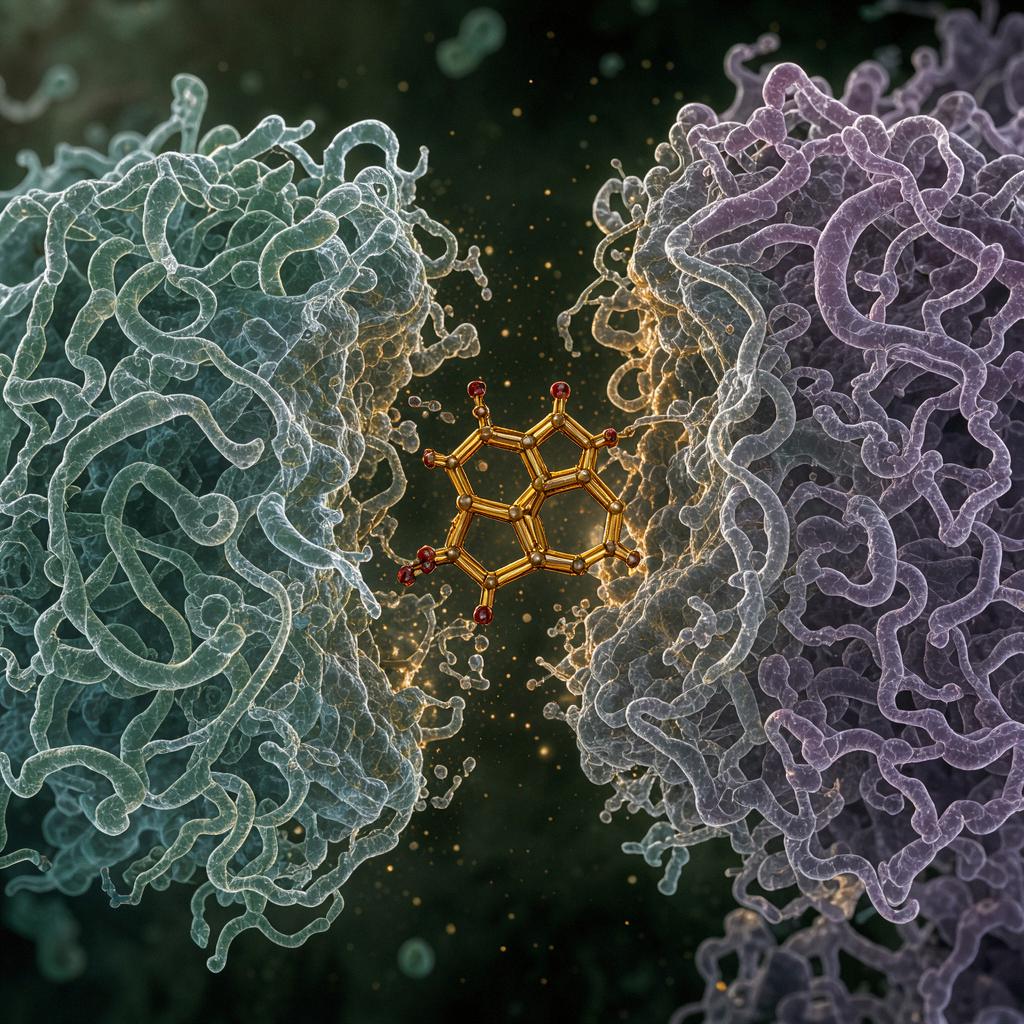
The central claim is that CIP2A harbors a previously undescribed druggable pocket (PDB 5UFL residues D477, K490, Q524, Q558) adjacent to the homodimerization surface, and that targeting it destabilizes CIP2A. The evidence chain is unusually complete for a pocket-discovery paper: dual computational prediction (Panther and P2Rank), MD simulation of the A476W mutation showing R557 shifting toward Q558 of the opposing monomer, in vitro GST pull-down confirming dimerization loss comparable to the known L533E interface mutant, reduced CIP2A-B56α binding, and full-length destabilization in 22RV1 cells matching the dimer-interface 3A mutant phenotype .
The GNA story is the strongest part: MST gives Kd = 780 ± 70 nM for GNA binding to CIP2A(1-560); SEC-MALS independently confirms dimer dissociation at 5–10x molar excess; fragment mapping shows the 331–560 pocket region is required for GNA sensitivity; and two independent "gatekeeper" mutations (L480W, S527W) blunt GNA's dimer-disrupting effect from ~80% to 40–50%, which is textbook pocket-validation logic . Two GNA batches from independent manufacturers ruled out batch effects — a control many papers omit.
Reported MST Kd values from the preprint; error bar shown only for GNA, the only compound with a reported uncertainty.
Where skepticism is warranted
1. GNA selectivity is unresolved by design. The authors explicitly concede that GNA/GIA hit multiple oncogenic targets , consistent with a prior structural study of gambogic acid binding an Hsp90β pocket . Consequently the cell-viability and endogenous-CIP2A-reduction data (MDA-MB-231, MDA-MB-436, 22RV1, HeLa) cannot be interpreted as CIP2A-specific effects — the authors say this plainly, which is honest but means the in cellulo pharmacology is correlative only .
2. Fragment-based limitations. All structural and binding work uses CIP2A(1-560); full-length recombinant CIP2A remains intractable. Notably, a 2026 preprint shows full-length CIP2A forms tetramers via a C-terminal coiled coil (residues 884–892) required for TOPBP1 recruitment — a quaternary state invisible to the 1-560 construct used here . This does not invalidate the pocket findings but means the dimer-centric structural model may understate CIP2A's oligomeric complexity in cells. The authors did test GST-CIP2A(331-905) and found GNA still works, which partially addresses the C-terminal tail concern.
3. Sample sizes and statistical power. Most quantifications use N = 3 biological repeats with Welch-corrected t-tests; cellular target engagement (bGNA pull-down) used only N = 2. These are adequate for directionality but not for precise effect-size estimation. No correction for multiple comparisons across the COSMIC mutation panel (five mutations tested) is reported.
4. Conflict of interest. OTP is founder/shareholder of Aurlide Ltd, a CIP2A-targeting company; the remaining authors declare no competing interests. This does not invalidate the biophysical data but warrants awareness in interpreting translational framing .
Significance and what would change the conclusion
CIP2A is a high-value target (synthetic lethal in BRCA/HRD cancers; implicated in AD pathogenesis), and no structural vulnerability had been demonstrated before — prior small-molecule "CIP2A inhibitors" lacked target-engagement evidence . The finding would be weakened if: (a) GNA binding to CIP2A(1-560) proves to be an artifact of the His-tag or non-native folding in the MST construct; (b) gatekeeper mutations fail to protect full-length endogenous CIP2A from GNA degradation in cells (the key missing experiment); or (c) independent groups cannot reproduce SEC-MALS dimer dissociation. Confidence: high on in vitro binding and dimer disruption; moderate on pocket causality; low-moderate on therapeutic translation given GNA polypharmacology and absent in vivo data.
Author Reviews: Explore full publication histories of key authors:
Feedback:
Updated: October 31, 2026
BGPT Paper Review
Study Novelty
90%
First demonstrated druggable pocket on CIP2A, a target lacking any structural vulnerability evidence despite extensive oncology literature; GNA pocket-engagement with gatekeeper mutant validation is a genuinely new structural-pharmacology finding.
Scientific Quality
80%
Methodologically rigorous (dual pocket predictors, MST + SEC-MALS + DSF orthogonal binding assays, two GNA batches, gatekeeper mutants). Deducted for N=3/N=2 replicates, no multiple-comparison correction on the COSMIC panel, fragment-only structural basis, and unaddressed selectivity of the tool compound.
Study Generality
70%
Highly relevant to cancer (broad) and AD, but pocket findings are CIP2A-specific and the paradigm (targeting PPI-adjacent pockets to destabilize scaffold proteins) is already known; generalizable principles are moderate.
Study Usefulness
90%
Opens structure-based CIP2A inhibitor/PROTAC development with defined coordinates and a validated tool compound; directly actionable for drug-discovery groups targeting HRD cancers and AD.
Study Reproducibility
70%
Detailed methods (vectors, buffers, MST/DSF/SEC-MALS parameters, primer sequences) and PDB 5UFL access support reproduction; raw datasets are not publicly deposited and some reagents (DAP-19, MAD-28) were gifts.
Explanatory Depth
80%
Mechanistic chain from pocket geometry → MD-predicted interface perturbation → dimer loss → B56α binding loss → protein destabilization is well-supported; deeper atomic-level understanding awaits a co-crystal or cryo-EM structure of GNA-bound CIP2A.
We'll email you the results when your analysis is finished.
Hypothesis Graveyard
Direct targeting of the flat CIP2A homodimerization interface by small molecules — falsified here: the computationally proposed interface binder AW00907 (CIP1) showed no dimerization inhibition at 20-100 µM.
Transcriptional CIP2A inhibition as the dominant drug mechanism for gamboge compounds — superseded: this work demonstrates a direct protein-level binding/destabilization mechanism via a defined pocket.

 Explore by Goal
 Quick Explanation
 Long Explanation
 Top Data Sources
 Ask a Follow-Up
 Key Insight
 Keep Exploring
 Hypothesis Graveyard
 Potential Experiments
 Discussion
