Check your hypothesis against versioned claims, exact reported results, and stated falsification criteria.Know what falsifiable science actually supports before you trust the answer.
Press Enter ↵ to search evidence
Explore by Goal
"For me, it is far better to grasp the Universe as it really is than to persist in delusion, however satisfying and reassuring."
- Carl Sagan
BGPT Odds of True
65%
80% Confidence
The hypothesis makes two linked claims: (1) state-dependent bradycardia (emerging during sleep/high vagal tone) and (2) XAF-1407 efficacy scaling with cholinergic load. Claim (1) is a mechanistically sound inference from the demonstrated stimulated-only gain-of-function, but was not directly tested in vivo; claim (2) is plausible given no baseline drug effect but lacks dose-response data. Likelihood is moderate because the mechanism supports the logic but the sleep-state and scaling predictions remain untested.
Hypothesis Novelty
70%
While the GNB2 R52L gain-of-function itself is documented, framing the bradycardia as sleep/vagal-state-dependent and predicting XAF-1407 efficacy scaling with cholinergic load is a novel mechanistic corollary not explicitly stated in the primary paper.
Quick Analysis Plan
Copied
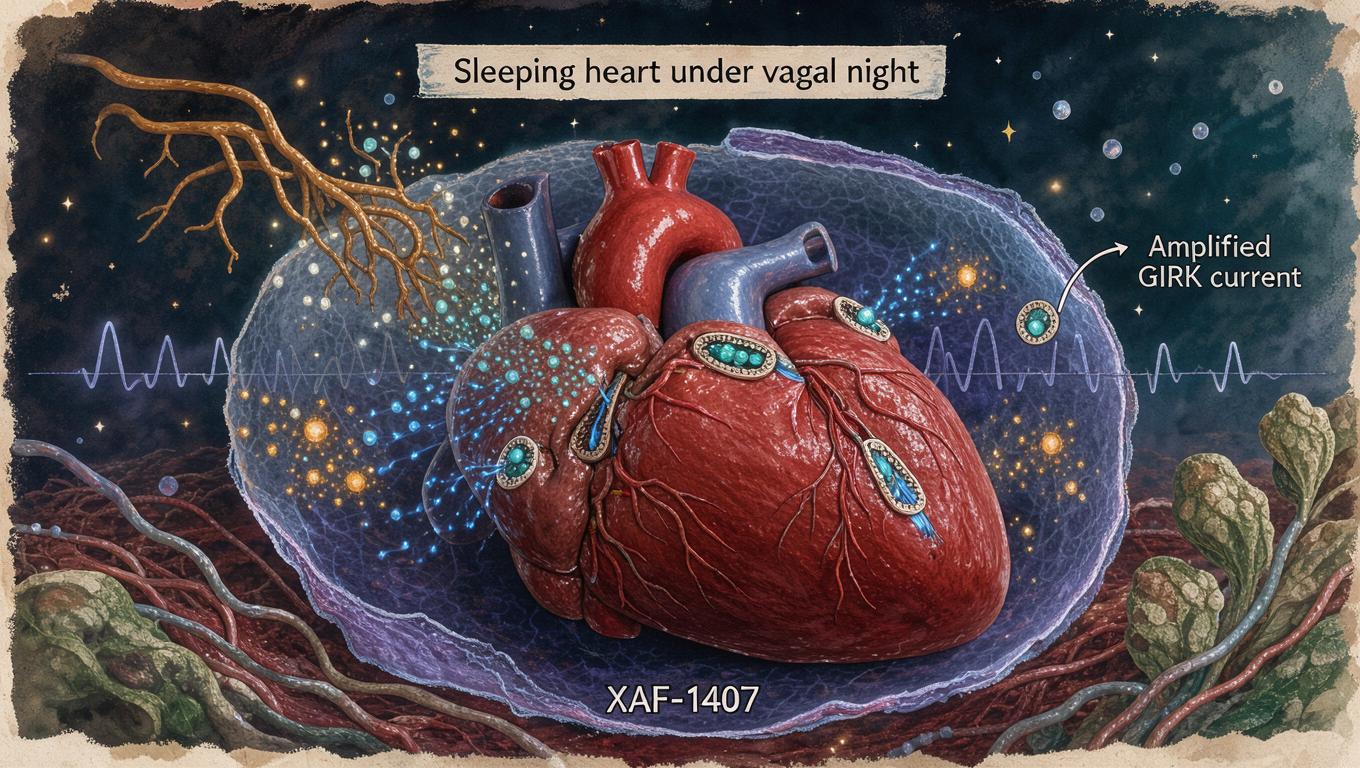
Yes, the supplied hiPSC-CM evidence supports a state-dependent mechanism: the GNB2 R52L variant showed no constitutively active I_K,ACh and no baseline MDP/pacing difference, but with carbachol (a muscarinic agonist mimicking vagal tone) it produced a larger CCh-sensitive current, greater MDP hyperpolarization (8.7 vs 2.1-2.2 mV) and slower pacing (0.7 vs 1.1 Hz), and 100 nM XAF-1407 reversed these CCh effects . The logical extension—that bradycardia emerges during sleep/high vagal tone and that XAF-1407 efficacy scales with cholinergic load—is mechanistically coherent but untested in vivo; the cell model cannot confirm sleep-state dependence or dose-response scaling.
Long Analysis Plan
Stimulated gain-of-function: what the evidence directly shows
The hypothesis's two premises are each supported, but only partially, by the hiPSC-CM data:
Baseline ("at rest"): no phenotype. Without GIRK-channel stimulation, mutant and control hiPSC-CMs had similar maximal diastolic potential and spontaneous pacing, and no constitutively active I_K,ACh was detected (XAF-1407-sensitive current at baseline did not differ; P > 0.05, two-way RM ANOVA) .
Under cholinergic stimulation: exaggerated response. With 10 µM carbachol (CCh), R52L-CMs showed a significantly larger CCh-sensitive I_K,ACh than both control lines (P < 0.05, two-way RM ANOVA + Bonferroni) , greater MDP hyperpolarization (8.7 ± 1.7 vs 2.2 ± 0.6 and 2.1 ± 0.8 mV, Kruskal-Wallis), and slower pacing (0.7 vs 1.1 Hz).
Pharmacological rescue. 100 nM XAF-1407 in continued CCh reversed the CCh effects on action potentials in five R52L-CMs .
State-dependence and XAF-1407 scaling: inference, not observation
The stimulated-only phenotype logically implies state-dependence: if I_K,ACh exaggeration requires muscarinic activation, bradycardia should emerge when vagal tone is high (sleep, parasympathetic dominance) rather than at rest. This is a defensible inference from the mechanism, but it was not directly tested—no sleep-stage, circadian, or in vivo vagal-tone experiments exist in the supplied data, and 10 µM CCh is a supraphysiologic muscarinic agonist that does not replicate physiological vagal titers.
Similarly, "XAF-1407 efficacy scaling with cholinergic load rather than being constant" is plausible but untested: the drug was only tested at one dose (100 nM) in one condition (during CCh) and had no effect at baseline. Because there is no baseline effect to block, efficacy must be at least conditional on cholinergic activation; whether it scales proportionally with cholinergic load requires a dose-response and CCh-concentration-response study that was not performed.
Key limitations and blind spots
Single-cell in vitro hiPSC-CM model; no in vivo or clinical validation .
Single mutant patient line (UKMi003-A) with unrelated controls; isogenic corrected clones were unusable (K6 chromosome 1 defects; K26 failed differentiation), leaving genetic background and line-level replication unresolved.
No mRNA or protein measurement of Kir channel expression, so the amplified current could reflect altered channel abundance rather than Gβγ signaling gain.
Sample sizes varied by experiment (baseline APs n=10-19/line; CCh APs n=6-13/line; XAF-1407 rescue n=5), limiting statistical power for the pacing effect.
hiPSC-CMs lack autonomic innervation; sleep-state dependence cannot be modeled in this system.
Confidence note: The stimulated gain-of-function mechanism is well-supported (moderate evidence, single-cell in vitro). The state-dependence corollary is a coherent inference, and the XAF-1407 scaling prediction is a testable hypothesis for which the supplied data provide only a qualitative foundation. Falsification would require demonstrating comparable CCh-induced MDP hyperpolarization and pacing slowing in R52L vs controls at physiological agonist concentrations, or demonstrating constant XAF-1407 efficacy across cholinergic loads.
Simulated I_K,ACh-mediated MDP hyperpolarization vs cholinergic load (carbachol concentration, 0.1-10 µM) based on the observed 8.7 mV R52L vs 2.2 mV control hyperpolarization at 10 µM CCh, assuming a monotonic sigmoid relationship and no baseline difference. Ranges are uncertain (±25%); simulated values, not observed data.
Generated scientific data; not direct experimental measurements.
Analysis Wizard
Simulating carbachol concentration-response curves for R52L and control I_K,ACh currents to model cholinergic-load-dependent XAF-1407 efficacy from the supplied hiPSC-CM evidence.
Get emailed when your analysis is done!
We'll email you the results when your analysis is finished.
Constitutive I_K,ACh gain-of-function (leaky GIRK channel at baseline): ruled out by the absence of baseline XAF-1407-sensitive current and normal baseline MDP/pacing in R52L-CMs.
Structural sinus node disease (fibrosis, HCN4 dysfunction): not supported by the supplied data; the phenotype is fully explained by cholinergic-dependent I_K,ACh exaggeration and reversible by pharmacological blockade.

 Explore by Goal

 Hypothesis Novelty
 Quick Analysis Plan
 Long Analysis Plan
 Top Data Sources
 Ask a Follow-Up
 Key Insight
 Keep Exploring
 DataGen
 Analysis
 Potential Hypothesis
 Hypothesis Graveyard
 Discussion
