Ask questions across claims linked to experiments, exact results, limitations, and sources.Know what falsifiable science actually supports before you trust the answer.
Press Enter ↵ to search evidence
Explore by Goal
"The molecules of life are like letters of the alphabet. You can't tell what a word says by knowing the number of letters in it."
- Matt Ridley
Quick Explanation
Copied
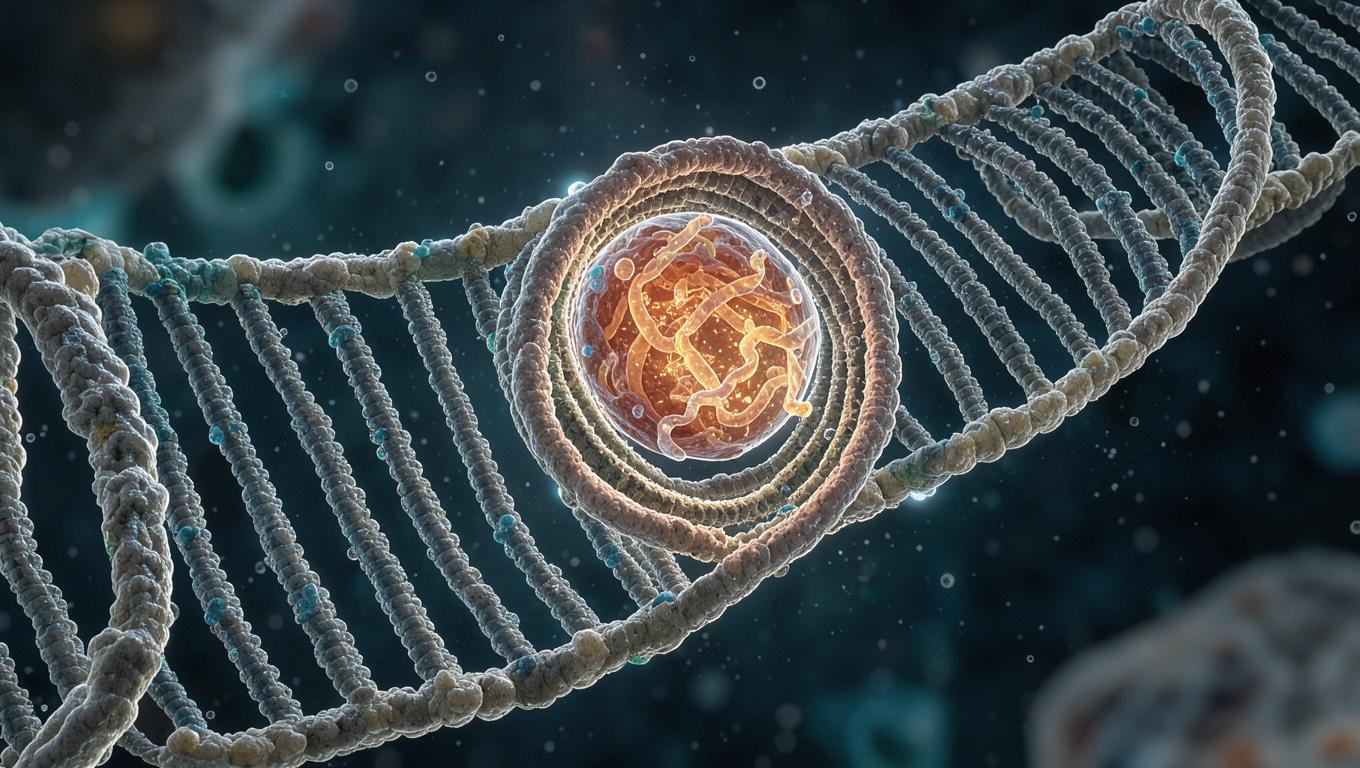
This arXiv preprint (Nov 2026) argues that DNA supercoiling creates force-insulated plectonemic pockets where protein–DNA co-condensates nucleate above the all-or-nothing critical force, producing droplets whose size is mechanically tunable by tension and linking number; coarse-grained MD, an extended two-phase theory, and magnetic-tweezer spermine experiments qualitatively support this . Caveats: experimental validation uses spermine, not proteins, and comparison is only qualitative.
Long Explanation
What the Paper Claims, and How Solid It Is
The preprint combines three strands of evidence: (1) coarse-grained Langevin MD of 8 kbp twistable worm-like-chain DNA with Lennard-Jones model proteins (788 protein-addition coarsening simulations plus 100 protein-free trajectories), (2) an analytic two-phase free-energy model extended with a co-condensate term (bulk −aL, interfacial bL2/3, bending cL1/3), and (3) magnetic tweezers (MT) on 20.6 kbp tethers with spermine .
Key reported results: torsionally relaxed DNA collapses all-or-nothing below a φ-dependent critical force (fc ≈ 0.18 pN at φ = 0.001); above it, plectonemes act as force-insulated pockets that nucleate co-condensates while extended domains stay bare. The droplet count coarsens to one in steady state, dominated by Ostwald ripening (≈89% of subordinate droplets vanish by ripening vs 11% coalescence), and the surviving droplet grows as Rg ∝ t0.095±0.002 — close to the predicted t1/9 signature of 1D plectoneme coarsening feeding a 3D droplet .
The MT data are the weakest quantitative link: spermine's electrostatics, non-ideal solution behavior, and groove binding shift DNA mechanics in ways the model does not capture, so the authors themselves state only qualitative agreement is possible . The measured critical forces are broadly consistent with prior spermine-condensation work .
Critical Assessment
Strengths: tight theory–simulation agreement, a falsifiable scaling prediction (t1/9), open analysis code (DropFinder), and a clean mechanistic concept (passive analogue of loop-extrusion tension shielding).
Blind spots: no in vivo or protein-specific condensate was tested; droplet size tunability by force/linking number is demonstrated only in simulation; the single-droplet free-energy assumption is built into the theory that then "confirms" single-droplet outcomes (partial circularity); 8 kbp tethers are short relative to genomic supercoiling domains.
What would falsify the claim: MT or fluorescence experiments at fixed σ above fc showing no plectoneme-localized partial condensation, or droplet size independent of force and ΔLk .
Confidence note: the simulation/theory claims are internally well-supported (strong evidence within the model); the in vivo relevance and experimental generality remain inferred, not demonstrated.
Author Reviews:
Feedback:
Updated: November 18, 2026
BGPT Paper Review
Study Novelty
80%
The concept of force-insulated plectonemic pockets enabling tunable 'topological droplets' above the all-or-nothing critical force is a genuinely new mechanistic link between DNA topology and co-condensation, building on prior supercoiling and co-condensation work.
Scientific Quality
80%
Rigorous theory–simulation agreement, quantitative kinetic predictions, and an honest MT control; but experimental validation is only qualitative (spermine, not proteins) and the theory's single-droplet assumption partially presupposes the simulated outcome.
Study Generality
60%
Demonstrated on a single 8 kbp tether and one condensing agent; the mechanism likely generalizes to bacterial supercoiling domains and condensate regulation, but generality is asserted rather than tested.
Study Usefulness
70%
Provides a testable physical mechanism for mechanically regulating condensate size, with direct implications for bacterial topological domains and supercoiling–protein recruitment feedback.
Study Reproducibility
60%
Detailed SI parameters, published analysis code (DropFinder), and calibrated MT protocols aid reproduction, but the DNA force field is cited as 'manuscript in preparation,' limiting full reproducibility.
Explanatory Depth
80%
Deep mechanistic account: free-energy concavity explains all-or-nothing, sub-extensive interfacial terms explain coarsening and torque jumps, and 1D-vs-3D crossover explains the t^1/9 exponent.
Generated scientific data; not direct experimental measurements.
Get emailed when your analysis is done!
We'll email you the results when your analysis is finished.
Hypothesis Graveyard
Plectonemes nucleate condensates merely because they raise local DNA density — rejected: the paper shows condensation is gated by force insulation of entry/exit points, not just density, since extended domains at equal density stay bare.
Condensate size is set by protein depletion in the simulation box — rejected by the authors' sizing analysis showing droplets stop growing when plectonemic DNA is exhausted, not when bulk protein runs out.

 Explore by Goal
 Quick Explanation
 Long Explanation
 Top Data Sources
 Ask a Follow-Up
 Key Insight
 Keep Exploring
 DataGen
 Hypothesis Graveyard
 Discussion
