Go beyond summaries to locate specific, verifiable claims and sources within research.Know what falsifiable science actually supports before you trust the answer.
Press Enter ↵ to search paper
Explore by Goal
"We cannot solve our problems with the same thinking we used when we created them."
- Albert Einstein
Quick Answer
Copied
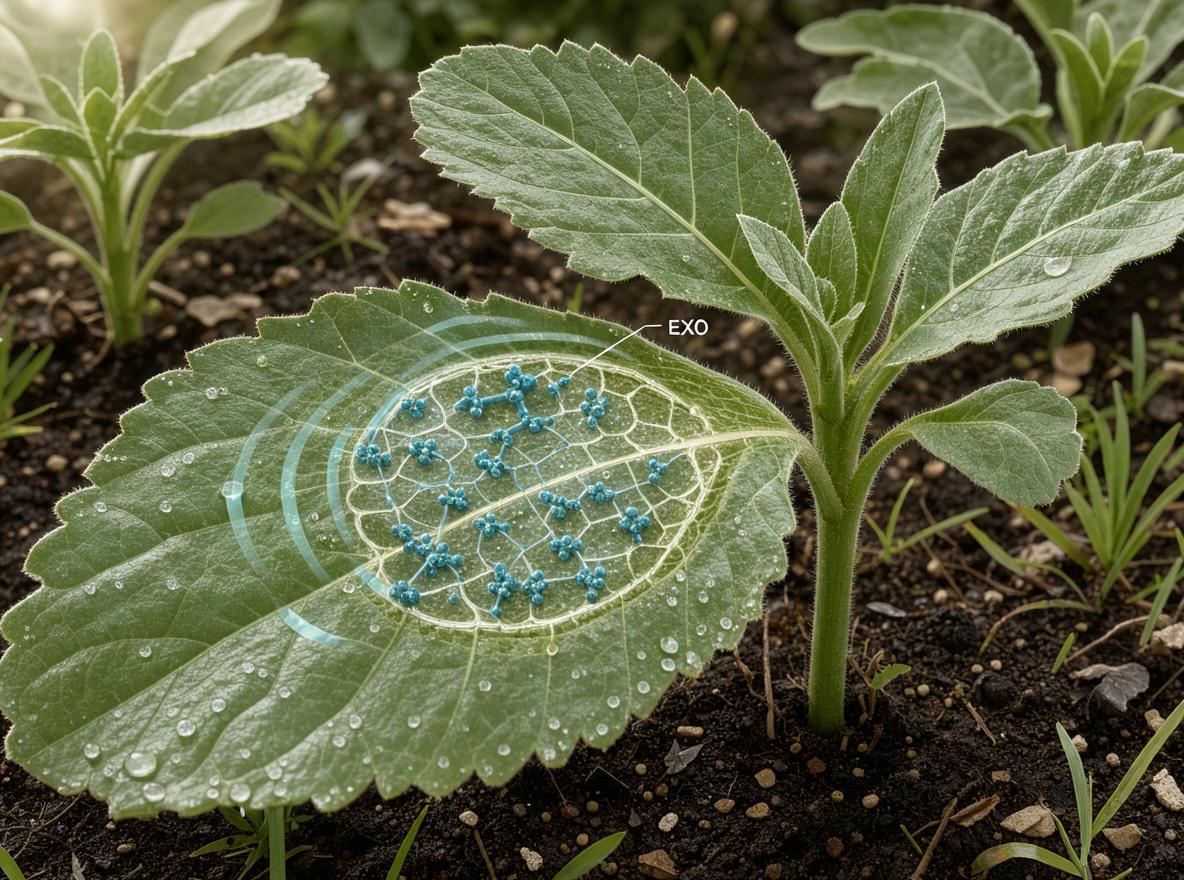
Schröder et al. show the apoplastic EXO protein (At4g08950) is required for brassinosteroid-promoted cell expansion: the exo knockout produces ~50–60% of wild-type biomass with smaller epidermal and palisade cells, and diminished cotyledon/hypocotyl BL responses, while most BR-regulated genes remain normally expressed, placing EXO downstream of core BR signaling in the shoot .
Long Answer
EXO is necessary but not sufficient for BR-driven growth
Schröder, Lisso, Lange and Müssig characterize the exo knockout (SALK_098602) and show that reduced leaf and root growth stems specifically from smaller epidermal, palisade, and spongy parenchyma cells — cell number was largely unaffected. Biomass was reduced to 50–60% of wild-type across six independent experiments, with root length 30%, 24%, and 19% shorter at 14, 21, and 31 days .
EXO:HA and EXO:GFP fusions localized to the apoplast, consistent with TargetP/Predotar predictions and cell-wall proteomics for the EXO/EXL family. Critically, exo shoots showed diminished brassinolide-induced cotyledon and hypocotyl growth, but exo roots were more sensitive to BL inhibition — a tissue-specific paradox the authors honestly flag as unresolved .
Mechanistic model and its blind spots
Only ~10 genes showed robust EXO-dependent expression (e.g., WAK1, log2FC 1.3); EXP5 and KCS1 downregulation (RT-PCR fold changes 2.6→1.6 and 2.1→1.5 with age) diminished developmentally, and most canonical BR-regulated genes were unchanged. The authors conclude EXO acts downstream of known BR signaling, likely coordinating wall properties with environmental/developmental inputs — a plausible but deliberately non-mechanistic hypothesis since no EXO/PHI1 homolog has a known catalytic function .
Key limitations the paper itself acknowledges: EXL-family redundancy may mask phenotypes (biomass varied 40–81% of WT across experiments); no direct BR-level measurements; microarray data lack a public accession, limiting reanalysis; the AtEM201 promoter-insertion line earlier showed no phenotype, raising conditional-expression caveats. Falsification would require showing exo shoots respond normally to BL with unchanged BR-gene expression — which the data do not support.
Verdict: a solid, well-controlled loss-of-function study with adequate replicates (n=50 plants/treatment for BR assays; three independent microarray experiments) that convincingly establishes EXO as an apoplastic growth mediator, while leaving the molecular mode of action open — as the authors transparently state.
Author reviews:
Feedback:
Updated: November 25, 2026
BGPT Paper Review
Study Novelty
70%
First functional characterization of an EXO knockout, establishing a novel apoplastic growth-mediator role for an otherwise uncharacterized protein family; built on prior overexpression work by the same group.
Scientific Quality
80%
Well-controlled genetics with complementation, microscopy, expression profiling, and FDR-adjusted statistics; weaknesses include variable biomass results across experiments, no public microarray accession, and unmeasured BR levels.
Study Generality
60%
Findings are specific to Arabidopsis EXO/EXL biology, though the concept of apoplastic BR-response modulators has broader plant-signaling relevance.
Study Usefulness
80%
Provides mutant lines, construct details, and quantitative phenotypes that enable downstream redundancy and mechanistic studies in BR signaling and cell expansion.
Study Reproducibility
80%
Detailed methods, primers, growth conditions, and statistics are reported; microarray raw data lack a public accession, slightly limiting independent reanalysis.
Explanatory Depth
70%
Establishes where EXO acts (downstream of BR signaling, apoplast) but the molecular mechanism remains unknown — honestly acknowledged rather than overclaimed.
Reanalyzing the reported exo microarray fold-changes and RT-PCR EXP5/KCS1 age-series to test whether EXO-dependent gene expression attenuates with development, and visualizing cell-size vs biomass effect sizes.
Get emailed when your analysis is done!
We'll email you the results when your analysis is finished.
Hypothesis Graveyard
EXO as a master BR transcriptional regulator — falsified by the finding that most BR-regulated genes, including DWF4 and CPD, remain normally expressed in exo.
EXO acting upstream of BR perception — inconsistent with exo's retained (and root-enhanced) BL sensitivity and normal core BR-gene expression.

 Explore by Goal
 Quick Answer
 Long Answer
 Top Data Sources
 Ask a Follow-Up
 Key Insight
 Keep Exploring
 Analysis
 Hypothesis Graveyard
 Potential Experiments
 Discussion
