Check each claim against its experiments, reported results, scope, and stated limitations.Know what the science actually supports before you trust the answer.
Press Enter ↵ to start review
Explore by Goal
"The only way to discover the limits of the possible is to go beyond them into the impossible."
- Arthur C. Clarke
Quick Explanation
Copied
This bioRxiv preprint (10.64898/2026.06.29.735265) reports a GA + ML + Markov-filter pipeline that designed four artificial proteorhodopsins (APR1/2/6/7) absorbing at ~410 nm, which enhanced C. necator H16 growth under blue light (mean μ 0.051–0.060 vs GR 0.039 h⁻¹) . Claims are notable but preprint-stage: proton pumping was never directly measured, only inferred from retinal bleaching spectra and growth/ATP effects.
Long Explanation
What the paper actually demonstrates
The pipeline has three in silico stages: a genetic algorithm (population 50, 5 elites) generating sequences, a stacked LASSO–XGBoost λmax regressor (R²=0.840, RMSE=12.64 nm, MAE=8.45 nm, <10 ms/prediction), and a first-order Markov bigram plausibility filter trained on 310 of 884 curated rhodopsins to keep search inside the proton-pump lineage . Four designs (APR1, APR2, APR6, APR7) were cloned into pLO11 and expressed in E. coli and C. necator H16. Hydroxylamine bleaching of membrane fractions gave λmax of 412.5, 410, 411.5, and 410 nm respectively — far outside the natural proton-pump median of 548 nm — with oxime peaks at 350–370 nm confirming retinal binding .
Biological validation and its limits
In Chi.bio reactors with formate as carbon source, all APR strains grew faster under 457 nm blue light than pooled dark controls (n=52); mean exponential-phase growth rates were APR2 0.0596, APR1 0.0583, APR7 0.0560, APR6 0.0508, and GR 0.0386 h⁻¹ (Welch ANOVA p=0.001), and ATP fraction rose from 0.186 to 0.252 under light .
Critical blind spots
No direct proton-pump measurement. The authors themselves concede the hydroxylamine assay proves retinal incorporation only — not photocycle kinetics, quantum yield, or proton flux; growth + ATP data are correlative, since light could act via other pathways .
Prediction miss. The regressor targeted 490 nm and predicted APR2/APR6 as green-absorbing; all four measured ~410 nm — a ~80 nm overshoot the authors attribute to regression-to-the-mean compression at the spectral tail (spectral-tail CV R²=0.648, RMSE=33.95 nm). So the headline "blue ~410 nm" phenotype was partly a prediction failure that fortuitously landed blue-er than intended.
Selection paradox. Candidates were chosen for maximal Levenshtein distance from the scaffold, not wavelength ranking, so the reported phenotype-to-model link is loose; only 4 of 5 ranked designs expressed at all.
Unreported GR dark control for bleaching spectra and single-host (C. necator H16) validation limit generality; no purified-protein spectra or action spectra yet.
Verdict
A genuinely interesting demonstration of extrapolative AI protein design with plausible — but indirect — functional validation. The structural (AlphaFold3 pTM 0.78–0.85) and spectroscopic evidence is solid; the causal proton-pumping claim remains an inference pending direct transport assays. Confidence: moderate; preprint, single-host, no pump-rate measurement. What would change this conclusion: purified-protein action spectra, direct pH-proton flux assays, and measured photocycle kinetics matching natural pumps.
Feedback:
Updated: October 12, 2026
BGPT Paper Review
Study Novelty
90%
First demonstration of AI-designed rhodopsins with absorption (~410 nm) outside the natural proton-pump spectral range that are biologically active; extrapolative (not interpolative) design in a constrained protein family.
Scientific Quality
70%
Rigorous statistical treatment of growth data, honest limitations section, and multiple CV diagnostics (spectral-tail, wildtype-grouped) are strengths; weaknesses: no direct proton-pump measurement, 80 nm prediction overshoot framed as success, candidates selected by distance not wavelength, preprint not yet peer-reviewed.
Study Generality
70%
The design-score-filter paradigm is framed as generalizable to other protein families, but validation is limited to one host, one spectral target, and one protein family.
Study Usefulness
80%
Practical blueprint for ML-guided membrane-protein engineering with immediate relevance to artificial photosynthesis, optogenetics, and spectral multiplexing in synthetic biology.
Study Reproducibility
70%
Fixed seeds, container definitions, extensive supplementary methods, and source data files aid reproduction, but the pipeline depends on proprietary platforms (Prodenovo, biodesign.top) and specialized Chi.bio hardware.
Explanatory Depth
60%
Mechanistic inference (proton-relay motifs, retinal pocket, SHAP residue importance) is reasonable but unproven at the transport level; no photocycle or QM/MM analysis of the designed proteins.
Simulated estimates only, assuming pump flux scales linearly with the observed light-minus-dark growth-rate advantage and reported μ values; assumptions untested — direct flux assays pending.
Generated scientific data; not direct experimental measurements.
Analysis Wizard
Building a phylogenetic and spectral-feature map of the 884 curated rhodopsins to quantify how far APR sequences drift from natural proton pumps and test filter generalization.
Get emailed when your analysis is done!
We'll email you the results when your analysis is finished.
Hypothesis Graveyard
Natural spectral distribution reflects physical limits of proton pumping — rejected here: 410 nm absorption with pump-like function shows the green-window bias is evolutionary sampling history, not physics.

 Explore by Goal
 Quick Explanation
 Long Explanation
 Top Data Sources
 Ask a Follow-Up
 Key Insight
 Keep Exploring
 DataGen
 Analysis
  Hypothesis Graveyard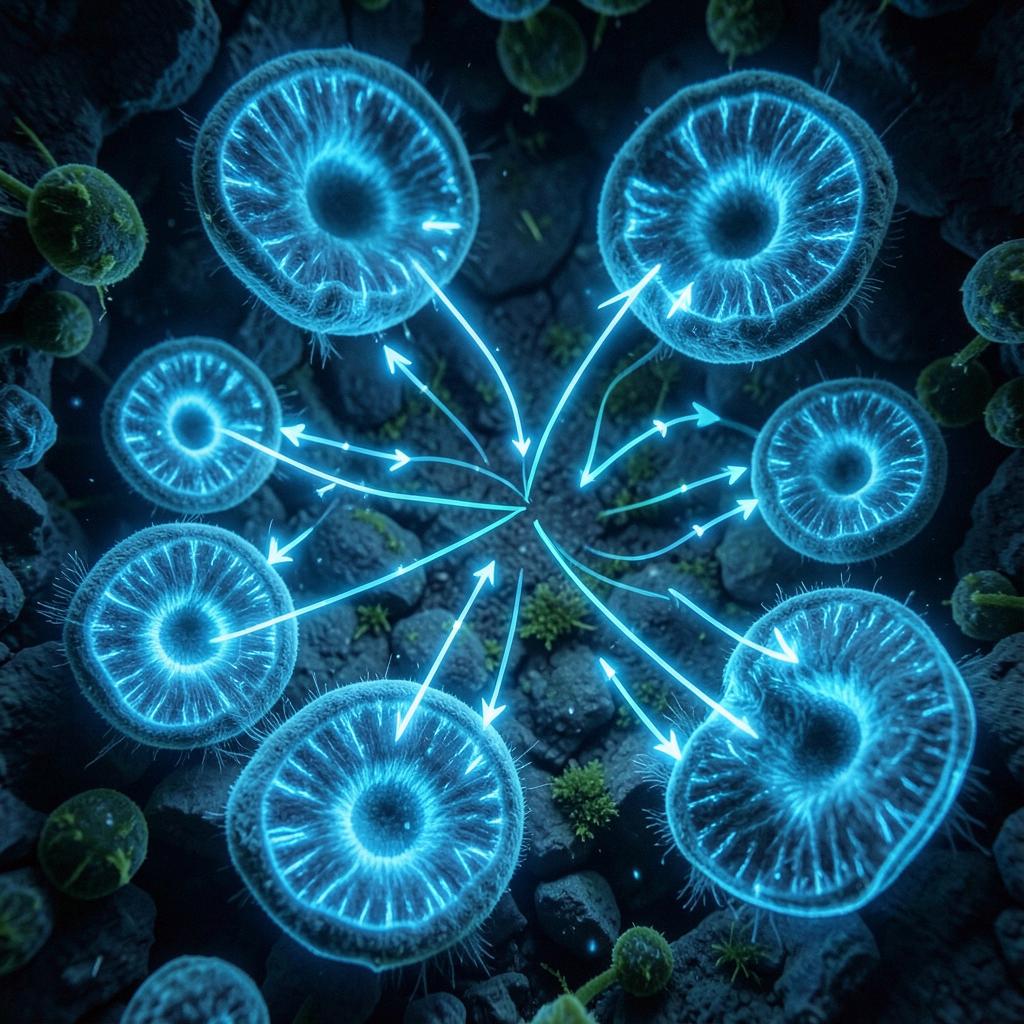
 Discussion