Check a paper's claims against linked experiments, exact results, stated scope, and limitations.Know what falsifiable science actually supports before you trust the answer.
Press Enter ↵ to search evidence
Explore by Goal
"Imagination is more important than knowledge. Knowledge is limited. Imagination encircles the world."
- Albert Einstein
Long Explanation
Copied
Overview of the Review
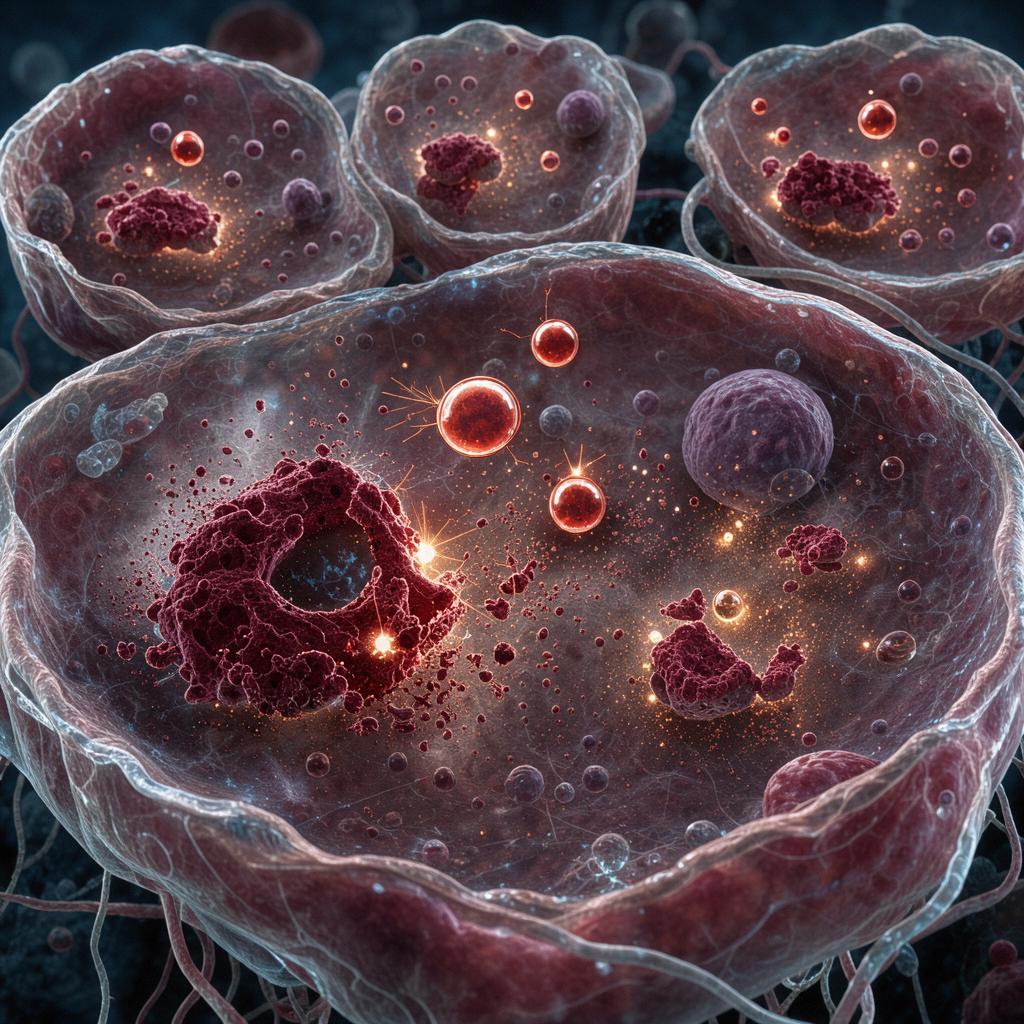
This narrative review (Wei, Xiong & Min; European Journal of Medical Research, received 17 Feb 2025, accepted 23 Jun 2025) synthesizes how reactive oxygen species (ROS) regulate seven forms of regulated cell death — apoptosis, ferroptosis, immunogenic cell death (ICD), pyroptosis, oxeiptosis, NETosis, and parthanatos — and how excessive ROS remodels biomolecular condensate dynamics (stress granules, P-bodies, G bodies, p62 bodies, Pbp1 condensates, lipid droplets, Urm1-mediated separation) as a therapeutic axis for cervical, ovarian, and endometrial cancer .
Strengths
Breadth and synthesis: 93 references spanning foundational (Dixon 2012 ferroptosis; Brangwynne 2009 phase separation) to 2024 work (Glorieux et al. Nat Rev Drug Discov; Urm1 condensates, Cell 2024), with clearly organized mechanisms per cell death modality and per condensate type .
Honest treatment of the ROS paradox: the authors explicitly discuss the double-edged role of ROS — promoting tumor development at moderate levels while killing tumor cells when excessive — and acknowledge tumor-vs-normal selectivity as a central unresolved challenge .
Novel linkage: connecting redox biology with phase separation in a gynecological-cancer context is a relatively fresh framing, supported by examples (TIA1 Cys36 oxidation suppressing stress granules; STAU1 transfer of oxidized RNA to P-bodies; p62/Keap1/Nrf2 condensates) .
Critical Weaknesses and Blind Spots
No primary data, no systematic method: the authors state no datasets were generated or analyzed; there is no search strategy, PRISMA flow, or risk-of-bias appraisal — classic narrative-review limitations that the authors themselves partially acknowledge (publication bias, heterogeneous ROS measurement, selective reporting) .
Gynecological-specific evidence is thin: much mechanistic content (Pbp1 methionine oxidation, Urm1 condensates, G bodies) derives from yeast, glioma, astrocyte, or plant models; the review's own text concedes that phase separation insights for gynecological cancer are largely inferred analogies, not demonstrated pathways .
Citation formatting errors: reference [11] (EGCG in endometrial cancer) shows corrupted journal metadata (listed under European Journal of Medical Research 2013/2025 with a misplaced note), and reference [63] is a near-empty entry — minor but indicative of editorial care lapses in a review whose entire value rests on citation accuracy.
Some claims are stated more firmly than the underlying evidence supports: e.g., hydrogen therapy for endometrial cancer and tanshinone IIA pyroptosis in HeLa are single preclinical studies presented within a therapeutic-optimism frame; no dose-response data, no effect sizes, and no clinical trial evidence are given for any ROS-based modality in gynecological cancer specifically.
Missing quantitative synthesis: with only one bar-chart-like presentation of mechanism counts, the review never quantifies key parameters (ROS thresholds, GSH/GPX4 levels, IC50 values) across the cited studies — a missed opportunity for a rigorous integrative treatment.
What Would Change the Verdict
The central hypothesis — that selectively pushing ROS past a lethal threshold while modulating condensates can improve gynecological cancer outcomes — would be falsified if ROS manipulation fails to alter gynecological tumor viability in appropriate models, if disrupting ROS-driven phase separation does not change ROS cytotoxicity, or if ROS-based strategies show no benefit in orthotopic/immunocompetent models. Currently, none of these tests exist for the phase separation arm at all, so that axis remains a conjecture, not a conclusion .
Feedback:
Updated: November 23, 2026
BGPT Paper Review
Study Novelty
70%
Linking ROS redox biology with biomolecular phase separation specifically in gynecological malignancies is a relatively fresh integrative framing; the underlying components (ROS death pathways, LLPS) are well established, so the novelty lies in synthesis and application rather than new discovery.
Scientific Quality
70%
Broad, well-organized 93-reference synthesis with honest treatment of the ROS paradox and stated limitations. Lowered for missing systematic methodology, corrupted citations ([11], [63]), absence of quantitative synthesis, and therapeutic claims resting on single preclinical studies.
Study Generality
70%
Mechanistic content (ferroptosis, ICD, pyroptosis, LLPS) generalizes across cancer biology, but much evidence is extrapolated from yeast, glioma, or other cancers; the gynecological-specific evidence base is thin.
Study Usefulness
70%
Provides a useful entry map for researchers exploring ROS-based therapeutics (PDT, SDT, CDT) and condensate-targeting drugs in gynecologic oncology, though no clinical-ready targets or protocols emerge.
Study Reproducibility
30%
As a narrative review with no datasets generated and no reported search strategy, reproducibility of the synthesis itself is low; the cited primary studies vary widely in reproducibility.
Explanatory Depth
80%
Mechanistic detail is substantial and specific (Keap1-PGAM5-AIFM1, GPX4/System Xc-, NLRP3-GSDMD, TIA1 Cys36 oxidation), offering a genuinely layered causal picture, though depth exceeds demonstrated gynecological-cancer evidence.
We'll email you the results when your analysis is finished.
Hypothesis Graveyard
'Antioxidant supplementation should improve gynecological cancer outcomes by suppressing ROS.' Weakened by the review's synthesis: moderate ROS support tumor growth while excessive ROS is cytotoxic, so global antioxidant reduction of ROS can be pro-tumoral rather than protective.
'All ROS-elevating nanotherapies (PDT/SDT/CDT) act mainly via apoptosis.' Weakened: the cited evidence shows SDT and PDT drive ICD and multiple death modalities, making single-pathway apoptosis models obsolete.

 Explore by Goal
 Long Explanation

 Top Data Sources
 Ask a Follow-Up
 Key Insight
 Keep Exploring
 Hypothesis Graveyard
 Potential Experiments
 Discussion
