Check your hypothesis against versioned claims, exact reported results, and stated falsification criteria.Know what falsifiable science actually supports before you trust the answer.
Press Enter ↵ to search evidence
Explore by Goal
"Just like a single cell, the character of our lives is determined not by our genes but by our responses to the environmental signals that propel life."
- Bruce H. Lipton
BGPT Odds of True
45%
80% Confidence
The hypothesis poses an unresolved either/or on one object. The twin reading is supported only by macroscopic author interpretation of a single artifact; the unfinished/abstract alternative is plausible but lacks published comparative evidence. Rough parity, slight tilt toward interpretive agnosticism.
Hypothesis Novelty
70%
Explicitly contrasting figurative twin-iconography with deliberate incompleteness/notched-plaquette formalism for a newly published Epi-palaeolithic Anatolian figurine is a fresh interpretive frame, though both interpretive modes are individually established in Palaeolithic art studies.
Quick Answer
Copied
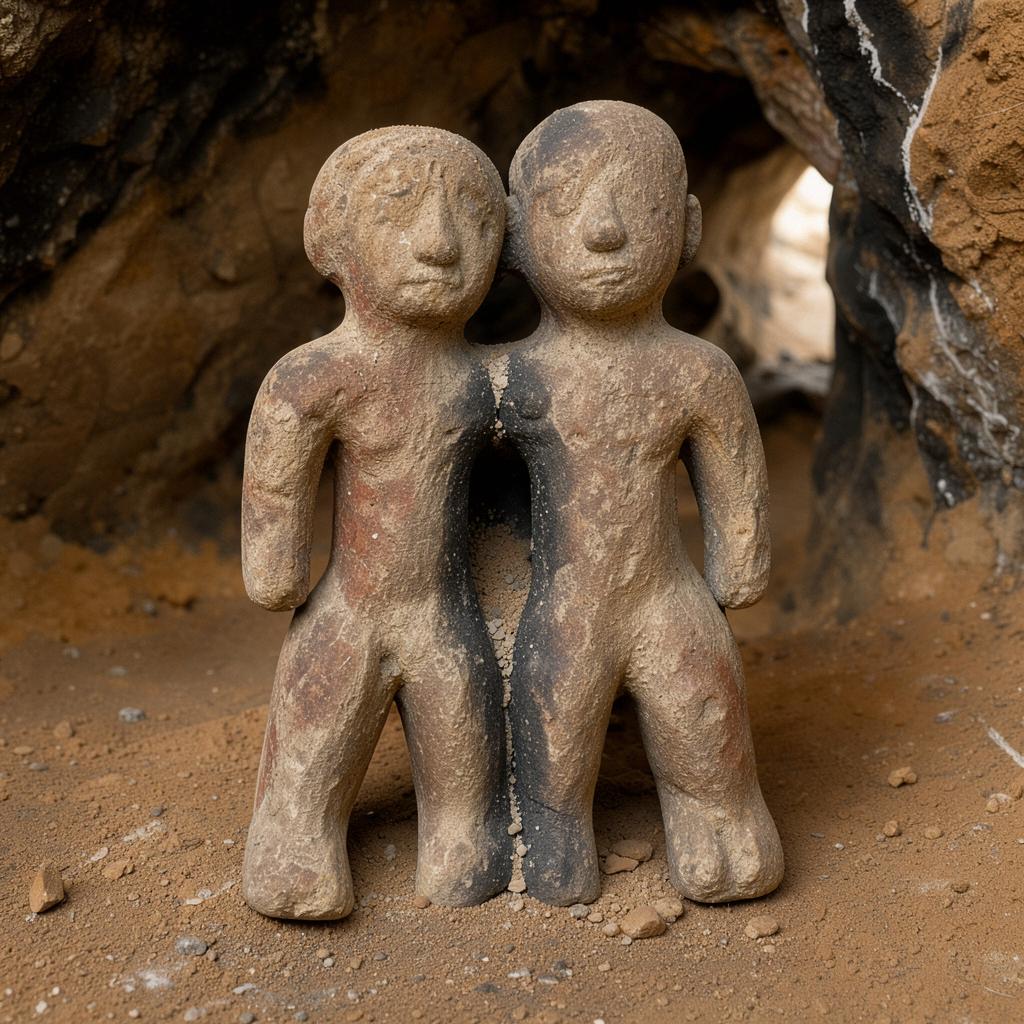
The conjoined-twin reading of Kızılin 2's deep groove rests solely on macroscopic interpretation of a 6.30×3.30×3.25 cm sandstone object whose groove is described as "boydan boya" (head-to-base division) . With no contextual deposits from the cave interior, no microscopic trace analysis, and no published notched-plaquette comparanda, both twin-representation and deliberately unfinished abstract form remain plausible; currently neither can be privileged.
Long Answer
Evidence Base and Its Limits
The entire published record for Kızılin 2 consists of a single primary report (N=2 figurines) describing the object as complete sandstone, 6.30 cm high, 3.30 cm wide, 3.25 cm thick, divided lengthwise by "a deep groove forming two different bodies" — the sole basis for the twin reading . The age (ca. 13,782 cal. BC for the JS-IIa context) comes indirectly from AMS dating of mollusc shells, since bone collagen was absent — a soft-water carbonate proxy with known reservoir-error risk .
Battle-Testing Both Interpretations
Twin hypothesis weaknesses: the interpretation is purely macroscopic; no traces (groove cross-section, tool micro-wear, pigment) have been published that distinguish deliberate anatomical modeling from natural sandstone bedding planes or a single worked groove. Sexing and identity of even Kızılin 1 are admitted to be analogical and uncertain .
Unfinished/abstract-form hypothesis: this alternative gains force from the report's own admission that the pieces show mixed European and Near Eastern traits and "cannot yet be connected to either region" — stylistic ambiguity cuts equally against a secure iconographic reading. However, the notched-Epi-palaeolithic-plaquette analogy is not documented in the supplied record: no published comparative measurements or notch typologies for Kızılin 2 exist, so this arm of the hypothesis is currently unsupported speculation rather than evidence-based inference.
What Would Decide It
Microscopic/microtopographic analysis of the groove (tool signature vs. natural fissure vs. pecked notch series).
Direct digital morphometry against measured corpora of Epi-palaeolithic notched plaquettes.
Excavation of the cave interior for associated symbolic assemblage context — currently a stated blindspot .
Verdict (low confidence, N=1 decisive artifact, weak-strength source): the twin reading is one interpretive hypothesis among several; the deliberately-unfinished/abstract reading is defensible but currently unevidenced beyond analogy. Falsification routes: discovery of polish/wear indicating functional notching would favor the abstract/plaquette view; detection of paired anatomical detailing (limbs, heads) flanking the groove would strengthen the twin reading.
We'll email you the results when your analysis is finished.
Hypothesis Graveyard
Twin depiction as settled fact: falsified as 'settled' because it derives solely from one report's macroscopic reading with no trace evidence, and the same report admits stylistic and sexual attributions are uncertain.
Natural fissure misread as carving: not yet eliminable — no published microscopic analysis rules out exploitation of a natural sandstone crack as the 'groove'.
Science Art
Science Movie
Make a narrated HD Science movie for this answer ($64 per minute)

 Explore by Goal

 Hypothesis Novelty
 Quick Answer
 Long Answer
 Top Data Sources
 Ask a Follow-Up
 Key Insight
 Keep Exploring
 Hypothesis Graveyard
 Discussion
