Check a paper's claims against linked experiments, exact results, stated scope, and limitations.Know what falsifiable science actually supports before you trust the answer.
Press Enter ↵ to search evidence
Explore by Goal
"The most incomprehensible thing about the world is that it is comprehensible."
- Albert Einstein
Quick Explanation
Copied
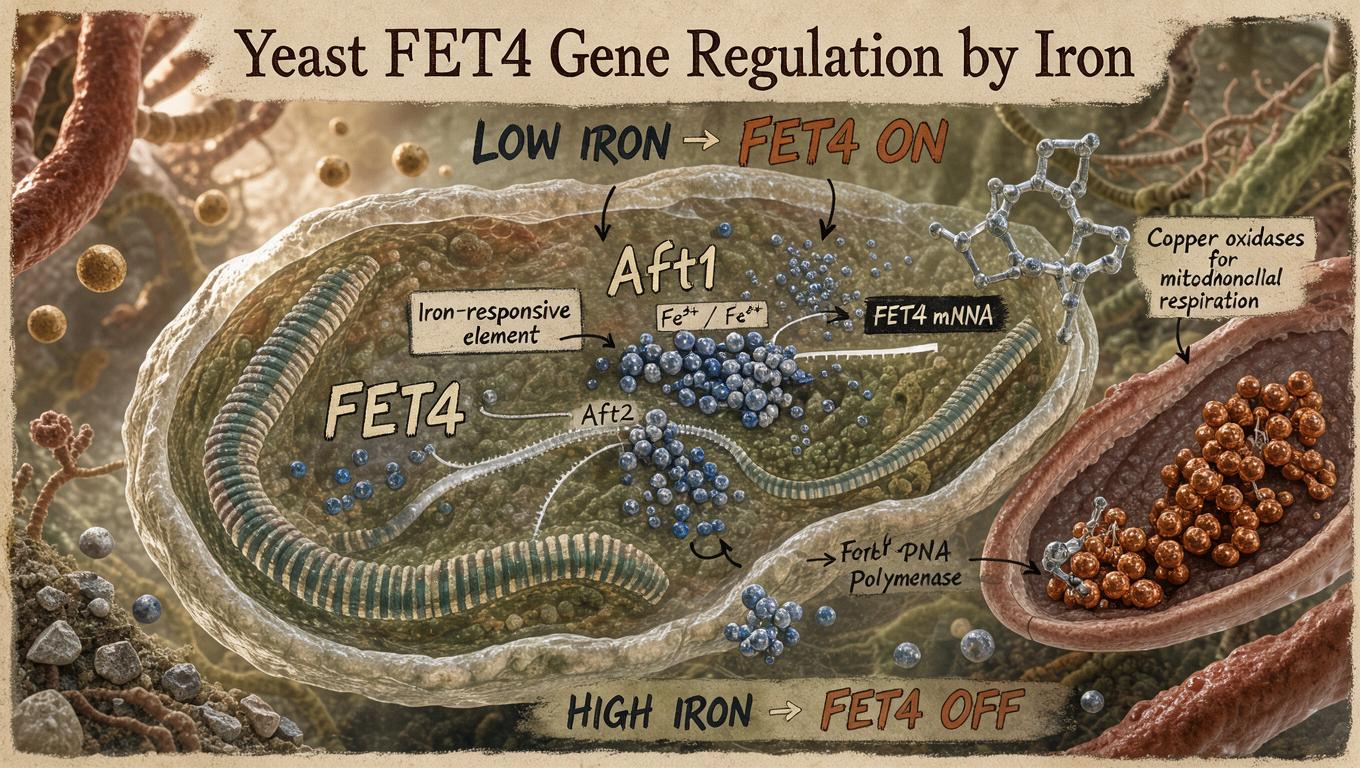
Waters & Eide (JBC, 2002) show that yeast FET4, a low-affinity metal transporter, is under combinatorial transcriptional control: Aft1 mediates iron induction (~2-fold), Zap1 zinc induction (~6-fold), and Rox1 represses expression in aerobic cells via heme/Hap1 signaling, with Fet4 itself confirmed as a physiologically relevant zinc transporter
Long Explanation
Core Findings and Evidence Quality
Waters and Eide dissect the regulation of the low-affinity iron/copper transporter gene FET4 in Saccharomyces cerevisiae using lacZ reporter fusions, transcription-factor deletion mutants, and site-directed promoter mutagenesis. Key quantitative results: FET4-lacZ is induced ~2-fold by iron limitation (enhanced by the chelator BPS) and ~6-fold by zinc limitation; iron responsiveness is abolished in an aft1Δ mutant, while most zinc-responsive expression is lost in a zap1Δ mutant; and aerobic expression increases ~10-fold in rox1Δ cells and anaerobically, implicating the heme-responsive Rox1 repressor .
The authors also demonstrate physiological relevance: FET4 overexpression suppresses the low-zinc growth defect of zrt1Δzrt2Δ cells, causes zinc sensitivity, and deleting FET4 in that background slows growth on low zinc; ZRE-lacZ is induced 2–3-fold in a fet4Δ mutant under moderate zinc, suggesting Fet4 feeds back on Zap1 activity .
Promoter Mapping
Mutation of Aft1 site 2 eliminates iron regulation; mutation of the Zap1-response element abolishes most (not all) zinc response, leaving a residual ~2-fold zinc induction the authors attribute to possible zinc effects on heme synthesis (ALA dehydratase is zinc-dependent); Rox1 sites 2 and 3 mediate most repression .
Critical Caveats
No direct ChIP/EMSA evidence that Aft1, Zap1, or Rox1 bind the FET4 promoter; the authors explicitly acknowledge inference from consensus-site mutagenesis and mutant phenotypes .
Reporter (lacZ) assays measure promoter activity, not endogenous mRNA or protein; only representative single experiments with n=3 technical replicates are shown.
Zinc-transport claims rely on growth phenotypes in high-affinity transporter mutants, which the paper acknowledges may have indirect effects (e.g., altered iron status).
Independent confirmation came concurrently from Jensen and Culotta (ref. 41), strengthening the Aft1/Rox1 conclusions.
Conclusion: The paper provides robust genetic and reporter-based evidence that FET4 integrates iron, zinc, and oxygen signals through Aft1, Zap1, and Rox1, and is well supported by concurrent independent work; its main gap is the absence of direct transcription-factor binding data. Confidence: moderate-high for regulatory assignments, moderate for Fet4 as a quantitatively important zinc transporter.
Feedback:
Updated: November 25, 2026
BGPT Paper Review
Study Novelty
70%
First molecular dissection of three-signal combinatorial control on a single yeast metal transporter promoter; concurrent work by Jensen & Culotta reduces novelty slightly.
Scientific Quality
80%
Rigorous controls (metal-specific reporters, isogenic mutants, site-directed mutagenesis); weaknesses: no direct TF binding evidence, representative single experiments, lacZ-only readouts.
Study Generality
60%
Mechanism is yeast-specific, but the principle of oxygen-gated repression of nonspecific metal transporters to avoid toxicity is broadly relevant to metal homeostasis.
Study Usefulness
70%
Rationalizes why nonspecific transporters are repressed aerobically and defines promoter logic useful for studying metal-regulated gene networks.
Study Reproducibility
70%
Standard yeast genetics with detailed media recipes and strain table; reproducibility limited by lack of raw data and representative single experiments shown.
Explanatory Depth
70%
Mechanistic chain from heme→Hap1→Rox1→Tup1/Ssn6 repression is well built, but direct binding and the residual zinc-response mechanism remain speculative.
We'll email you the results when your analysis is finished.
Hypothesis Graveyard
Fet4 as merely a low-affinity iron transporter: falsified by demonstration of physiologically relevant zinc (and previously copper) uptake and Zap1 regulation.
'General divalent metal uptake system' hypothesis of the 1980s: revived rather than dead—Fet4 partially validates it, but specificity still resides in the high-affinity transporters.

 Explore by Goal
 Quick Explanation
 Long Explanation
 Top Data Sources
 Ask a Follow-Up
 Key Insight
 Keep Exploring
 Hypothesis Graveyard
 Potential Experiments
 Discussion
