Check a paper's claims against linked experiments, exact results, stated scope, and limitations.Know what falsifiable science actually supports before you trust the answer.
Press Enter ↵ to search evidence
Explore by Goal
"The aim of science is not to open the door to infinite wisdom, but to set a limit to infinite error."
- Bertolt Brecht
Quick Answer
Copied
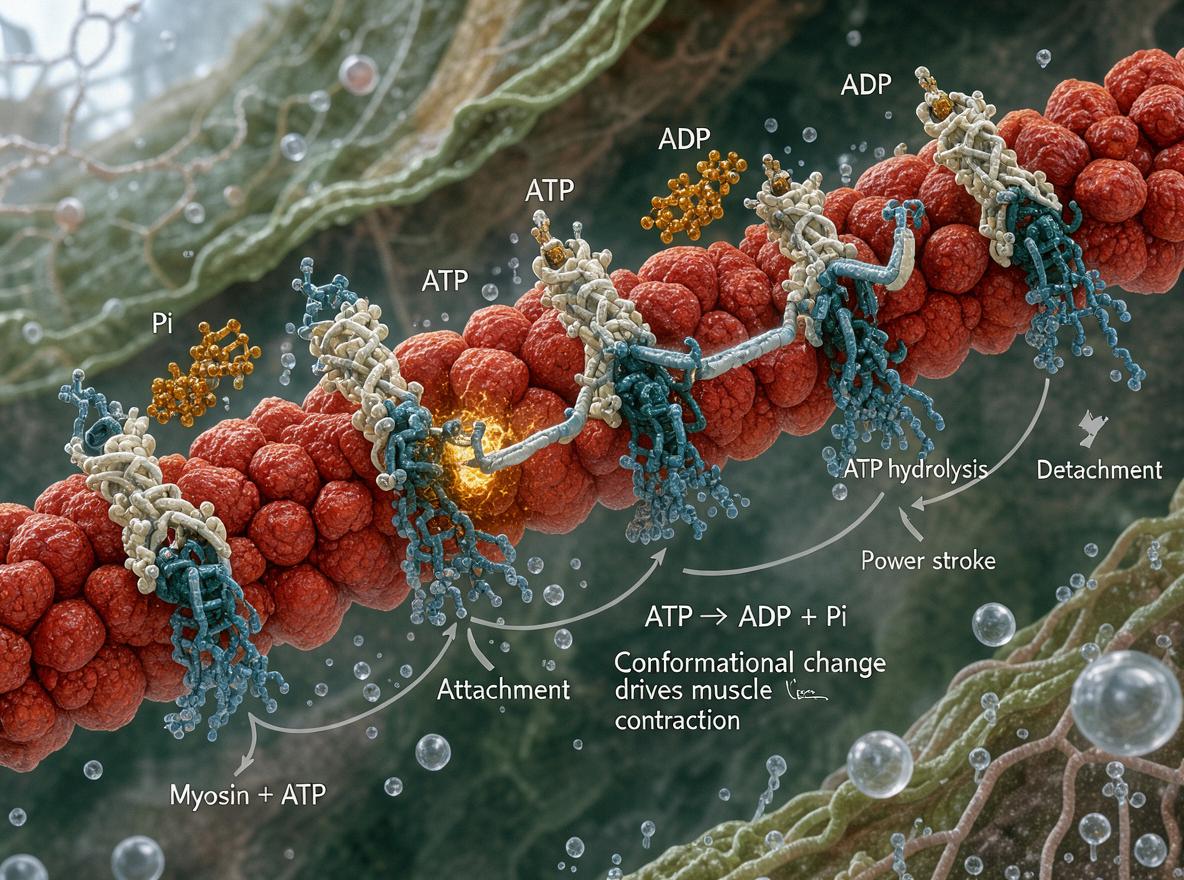
Yang, Yu, and Cui (JMB 2008) use QM/MM simulations to argue that myosin ATP hydrolysis is gated not just by Switch II closure but by remote rearrangements (relay helix N-terminus, wedge loop) stabilizing the Arg238-Glu459 salt bridge and a bridging water; the evidence is strong internally but rests on a single modeled closed post-rigor state and a semiempirical QM method, awaiting mutational validation .
Long Answer
Core Claim and Evidence
This QM/MM study (Dictyostelium myosin II; PDB 1FMW post-rigor, 1VOM pre-powerstroke) tests whether Switch II closure alone suffices to activate ATP hydrolysis. The pre-powerstroke state yields a PMF barrier of ~16 kcal/mol for the rate-limiting first step, matching the experimental 15–17 kcal/mol, whereas MEP barriers in an in-silico-closed post-rigor state fluctuate from 32.0–53.0 kcal/mol (SD 4.4) despite a similarly closed active site .
Mechanistic detail: the discrepancy is attributed to second-sphere effects: a stable Arg238-Glu459 (SwI–SwII) salt bridge and Wat2 electrostatically stabilize the transition state. In the closed post-rigor state, Glu459 rotates out of the salt-bridge plane because the N-terminal relay helix (Gln468, Asn472) and wedge loop (Tyr573, Phe458 rotamers) fail to provide hydrogen-bonding support; Wat2 then contributes unfavorably (~6 kcal/mol) to the barrier. Notably, the nucleophilic attack angle penalty is only 2–3 kcal/mol, overturning the emphasis on lytic-water in-line alignment .
Critical Assessment
Strengths: the two-conformation design (similar active sites, different remote structure) is an elegant causal test; the authors transparently report that MEP barriers in pre-powerstroke (31.3 kcal/mol avg) exceed the PMF result due to Ser181/Wat3 isomerization, and they benchmark SCC-DFTBPR against QCRNA and MP2 reference data. They also propose falsifiable predictions: Gln468/Asn472/Tyr573-to-alanine mutants should impair both motility and ATPase, unlike converter-side decoupling mutants. A 2016 review confirms the broader debate: later QM/MM work favors a dissociative mechanism with low barriers (8.7–10.3 kcal/mol) based on ADP-vanadate structures, illustrating that the associative/Ser236-relay pathway analyzed here remains contested .
Weaknesses: the closed post-rigor state is generated in silico (umbrella-sampling snapshot), not a crystallographic or kinetically characterized intermediate; only the associative Ser236-relay pathway is modeled even though S236A mutants retain near-wild-type ATPase; relative-benefit framing assumes systematic QM errors cancel between conformations, which is plausible but unproven; trajectory lengths (2–12 ns) may not sample slower motifs fully. The authors acknowledge all of these explicitly, which is a positive signal. Confidence in the qualitative conclusion (remote motifs gate hydrolysis) is moderate-to-high; confidence in exact barrier magnitudes is lower given the ~3–5 kcal/mol semiempirical RMSE.
Follow-up
Feedback:
Updated: November 21, 2026
BGPT Paper Review
Study Novelty
70%
First demonstration that remote relay-helix/wedge-loop structure, not just Switch II closure, gates myosin ATP hydrolysis—building directly on the group's own 2007 studies but adding a novel two-conformation causal comparison.
Scientific Quality
80%
Rigorous benchmarking (SCC-DFTBPR vs MP2/QCRNA), PMF validation against experiment, transparent reporting of MEP-PMF discrepancies and the S236A mechanistic caveat; weaknesses are the in-silico closed state and single semiempirical QM level.
Study Generality
70%
Insights on second-sphere electrostatics and slow-motion gating of catalysis extend conceptually to kinesin, G-proteins, and F1-ATPase, though quantitative details are myosin-II-specific.
Study Usefulness
80%
Provides concrete, testable mutational targets (Gln468, Asn472, Tyr573) and a mechanistic framework distinguishing ON/OFF-coupled from decoupling mutants, valuable for motor design and drug-target reasoning.
Study Reproducibility
60%
Methods (CHARMM, GSBP, SCC-DFTBPR parameters, PMF windows) are described in detail and supplementary data exist, but the custom SCC-DFTBPR parameters and modeled closed state require expert reimplementation; no code deposit.
Explanatory Depth
90%
Deep mechanistic chain from lytic water to salt bridge to relay helix to converter rotation, quantified by perturbation analysis of individual residue contributions (~3 to ~6 kcal/mol effects).
We'll email you the results when your analysis is finished.
Hypothesis Graveyard
Switch II closure alone turns on ATPase: falsified here by high closed post-rigor barriers despite closed geometry.
Lytic-water in-line alignment is the dominant catalytic gate: downgraded, since the angular penalty is only 2-3 kcal/mol versus larger second-sphere electrostatic effects.

 Explore by Goal
 Quick Answer
 Long Answer
 Top Data Sources
 Ask a Follow-Up
 Key Insight
 Keep Exploring
 Hypothesis Graveyard
 Potential Experiments
 Discussion
