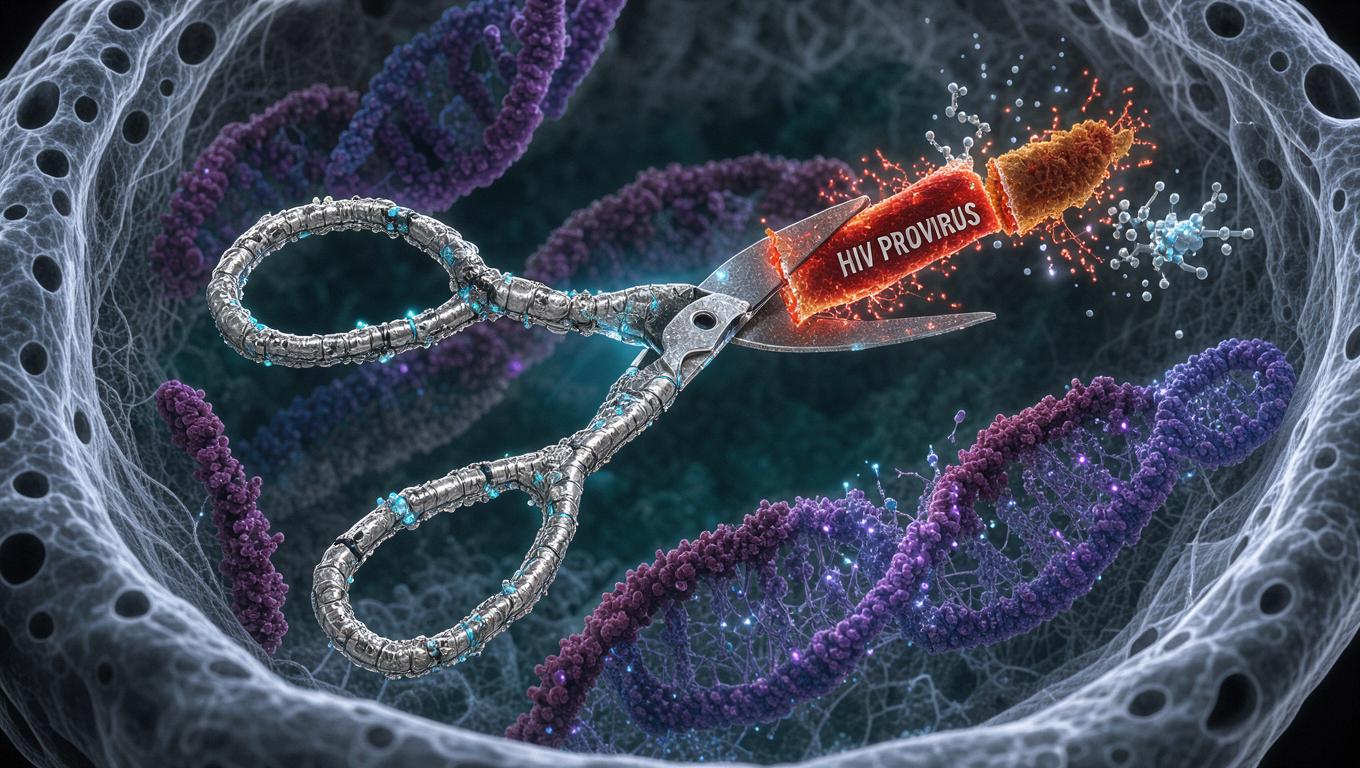
The paper is a narrative reviewβno new experimentsβcovering four editing modalities. It anchors the functional-cure rationale in the Berlin and London patients, both cured via CCR5 Ξ32 homozygous donor HSCT, and argues this is impractical to replicate, motivating ex vivo gene editing (). Key quantitative claims the review reports: ZFN disruption of CCR5 in human HSCs at ~17% allele frequency with engraftment retention; ~50% CCR5 allele disruption in primary CD4+ T cells; TALEN CCR5 knockout >90% in PM1 cells and >50% in primary T cells; and the Tebas phase I trial (12 patients) where CCR5-modified cells declined at -1.81 cells/day during treatment interruption versus -7.25 cells/day for unmodified cells ().
Strength: The review correctly highlights the central mechanistic threat to CRISPR-based cureβNHEJ repair generating indels that produce replication-competent Cas9-resistant HIV-1 escape variants, which could accelerate viral escape (). An independent comparative analysis corroborates that both RNAi and CRISPR-Cas face viral escape when targeting non-conserved sequences, so the review's caution is evidence-aligned ().
Blind spots: The review does not quantify how incomplete reservoir excision must be to still permit rebound, nor does it mention the germline-editing shadow cast by the CCR5-edited embryo births, which independently demonstrated mosaicism and off-target concerns in humans (). It also frames CCR5 as the dominant target while natural HIV controllers with wild-type CCR5 control infection via immune mechanisms, implying editing host factors alone may be insufficient ().
Post-2021 work the review could not include: multiplexed HSPC engineering combining CCR5 knockout with B-cell secretion of HIV-inhibiting antibodies, showing layered resistance in NSG mouse models () and broader syntheses concluding a universal cure remains elusive with CRISPR still lacking robust clinical data ().
Confidence note: Verdict rests on the review's own reported values plus supplied independent records; the review's citation tables were partially garbled in extraction (Table 3 rows misaligned), limiting full verification of its enumerated studies. The falsifier for the field remains unchanged: durable suppression off ART without unacceptable off-target toxicity in randomized human cohorts.
Feedback:
Updated: October 27, 2026
Know what changed, what holds up, and what remains uncertain. Every Friday. No ads.