Check a paper's claims against linked experiments, exact results, stated scope, and limitations.Know what falsifiable science actually supports before you trust the answer.
Press Enter ↵ to search evidence
Explore by Goal
"Mood reflects the biology of the brain. How you feel is affected by the chemicals in the brain, and these are the same chemicals that form the basis of mood-altering drugs."
- Liz Miller
Long Explanation
Copied
Compston's Sex Steroids and Bone: A Landmark 2001 Review
Published in Physiological Reviews, this Wellcome Trust–funded review by Juliet E. Compston (University of Cambridge) synthesizes ~395 references spanning bone cell biology, lifetime bone-mass trajectories, estrogen/progesterone/androgen mechanisms, and SERMs into a single authoritative narrative .
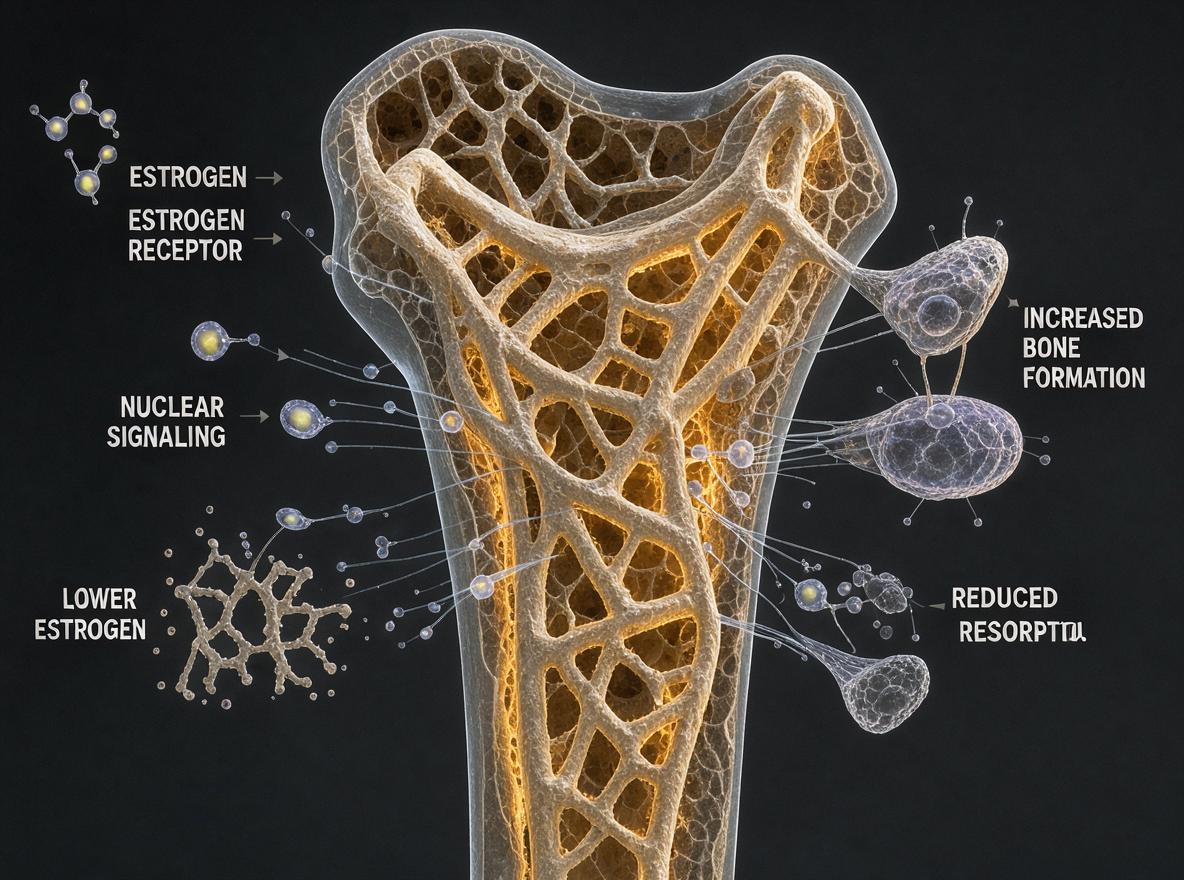
The review's mechanistic core: estrogen deficiency raises activation frequency of bone remodeling units and produces remodeling imbalance, largely via cytokine-mediated effects — estrogen suppresses IL-1, IL-6, and TNF-α, increases osteoprotegerin (OPG), and promotes osteoclast apoptosis via TGF-β. Histomorphometric evidence from GnRH-analog–induced estrogen withdrawal in premenopausal women showed rapid trabecular disruption within 6 months, supporting a transient increase in osteoclastic resorption depth, not just elevated turnover .
Schematic reconstruction of the review's Fig. 6 concept — the qualitative pattern (peak in third decade, menopause acceleration in women, lifelong loss in both sexes) — not observed patient data.
Three Insights That Aged Well — and Two That Did Not
Estrogen is essential in the male skeleton. Evidence from ER-resistance and aromatase-deficiency cases remains foundational — later clinical cohort data confirm low testosterone independently predicts mortality in men across CKD stages (adjusted HR 0.93 per nmol/L, 95% CI 0.88–0.99), underscoring androgen–bone–survival linkages the review could only infer .
High-dose estrogen has anabolic skeletal effects. Compston's estradiol-implant histomorphometry showed increased wall width (increased cellular bone formation) — later human RNA-seq work confirms estrogen therapy restores a subset of age-altered skeletal genes (678 genes altered by aging; 21 by estrogen) .
SERMs tissue specificity via ERα/ERβ and AF-1/AF-2 domains — mechanistically correct, and ERα genotype (PvuII) demonstrably modulates osteoblast responses to estradiol and testosterone in vitro .
The 'ideal estrogen' framing aged poorly: the review's optimism about HRT benefits predated WHI findings on cardiovascular and cancer risks, though it did flag observational-study healthy-user bias.
ER knockout discrepancies (ERKO/BERKO mild phenotypes vs. human ER-resistance severity) were honestly acknowledged as unresolved — a caveat the author correctly identified.
Critical Assessment
Limitations: reliance on cross-sectional histomorphometry with small samples and large measurement variance (the author self-cites this); ovariectomized-rat models imperfectly translate; progesterone/bone evidence was genuinely conflicting (norethisterone preserved, norgestrel lost metacarpal BMD). Missing: no RCT-level fracture data for estrogen itself — the review openly states evidence for hip/vertebral fracture protection was 'almost exclusively from observational studies.' This is the review's key epistemic vulnerability, correctly framed at the time but later resolved against unopposed HRT for chronic disease prevention.
Confidence & Falsifiability
Confidence in the mechanistic synthesis: high (strong, convergent animal + human cellular + clinical-genetic evidence). What would change this conclusion: demonstration that RANKL/OPG signaling is dispensable for estrogen's antiresorptive effect in humans, or that cytokine-mediated pathways do not explain postmenopausal bone loss — the 2001 review predates definitive RANKL-pathway pharmacology but correctly anticipated its centrality.
Feedback:
Updated: November 20, 2026
BGPT Paper Review
Study Novelty
70%
For 2001, the synthesis was authoritative but not paradigm-shifting; the novelty lies in integrating cytokine biology, ER subtype structure, and clinical-genetic estrogen-dependence evidence in men.
Scientific Quality
80%
High-quality Wellcome Trust–funded review in a top journal; honest about observational-study bias and knockout-model discrepancies; limited by absent RCT fracture data for estrogen and a pro-HRT framing later tempered by WHI.
Study Generality
90%
Covers fundamental bone biology applicable across endocrinology, rheumatology, and geriatrics; mechanisms (RANKL/OPG, cytokines) remain central to the field.
Study Usefulness
80%
Excellent pedagogical and mechanistic reference; practical value diminished over time as SERM and antiresorptive landscapes evolved, but the physiology core remains intact.
Study Reproducibility
50%
As a review, not directly reproducible; cited primary evidence is verifiable but the paper reports no original data or methods.
Explanatory Depth
80%
Deep mechanistic coverage of remodeling, cytokine networks, receptor domain structure, and local steroid metabolism; acknowledges unmechanized areas (SERM tissue specificity) honestly.
We'll email you the results when your analysis is finished.
Hypothesis Graveyard
Unopposed estrogen is beneficial for lifelong postmenopausal disease prevention (WHI falsified the broad-claim version; skeletal benefit persists but is outweighed for chronic use).

 Explore by Goal
 Long Explanation

 Top Data Sources
 Ask a Follow-Up
 Key Insight
 Keep Exploring
 Hypothesis Graveyard
 Potential Experiments
 Discussion
