Ask questions across claims linked to experiments, exact results, limitations, and sources.Know what the science actually supports before you trust the answer.
Press Enter ↵ to search evidence
Explore by Goal
"Science is not only a disciple of reason but, also, one of romance and passion."
- Stephen Hawking
Quick Explanation
Copied
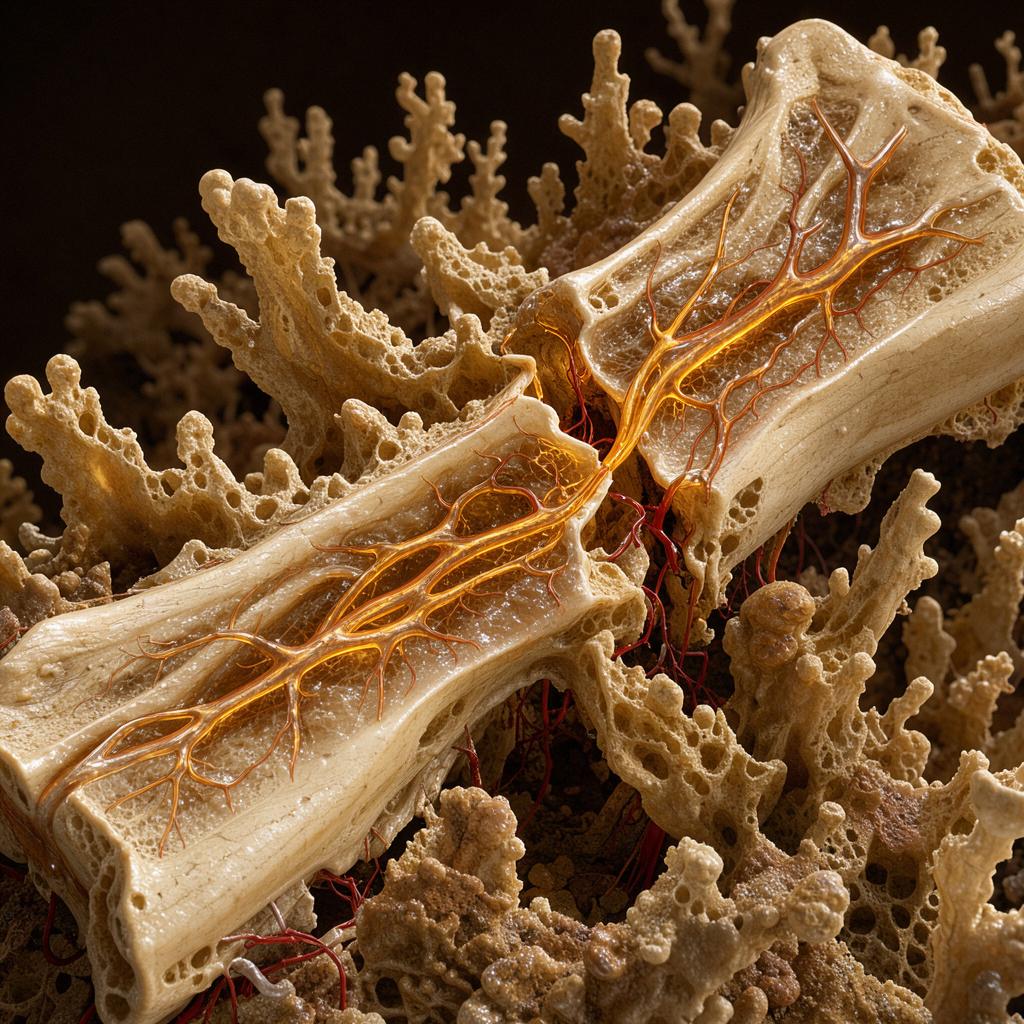
Bone healing proceeds through inflammation, soft then hard callus formation, and remodeling, and succeeds only when four elements—the 'Diamond Concept' of scaffold, osteoinductive factors, osteogenic cells, and mechanical stability—converge . Angiogenesis is essential, though its benefit can be negated by early mechanical loading .
Long Explanation
How bone heals: a staged, vascular-driven process
Fracture repair is not simple wound closure. It is a coordinated biological sequence in which inflammation, angiogenesis, cartilage (soft callus) formation, new bone deposition, and remodeling must all occur . In some contexts—like skull injuries in Xenopus tropicalis—regeneration proceeds via direct intramembranous ossification: a vascularized mesenchymal plug forms over a 500 µm lesion and new bone matrix closes it within 15 days .
The prevailing framework, the Diamond Concept, holds that healing requires the convergence of four pillars: an osteoconductive scaffold, osteoinductive growth factors, osteogenic cells, and mechanical stability .
Angiogenesis: necessary but load-sensitive
New blood vessels are a prerequisite for callus maturation. Delivery of the pro-angiogenic protein CYR61 in a mouse femoral fracture model significantly enhanced neovascularization—but did not directly promote chondrogenesis or osteogenesis, and critically, early mechanical loading negated its angiogenic effects (32 C57BL/6J female mice) . This illustrates a key tension: mechanical stimulation is part of the Diamond Concept, yet timing and magnitude matter—a blind spot the authors themselves flag regarding untested loading conditions.
Why engineered scaffolds often underperform
Scaffold-based regeneration remains challenging in practice. Micro-computed tomography of polymer scaffolds implanted in orbital defects of ten pigs showed that bone ingrowth was limited and poorly connected to host bone . Porosity is a key design variable: compressed CO2 foaming can produce PCL:PLGA scaffolds with 68–75% porosity and ~100 µm macropores, but storage at 25°C/65% RH for 3 months caused densification—open porosity in St-DXMT scaffolds fell from 65.3% to 46.3%—and reduced dexamethasone burst-release rate (k1: 15.1 → 11.6 day⁻¹) . BGPT inference: shelf stability of biomaterials is an under-reported variable that could confound preclinical-to-clinical translation, since scaffold geometry changes before implantation may alter ingrowth outcomes.
Materials that actively drive healing
Bioactive glasses offer an alternative scaffold paradigm: their silicate network connectivity (~2.4 marks a percolation threshold) governs dissolution, surface apatite formation, and therapeutic ion release—structure, not just composition, dictates bioactivity .
Quantitative example: dimensional healing in alveolar ridge preservation
Tooth-extraction sockets provide a measurable human model of bone healing. In a prospective pilot study of 11 molars in 9 patients with open-healing collagen membranes, horizontal ridge width loss at the crest declined from a mean of −1.7 ± 0.5 mm at 1 month to −1.0 ± 0.5 mm at 3 months and −0.5 ± 0.2 mm at 5 months; single- and double-layer membrane coverage showed no significant difference .
What would change these conclusions
Falsification: Randomized trials showing cell/growth-factor therapies offer no benefit over standard autografts would undermine the therapeutic optimism in reviews .
Species limits: Xenopus, mouse, pig, and human healing differ substantially; the 15-day amphibian closure should not be extrapolated to humans.
Small samples: The alveolar pilot (n=9 patients) and pig scaffold study (n=10) are underpowered for generalizable claims.
We'll email you the results when your analysis is finished.
Hypothesis Graveyard
'Scaffold porosity alone determines bone ingrowth' — the pig micro-CT study showed limited ingrowth and poor host-bone connection despite designed porosity, so vascular integration and mechanical coupling matter at least as much.
'More angiogenic delivery = faster healing' — CYR61 enhanced neovascularization but not osteogenesis, and loading negated its effect; angiogenesis is necessary but not sufficient.

 Explore by Goal
 Quick Explanation
 Long Explanation
 Top Data Sources
 Ask a Follow-Up
 Key Insight
 Keep Exploring
 Hypothesis Graveyard
 Potential Experiments
 Discussion
