Ask questions across claims linked to experiments, exact results, limitations, and sources.Know what falsifiable science actually supports before you trust the answer.
Press Enter ↵ to search evidence
Explore by Goal
"The day science begins to study non-physical phenomena, it will make more progress in one decade than in all the previous centuries of its existence."
- Nikola Tesla
Quick Explanation
Copied
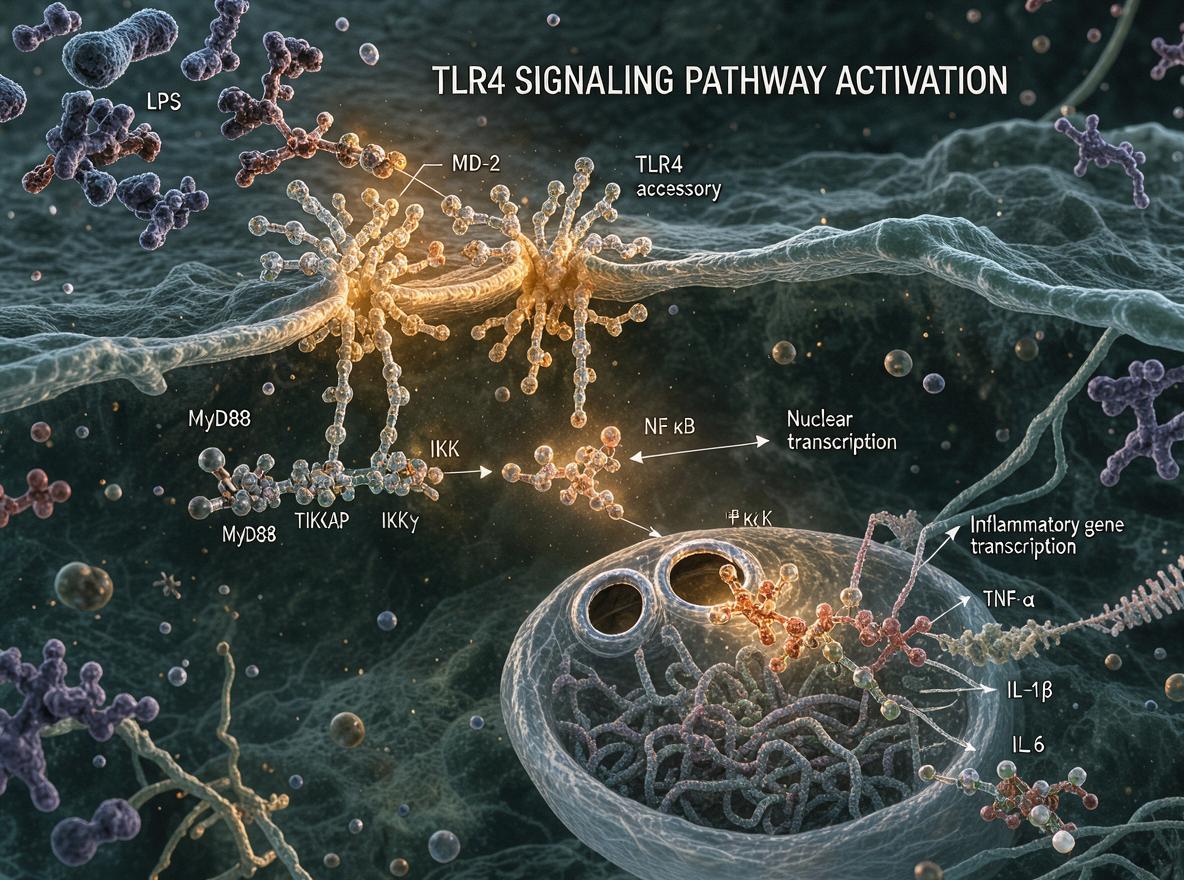
Seki et al. show that TLR4 signaling in quiescent hepatic stellate cells—not Kupffer cells—drives hepatic fibrosis by MyD88-NF-κB-dependent downregulation of the TGF-β pseudoreceptor Bambi, sensitizing HSCs to TGF-β and recruiting macrophages .
Long Explanation
Core Mechanistic Findings (Reported)
Seki et al. (Nature Medicine, 2007) tested whether TLR4 links gut-derived bacterial products to hepatic fibrogenesis. In C3H/HeJ (TLR4-mutant) vs C3H/HeOuJ (wild-type) mice, bile duct ligation (BDL) produced significantly less fibrosis in mutants (Sirius red, hydroxyproline, α-SMA), with reduced Col1a1, Acta2, Tgfb1 and Timp1 mRNA at 5 days, while serum ALT was unchanged—indicating reduced fibrosis without reduced injury (n=8/group at 21 d; n=5/group at 5 d) . Broad-spectrum antibiotics (ampicillin, neomycin, metronidazole, vancomycin for 4 weeks) suppressed plasma LPS and reduced fibrosis and macrophage infiltration, implicating the intestinal microflora .
The decisive experiment was bone-marrow chimerism: mice with Tlr4-mutant resident liver cells showed reduced fibrosis regardless of marrow genotype, while Tlr4-mutant marrow did not protect—placing the fibrogenic TLR4 target in radioresistant, non-bone-marrow-derived cells, i.e., hepatic stellate cells (HSCs) . Mechanistically, LPS downregulated Bambi (the TGF-β pseudoreceptor) ~70% via MyD88-NF-κB (IκB super-repressor blocked downregulation; Myd88−/− HSCs were resistant, Trif-deficient HSCs were not), sensitizing HSCs 2.5–3-fold to TGF-β-driven collagen reporter activity. Dominant-negative Bambi phenocopied LPS, while Bambi overexpression blunted activation. Myd88−/− mice showed reduced fibrosis at 3 weeks; Trif-deficient mice were normal at 5 days but showed modestly less fibrosis at 3 weeks, implying Bambi-independent, late Trif effects .
Critical Appraisal and Limitations
Strengths include convergent evidence across three fibrosis models (BDL, CCl4, TAA), chimeric mice, adenoviral gain/loss of Bambi, and reporter assays—all reported with ≥3 independent replicates. Weaknesses: (1) TLR4-mutant C3H/HeJ mice carry the Lps-d mutation on a restricted background; a second background was cited only as 'data not shown,' so strain-specific confounding is incompletely addressed. (2) LPS challenge used 0.1 mg/g IP and 100 ng/mL in vitro—supraphysiologic compared with portal levels, leaving in-vivo dose-response uncertain. (3) NF-κB inhibition, Kupffer depletion, and clodronate all systemically perturb inflammation, so downstream attribution relies on the chimera plus HSC-specific in vitro data. (4) No direct human validation is included; supporting human evidence comes only from a cited association of the TLR4 T399I SNP with slower fibrosis in chronic hepatitis C. (5) The authors appropriately note they cannot exclude endogenous TLR4 ligands (HMGB1, hyaluronan) at other timepoints, and an unindexed HMGB1 blocking-antibody result is 'unpublished'—a transparency gap. The statistical approach (unpaired t-tests only, no correction for multiple comparisons across many genes) is minimal by modern standards.
What Would Disprove the Model
Cell-type-specific HSC Tlr4 deletion failing to reduce fibrosis, normal fibrosis in germ-free mice after BDL, or Bambi-independent LPS sensitization of Smad signaling would each break the proposed TLR4→MyD88→NF-κB→Bambi↓→TGF-β sensitization chain. Conversely, the reported ~70% Bambi reduction and 2.5–3-fold sensitization are large, internally consistent effects; confidence in the mouse-level mechanism is high, confidence in human translation is moderate.
Feedback:
Updated: November 18, 2026
BGPT Paper Review
Study Novelty
80%
First demonstration that a TLR4-MyD88-NF-κB axis downregulates the TGF-β pseudoreceptor Bambi in quiescent HSCs, directly linking innate immune signaling to TGF-β sensitization; the chimera-based HSC localization was unexpected given Kupffer-cell dogma.
Scientific Quality
80%
Convergent genetic, chimeric, pharmacologic and adenoviral evidence across three fibrosis models. Weaknesses: restricted genetic background for the Lps-d mutation, supraphysiologic LPS doses, t-tests only, and reliance on unpublished data for the HMGB1 counterargument.
Study Generality
70%
The TLR4-Bambi-TGF-β logic is proposed to extend to lung, kidney and heart wound healing, but only hepatic data are presented; other TLR4-expressing fibroblast populations were not tested.
Study Usefulness
80%
Redirected the field from Kupffer-cell-centric to HSC-centric TLR4 fibrogenesis, informed microbiome-targeted and TLR4-antagonist antifibrotic strategies, and made Bambi a mechanistic node for HSC activation.
Study Reproducibility
70%
Detailed methods (mouse strains, antibiotic cocktail, BMT protocol, HSC isolation purity 99%) support replication; but some key results (second background, HMGB1 antibody) are 'data not shown' or unpublished.
Explanatory Depth
80%
Full signaling chain resolved from ligand source (gut LPS) through receptor, adaptors (MyD88 vs Trif), transcription factor (NF-κB), target gene (Bambi), and functional outcome (TGF-β sensitization), with pathway-specific temporal resolution.
We'll email you the results when your analysis is finished.
Hypothesis Graveyard
Kupffer cells are the primary profibrogenic LPS target: falsified by the chimera data showing mutant marrow does not protect and mutant residents suffice.
LPS acts mainly by increasing TGF-β activation (latent-to-active conversion): excluded because LPS sensitized HSCs equally to active and latent TGF-β.

 Explore by Goal
 Quick Explanation
 Long Explanation
 Top Data Sources
 Ask a Follow-Up
 Key Insight
 Keep Exploring
 Hypothesis Graveyard
 Potential Experiments
 Discussion
