Ask questions across claims linked to experiments, exact results, limitations, and sources.Know what falsifiable science actually supports before you trust the answer.
Press Enter ↵ to search evidence
Explore by Goal
"The most beautiful experience we can have is the mysterious."
- Albert Einstein
BGPT Odds of True
55%
80% Confidence
The hypothesis that contact timing modifies conversion probability is biologically plausible given CX3CR1-dependent microglial response kinetics, but no supplied record tests it directly; the estimate reflects plausibility, not demonstrated effect.
Hypothesis Novelty
70%
Most microglia-neuron interaction studies use static proximity; explicitly modeling temporal lead/lag of contacts relative to single-mitochondrion events is a comparatively new analytical framing.
Quick Analysis Plan
Copied
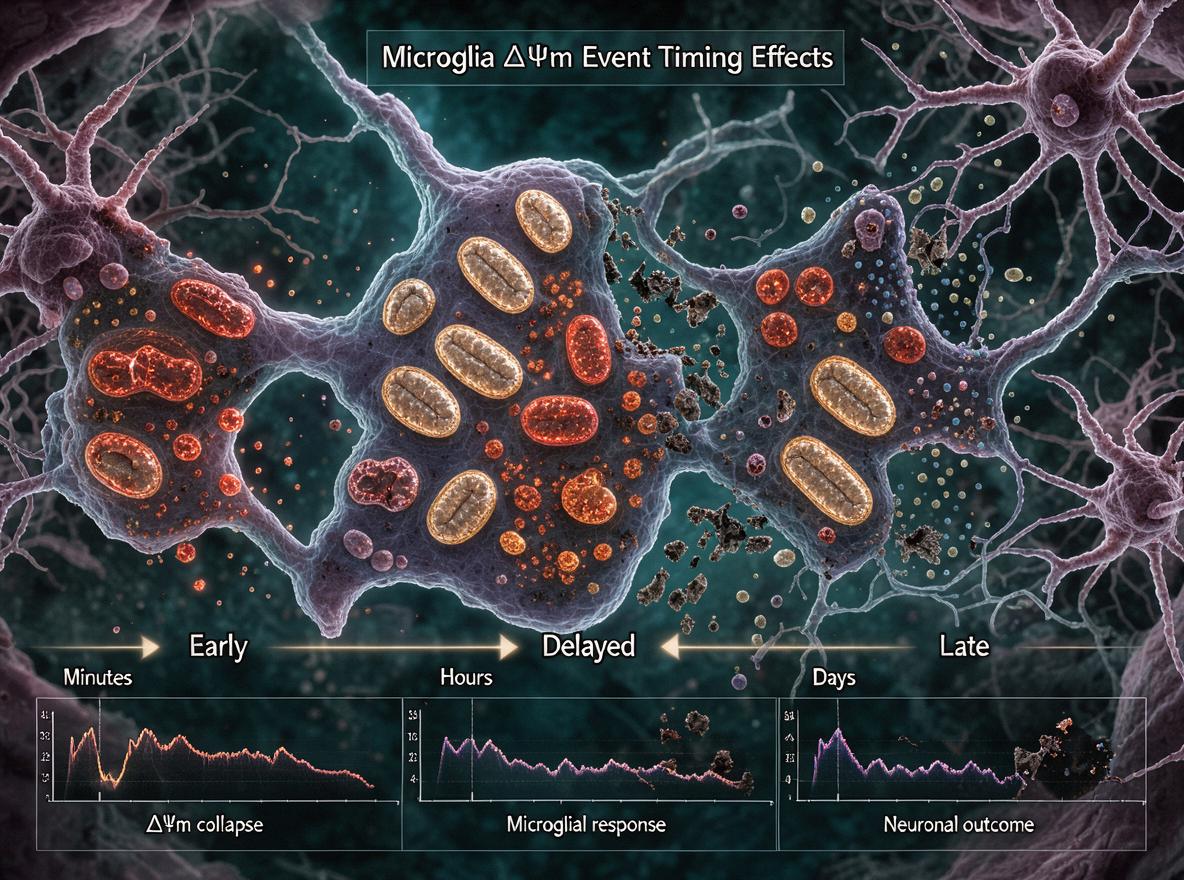
No supplied record directly tests whether microglia contact timing relative to a ΔΨm event changes mitophagy conversion, so this remains an open, testable modifier rather than an established effect. Available CX3CR1 evidence supports the premise that microglial response kinetics depend on CX3CR1 signaling — e.g., cochlear macrophage density rises 25–40% after noise in WT but not in CX3CR1-deficient mice — which motivates annotating contact timing explicitly rather than only static proximity.
Long Analysis Plan
Evidence status of the contact-timing hypothesis
The supplied claim-level records do not contain any experiment measuring microglia–neuron contact timing relative to a mitochondrial depolarization event, so the hypothesis is untested rather than supported or refuted. What the records do establish is context for design choices:
Microglial response is dynamic and CX3CR1-dependent. After noise trauma, cochlear macrophage density increased 25–40% in WT mice but showed no increase in CX3CR1 KO or hCX3CR1 I249/M280 mice, with altered morphology and proinflammatory cytokines in mutants . This implies contact-before vs contact-after distinctions may carry genotype-dependent signal.
Baseline priming matters. CX3CR1-deficient microglia show elevated basal NLRP3/ASC oligomerization even before a second insult — so contact-timing analyses should stratify by baseline microglial activation state.
CX3CL1–CX3CR1 signaling is anti-inflammatory in some tissues (Kupffer cells: IL-10/arginase-1 induction, AKT/ERK-dependent) , consistent with the hypothesis that the microglial state at contact time — not contact per se — could be the operative variable.
Automatic annotation of contact dynamics
A concrete pipeline: (1) segment CX3CR1-reporter microglia somata and skeletons and neuronal ROIs per frame; (2) define a contact event when the microglia mask intersects a fixed dilation shell (e.g., ≤2 µm) around the neuron or the specific mitochondrion ROI; (3) timestamp each contact onset/offset relative to each ΔΨm event, binning into pre-window (e.g., −60 to 0 min), peri-event (±10 min), and post-window (0 to +60 min, then daily); (4) extract features: contact lead-time, contact duration, number of contacts, process-vs-soma contact, and microglial morphology at contact; (5) feed these as time-varying covariates into the logistic mixed model (or preferably a discrete-time survival model, since conversion is time-to-event within 7 days). Validate the automated contact detector against manually annotated frames and report precision/recall; quantify tracking error across days and run sensitivity analyses excluding ambiguous events.
Key weaknesses to battle-test
Contact timing and proximity are confounded with baseline microglial density; include density and use spatial surrogate nulls to control spatial autocorrelation in the proximity predictor .
Morphological activation scoring is a proxy; the cochlear study shows CD68-up and morphology shifts track functional state, supporting multimodal scoring rather than morphology alone .
None of the supplied records establish a causal direction: microglia may contact neurons because the ΔΨm event occurred (sensing), not cause conversion. Distinguishing sensing from causation requires temporal lead/lag analysis and perturbation (e.g., contact blockade) experiments not present in the records.
Building an automated pipeline that segments microglia and neurons from time-lapse imaging, detects mask-intersection contact events, timestamps lead/lag timing relative to detected stress events, and fits a survival mixed model for conversion.
Get emailed when your analysis is done!
We'll email you the results when your analysis is finished.
Static proximity alone determines conversion probability — the dynamic CX3CR1-dependent macrophage response data (25–40% density shifts after insult in WT but not mutants) argue state and timing, not just distance, carry information.
Contact is purely causal — without lead/lag analysis, sensing-driven contact (microglia detecting stressed neurons) cannot be distinguished from contact causing conversion.

 Explore by Goal

 Hypothesis Novelty
 Quick Analysis Plan
 Long Analysis Plan
 Top Data Sources
 Ask a Follow-Up
 Key Insight
 Keep Exploring
 Analysis
 Potential Hypothesis
 Hypothesis Graveyard
 Potential Experiments
 Discussion
