Ask questions across claims linked to experiments, exact results, limitations, and sources.Know what the science actually supports before you trust the answer.
Press Enter ↵ to search evidence
Explore by Goal
"Imagination is more important than knowledge. Knowledge is limited. Imagination encircles the world."
- Albert Einstein
Quick Explanation
Copied
Jankauski's 2019 bioRxiv preprint provides the first direct vibration-test measurements of Hymenoptera thorax frequency response functions, finding measured fundamental frequencies (~313-558 Hz) exceed reported wingbeat frequencies by 50-150%, which the author attributes to stiffening boundary conditions from the experimental clamp setup.
Long Explanation
What the Paper Reports
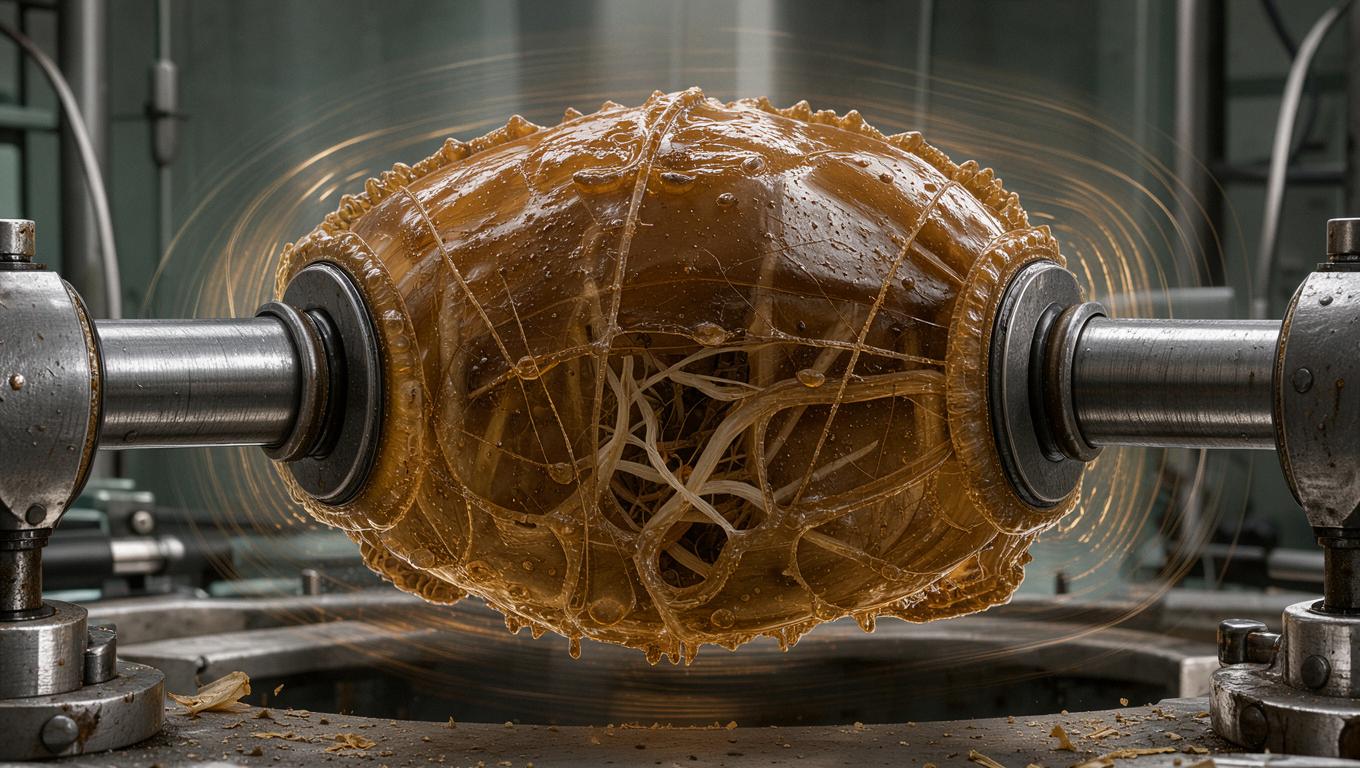
This single-author preprint from Montana State University measures, for the first time, the linear frequency response function (FRF) of excised thoraxes from three Hymenoptera species — Apis mellifera (honeybee, n=7), Polistes dominula (paper wasp, n=3), and Bombus huntii (bumblebee, n=3) — using an electrodynamic shaker with piezoelectric force/acceleration sensors, periodic chirp excitation (10-1000 Hz), and modal fitting (peak-picking or least-squares rational function) of the FRF .
Key quantitative findings: at minimal 50 µm compression, mean fundamental frequencies were 368 Hz (honeybee), 402 Hz (wasp), and 363 Hz (bumblebee), versus reported wingbeat frequencies of ~220-250 Hz (honeybee), ~140-160 Hz (wasp/yellowjacket proxy), and ~120-190 Hz (bumblebee). Fundamental frequency increased nearly monotonically with compression up to 300 µm (linear fit R² = 0.934-0.994), and static force-displacement testing of honeybee thoraxes (n=10) fit a linear-cubic hardening spring model (R² = 0.9992 vs 0.9802 linear), supporting a Duffing-oscillator characterization.
Interpretation: Circumstantial, Not Demonstrated
The central resonance hypothesis is not directly confirmed. The author's own explanation for the 50-150% mismatch is that clamping the thorax between push rods artificially stiffens it. A simplified finite-element hoop model suggests fixed-fixed constraints raise the first natural frequency ~64% (386 vs 236 Hz for a free-free idealization), but this is a crude analog, not the thorax itself . Thus, "insects flap at their thorax fundamental frequency" remains a plausible but untested inference; the paper only shows that constrained thoraxes resonate above wingbeat frequency.
Notably, follow-up work from a related group measured the wing hinge frequency response and found that honeybees (natural frequency 224.14 ± 30.33 Hz, damping ratio 0.15 ± 0.04, n=10) flap near a wing hinge resonance rather than a thorax resonance . This post-dates the reviewed paper and directly challenges its framing — the resonant element may be the hinge, not the thorax bulk. Theoretical work on distributed elasticity also shows resonance bands depend strongly on how elasticity is distributed between thorax and wing root .
Critical Limitations
Dead specimens, artificial loading: insects were euthanized with ethyl acetate, legs removed, glued to screws; muscle tone, hemolymph pressure, and live steering-muscle tension are absent, so measured stiffness may not reflect flight conditions.
Small, non-random samples: n=3 for two species; specimens were discarded when thoraxes rotated during testing (an undisclosed number), introducing selection/exclusion opacity.
No tensile loading and single-axis (dorsoventral) excitation only; thorax mechanics are 3D.
Wingbeat frequency comparisons come from literature for different (sometimes different) populations/species; the paper could not find wingbeat data for P. dominula and borrowed yellowjacket values.
Compression range (50-300 µm) may exceed natural deformation (~20-150 µm peak estimates from other species via single-point laser vibrometry, whose accuracy the author himself questions).
Single author, no peer review (bioRxiv preprint), no stated funding, no data/code deposition, no formal statistical testing of frequency-compression trends beyond R² of fits.
Confidence note: The FRF measurement methodology and hardening-spring observation appear methodologically sound and internally consistent (moderate confidence). The resonance-flapping conclusion remains an inference requiring free-boundary or in vivo validation (low confidence). Falsification would come from measuring thorax FRF with flight-realistic boundary conditions or intact animals — if the free fundamental frequency still exceeds wingbeat frequency, the resonance hypothesis fails.
Feedback:
Updated: November 16, 2026
BGPT Paper Review
Study Novelty
70%
First direct FRF measurement of the insect thorax, filling a genuine gap in a literature that had only inferred resonance indirectly (Pringle's cyber-physical beetle experiments); the hardening-spring characterization adds novelty.
Scientific Quality
60%
Sound experimental methodology with calibration-grade instrumentation, but small samples (n=3 for two species), no peer review, no statistical inference testing, undisclosed discarded trials, crude FE boundary-condition model, and a central conclusion resting on an unverified assumption that clamping explains the frequency mismatch.
Study Generality
60%
Restricted to three Hymenoptera species and one loading axis, but the resonance/hardening-spring framework generalizes to the ~75% of flying insects with asynchronous muscle and informs FWMAV design broadly.
Study Usefulness
70%
Provides quantitative thorax stiffness data and a nonlinear oscillator framework directly useful for flapping-wing MAV design and for motivating subsequent wing-hinge frequency-response studies.
Study Reproducibility
60%
Equipment models, excitation parameters, fitting algorithms, and compression protocol are fully specified and could be replicated, but no raw data or code are deposited and the number of discarded trials is unstated.
Explanatory Depth
60%
Mechanistic reasoning links hardening stiffness to Duffing dynamics and frequency modulation, but key mechanistic claims (in-flight resonance, steering-muscle tuning) remain speculative given the boundary-condition confound.
We'll email you the results when your analysis is finished.
Hypothesis Graveyard
Thorax resonance alone determines wingbeat frequency — undermined by 2025 wing hinge FRF measurements showing honeybees match hinge (224 Hz), not constrained thorax, resonance, and by distributed-elasticity theory showing band structure depends on elasticity distribution, not a single resonator.
Linear thorax dynamics suffice to model flapping — falsified by the paper's own static tests showing cubic hardening (R²=0.9992 vs 0.9802 linear) and observed amplitude-dependent harmonics in bee buzzing.

 Explore by Goal
 Quick Explanation
 Long Explanation
 Top Data Sources
 Ask a Follow-Up
 Key Insight
 Keep Exploring
 Hypothesis Graveyard
 Potential Experiments
 Discussion
