Ask questions across claims linked to experiments, exact results, limitations, and sources.Know what the science actually supports before you trust the answer.
Press Enter ↵ to search evidence
Explore by Goal
"The first principle is that you must not fool yourself — and you are the easiest person to fool."
- Richard Feynman
Quick Explanation
Copied
“11β-HSD2 → converts intracellular cortisol to cortisone” is supported as a core, directionally protective mechanism for mineralocorticoid receptor (MR) specificity in tissues where 11β-HSD2 is expressed, as summarized for AME. However, the provided evidence set does not include fibroblast-specific cortisol→cortisone directionality, nor any data linking 11β-HSD2 in fibroblasts to a “collagen barrier,” so that mechanistic claim is currently unsupported by the supplied sources.
Long Explanation
What is directionally supported vs missing
Supported directionality (general biology): Loss or dysfunction of HSD11B2 (11β-HSD2) abolishes conversion of cortisol to cortisone, allowing cortisol to activate MR and producing the biochemical/clinical pattern of apparent mineralocorticoid excess (AME).
Not supported (for fibroblasts / collagen barrier in the provided evidence): None of the supplied sources directly measure in fibroblasts the cortisol→cortisone conversion rate (or directionality), nor do they experimentally connect fibroblast 11β-HSD2 to collagen barrier formation, ECM deposition, barrier permeability, or “directionality” of barrier function.
Evidence in the provided set that can be used cautiously
System-level cortisol regulation (model organism): In a zebrafish hsd11b2 knockout, stress-associated cortisol is prolonged vs wild type in larvae, showing that Hsd11b2 impacts cortisol kinetics under stress.
Cell-type regulatory context: HSD11B2 transcription is cell-type regulated (e.g., different mRNA levels across epithelial-like cell lines), consistent with the idea that fibroblasts may differ from other tissues.
Signaling control in a specific human context: In human placental trophoblasts, hCG/cAMP and MAPK signaling influence HSD11B2 expression (p38 MAPK promotes; ERK1/2 opposes). This demonstrates regulation can be tissue- and pathway-specific, but it is not fibroblast-specific.
Quantitative snapshot available from the provided dataset
The dataset includes zebrafish larval cortisol values (pg/larva ± SEM) at multiple stress time points; later points are missing for wild type (N/A), so the graph only plots reported values.
Scope limitations (what would be needed to answer the exact fibroblast+collagen barrier question)
To make “11β-HSD2 fibroblast cortisol→cortisone” and “collagen barrier directionality” scientifically answerable, the evidence set would need (i) fibroblast-specific 11β-HSD2 expression/kinetics and (ii) fibroblast ECM/barrier assays (e.g., collagen deposition/remodeling readouts and permeability or barrier-function measures) under manipulated cortisol/cortisone exposure or HSD11B2 perturbation.
No bioinformatics code is required because the provided evidence set lacks fibroblast-specific conversion/barrier datasets; the quantitative part available is already plotted from extracted cortisol timepoints.
Get emailed when your analysis is done!
We'll email you the results when your analysis is finished.
Hypothesis Graveyard
The proposition that “11β-HSD2 in fibroblasts deterministically sets collagen barrier directionality” is not currently supported by the provided sources; without fibroblast-specific conversion and ECM/barrier experiments, this cannot be favored over alternative explanations like cell-type heterogeneity or non-11β-HSD2 cortisol handling pathways.
That HSD11B2 regulation in placental trophoblasts directly implies identical cortisol→cortisone directionality in fibroblasts is unlikely; the provided evidence emphasizes cell-type-specific promoter control, so extrapolation is not justified.
Science Art
Science Movie
Make a narrated HD Science movie for this answer ($32 per minute)

 Explore by Goal
 Quick Explanation
 Long Explanation
 Top Data Sources
 Ask a Follow-Up
 Key Insight
 Analysis
  Hypothesis Graveyard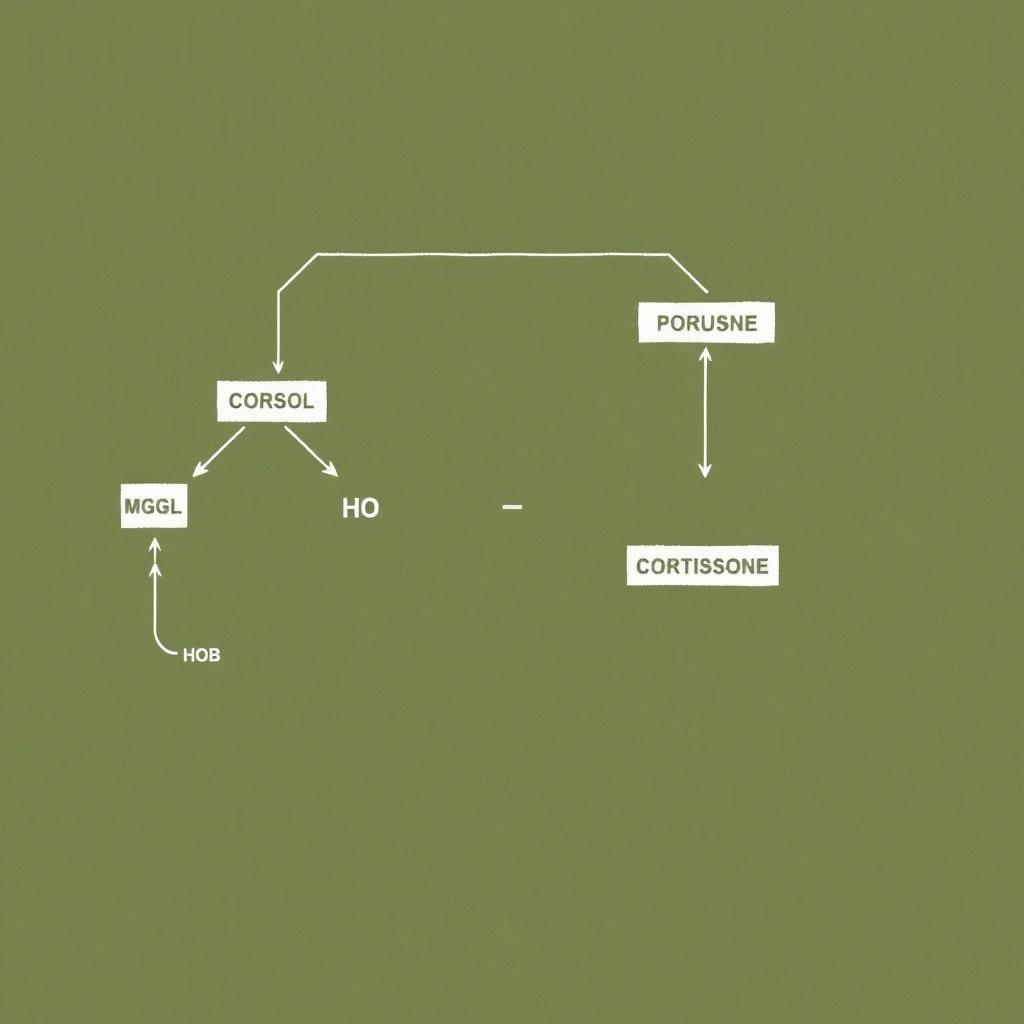
 Discussion