Choose methods and controls based on claims linked to prior experiments and limitations.Know what the science actually supports before you trust the answer.
Press Enter ↵ to search evidence
Explore by Goal
"Biology is also more important than physics, as measured by its economic consequences, by its ethical implications, or by its effects on human welfare."
- Freeman Dyson
Quick Analysis Plan
Copied
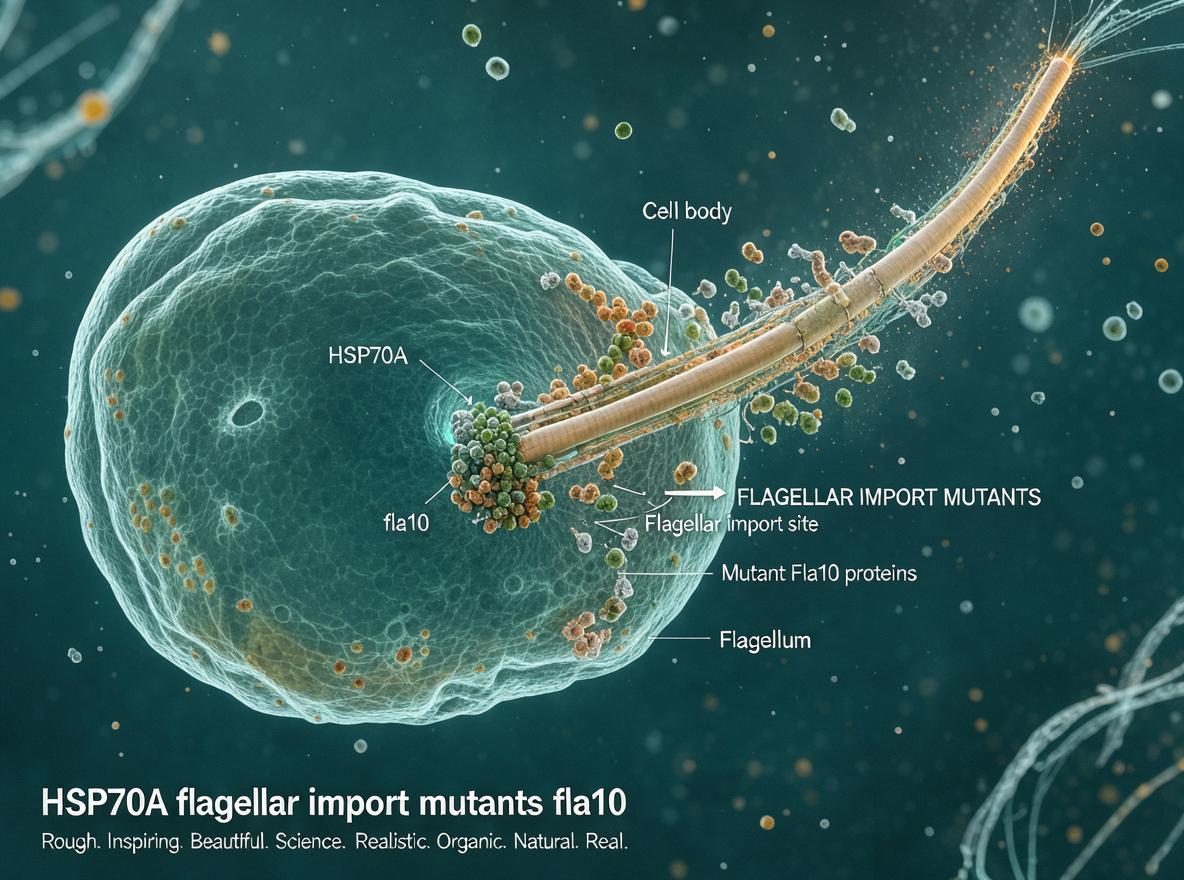
Verdict: feasible and cheaply decisive. Flagellar HSP70A extensively co-localizes with the IFT kinesin-II motor FLA10 (>90% overlap) in Chlamydomonas flagella, and the same fla10 temperature-shift assay has been validated as a test of IFT trafficking (FAP163 flagellar levels drop at restrictive temperature). Shifting fla10 cells to 32°C and tracking flagellar HSP70A by immunoblot/immunofluorescence will cleanly split cargo versus free-diffusion hypotheses: a decline mirrors the FAP163 positive control; persistence suggests diffusion.
Long Analysis Plan
Rationale from existing evidence
The fla10 kinesin-II temperature-sensitive allele is the standard cheap probe for anterograde IFT dependence: FAP163 flagellar levels drop in fla10 at restrictive temperature, confirming IFT trafficking for that protein . HSP70A is already known to be present in the flagellar matrix (~10% of cellular pool), punctate along the flagellum, concentrated at tips, and >90% colocalized with FLA10 — exactly the pattern expected of an IFT passenger, but colocalization alone cannot exclude diffusion. The temperature shift is the missing discriminator.
Experimental design
Strains: fla10 ts mutant (e.g., CC-2637 background) plus isogenic WT; both carrying endogenous or HA-tagged HSP70A (tagged CC-2929-style transformant as secondary readout).
Protocol: Grow at 21°C with full-length flagella; shift to 32°C (restrictive). Harvest flagella at 0, 15, 30, 60, 120 min by pH-shock or dibucaine deflagellation.
Readouts: (1) Anti-HSP70A immunoblot of flagellar matrix normalized to axonemal tubulin and total cellular HSP70A; (2) anti-HSP70A/anti-FLA10 double immunofluorescence for tip-enrichment loss; (3) FAP163 or kinesin-II itself as positive IFT-trafficking control; (4) IFT46 depletion as blockage confirmation.
Interpretation: Flagellar HSP70A halving within ~60–120 min (mirroring FAP163) → IFT-dependent import (cargo hypothesis). Persistence at high levels → passive diffusion through the transition zone dominates. Partial/slow loss → mixed mechanism.
Critical controls: permissive-temperature time course (rules out photobleaching/turnover artifacts), WT at 32°C (rules out heat-shock-driven HSP70A upregulation masking loss — note 40°C heat shock strongly induces HSP70A transcription in Chlamydomonas , and 32°C induction must be checked), and flagellar length verification (IFT blockage shortens flagella).
Predicted outcomes (simulated hypothesis space, not observed data)
Simulated curves only, assuming first-order export/turnover for the cargo case (~50% loss/hour, ±10% shading reflects measurement uncertainty), permissive turnover for the diffusion case, and a two-compartment mix. These are hypothetical expectations to pre-register, not measured data. Note the confound: heat-inducible HSP70A synthesis at 32°C could offset flagellar loss in the cargo case; cycloheximide addition or transcriptional monitoring (RT-qPCR) is required to keep the readout interpretable .
Known unknowns
No published data in the supplied records quantify flagellar HSP70A turnover rate or half-life — the decay kinetics above are assumptions, not evidence.
The 32°C shift may partially (not fully) inactivate kinesin-II; a dose–response across 25/27/29/32°C would bound the residual-transport artifact.
Colocalization >90% does not establish physical binding; no direct HSP70A–IFT interaction was biochemically resolved in the original study (cofractionation failed to identify interactors), so a negative result would still need an orthogonal IFT-independent-entry test (e.g., transition-zone permeability measurement with size-excluded dextrans).
Simulated two-compartment model (cell body vs flagellum) of HSP70A flagellar abundance under cargo, mixed, and diffusion hypotheses after fla10 shift, with ±10% uncertainty bands; assumptions: first-order decay, no new synthesis; shown in long_response as clearly labeled hypothetical predictions.
Generated scientific data; not direct experimental measurements.
Analysis Wizard
Fitting exponential-decay models to planned fla10-shift HSP70A time-course data to statistically distinguish IFT-cargo from diffusion kinetics and estimate flagellar entry half-life.
Get emailed when your analysis is done!
We'll email you the results when your analysis is finished.
Hypothesis Graveyard
HSP70A is an integral structural IFT component: rejected by the original study's own interpretation (it cofractionates but lacks IFT-complex stoichiometry) and by its presence at ~10% of the cellular pool, inconsistent with a stoichiometric motor component.
Flagellar HSP70A entry is entirely diffusion-based: the extreme tip enrichment and FLA10 colocalization are hard to reconcile with pure diffusion, which would predict uniform axial distribution — though this hypothesis is not formally excluded without the temperature-shift experiment.

 Explore by Goal
 Quick Analysis Plan
 Long Analysis Plan
 Top Data Sources
 Ask a Follow-Up
 Key Insight
 Keep Exploring
 DataGen
 Analysis
 Hypothesis Graveyard
 Discussion
