Analyze how experimental results and claims are presented, scoped, and limited in a paper.Know what the science actually supports before you trust the answer.
Press Enter ↵ to analyze
Explore by Goal
"Just like a single cell, the character of our lives is determined not by our genes but by our responses to the environmental signals that propel life."
- Bruce H. Lipton
Quick Explanation
Copied
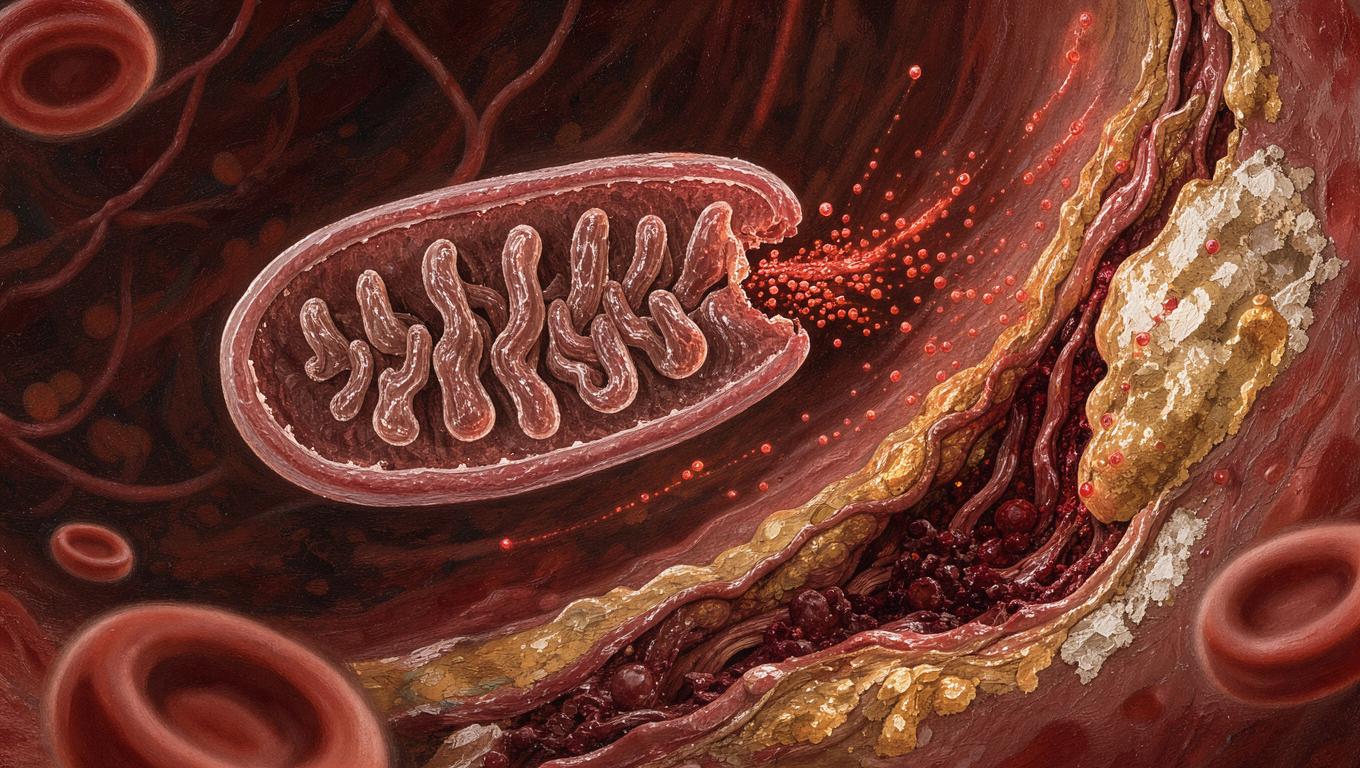
This 2007 Circulation Research review by Madamanchi and Runge () is a high-quality, influential synthesis, but its core causal claim—that mitochondrial dysfunction drives atherosclerosis—remains explicitly unresolved by the authors and largely correlative even today.
Long Explanation
What the Review Claims, and How Well It Supports It
Madamanchi and Runge assemble mechanistic evidence that mitochondria are both a major source and a major target of reactive oxygen species in vascular cells: complexes I and III leak electrons to form superoxide, mtDNA (16,569 bp, no protective histones) is preferentially damaged, and oxidized lipids such as 4-hydroxynonenal trigger vascular cell apoptosis via mitochondrial pathways (). The strongest cited human signal: hearts from coronary artery disease patients had 8–2,000× more mtDNA deletions than age-matched controls, and aortic mtDNA damage was greater in atherosclerotic vs. non-atherosclerotic samples.
The review's honest limitation, stated in its own conclusion, is that cause vs. consequence was unresolved in 2007. Two caveats it does NOT fully resolve: (1) the POLG proofreading-mutant mice developed aging phenotypes and mtDNA mutations without increased ROS, directly weakening the oxidative "vicious cycle" framing the review otherwise endorses; (2) most mechanistic links come from cultured cells and apoE-knockout mice, with over-generalization risk to human atherogenesis.
Post-2007 Validation and Divergence
Later work partially vindicates and complicates the thesis. Somatic mtDNA heteroplasmy was found enriched in human atherosclerotic plaques—e.g., G14459A rose from 8% (1/12) of unaffected intima to 50% (6/12) of lesions, G15059A from 58% to 100%—though n=12 autopsy samples limits generalizability (). Recent reviews extend the mechanism to macrophage polarization via mtDNA mutations (), and mtDNA haplogroups associate with cardiovascular outcomes (e.g., haplogroup N1, SCD OR 1.76, 95% CI 1.02–3.04, n=91) (). However, the 2025 macrophage work cites this paper's literature base rather than overturning it, and no human interventional trial has yet established causality.
Note: this figure draws on the 2013 follow-up study, not the 2007 review itself; the review's quantitative human claims are ranges (e.g., 8–2,000× deletion burden) without per-subject data, which limits any re-plotting of its own figures.
Blind Spots and What Would Change the Verdict
Causality gap: no randomized or genetic-human evidence isolates mitochondrial ROS as sufficient for plaque initiation; plaque mtDNA damage could equally be a downstream artifact of oxidized lipid influx.
Model transfer: apoE−/− mouse atherosclerosis differs from human plaque biology; species differences in UCP and SOD isoform distribution compound this.
Selection bias: as a narrative review, cited literature skews toward positive mechanistic findings; null results on mitochondrial antioxidants in humans are not discussed.
Falsification: demonstration that mtDNA repair enhancement, SOD2 overexpression, or mitochondrial-targeted catalase fails to reduce plaque burden in well-powered models—or that plaque mtDNA damage appears only after lesions form—would substantially weaken the central thesis.
Bottom line: a rigorous, well-organized mechanistic synthesis whose causal framing outran the evidence available in 2007; nearly two decades later, the correlation-to-causation gap persists.
Feedback:
Updated: October 31, 2026
BGPT Paper Review
Study Novelty
70%
For 2007, consolidating mitochondrial ROS, mtDNA damage, and oxidized lipids into a unified atherogenesis framework was forward-looking, but the individual mechanisms (electron leak, oxLDL, apoptosis) were already established; the integration, not the components, is the novelty.
Scientific Quality
90%
Excellently referenced (207 sources), mechanistically precise, and candid about the cause-vs-consequence uncertainty. Weaknesses: narrative (non-systematic) selection of literature, reliance on cell/animal models, and under-discussion of the POLG no-ROS-increase finding that undercuts the oxidative vicious-cycle model it endorses.
Study Generality
80%
The framework spans multiple risk factors (diabetes, dyslipidemia, hypertension, aging, smoking, HIV therapy) and vascular cell types, giving broad explanatory reach, though it is specific to atherogenesis rather than a universal principle.
Study Usefulness
80%
Strongly useful as a mechanistic map for vascular mitochondrial biology and for identifying therapeutic targets (UCPs, SOD2, PTP, p66Shc); practical payoff was limited by the unresolved causality and lack of validated mitochondrial interventions at publication.
Study Reproducibility
50%
A review generates no primary data; reproducibility depends entirely on the cited primary studies, many from small animal or cell-culture experiments without registered protocols or shared datasets.
Explanatory Depth
90%
Deep mechanistic coverage: electron leak topology at complexes I/III, ROS-induced ROS release, cardiolipin oxidation, PTP composition, p66Shc biochemistry, and the PARP-GAPDH hyperglycemia cascade, all tied to specific primary experiments.
We'll email you the results when your analysis is finished.
Hypothesis Graveyard
The mitochondrial 'vicious cycle' (ROS → mtDNA damage → more ROS) as the dominant aging/atherogenesis engine: weakened by POLG mutant mice accumulating mutations and aging phenotypes with no ROS increase, implying mutation load alone can drive pathology.
Smoking-induced mtDNA damage as purely direct oxidative injury: partial, since NRTI and secondhand-smoke data show ANT/SOD2 nitration and PTP sensitization, indicating indirect signaling disruption dominates some contexts.

 Explore by Goal
 Quick Explanation
 Long Explanation
 Top Data Sources
 Ask a Follow-Up
 Key Insight
 Keep Exploring
 Hypothesis Graveyard
 Potential Experiments
 Discussion
