Check whether claims match experiments, exact reported results, and stated limitations.Know what the science actually supports before you trust the answer.
Press Enter ↵ to review paper
Explore by Goal
"Just like a single cell, the character of our lives is determined not by our genes but by our responses to the environmental signals that propel life."
- Bruce H. Lipton
Quick Explanation
Copied
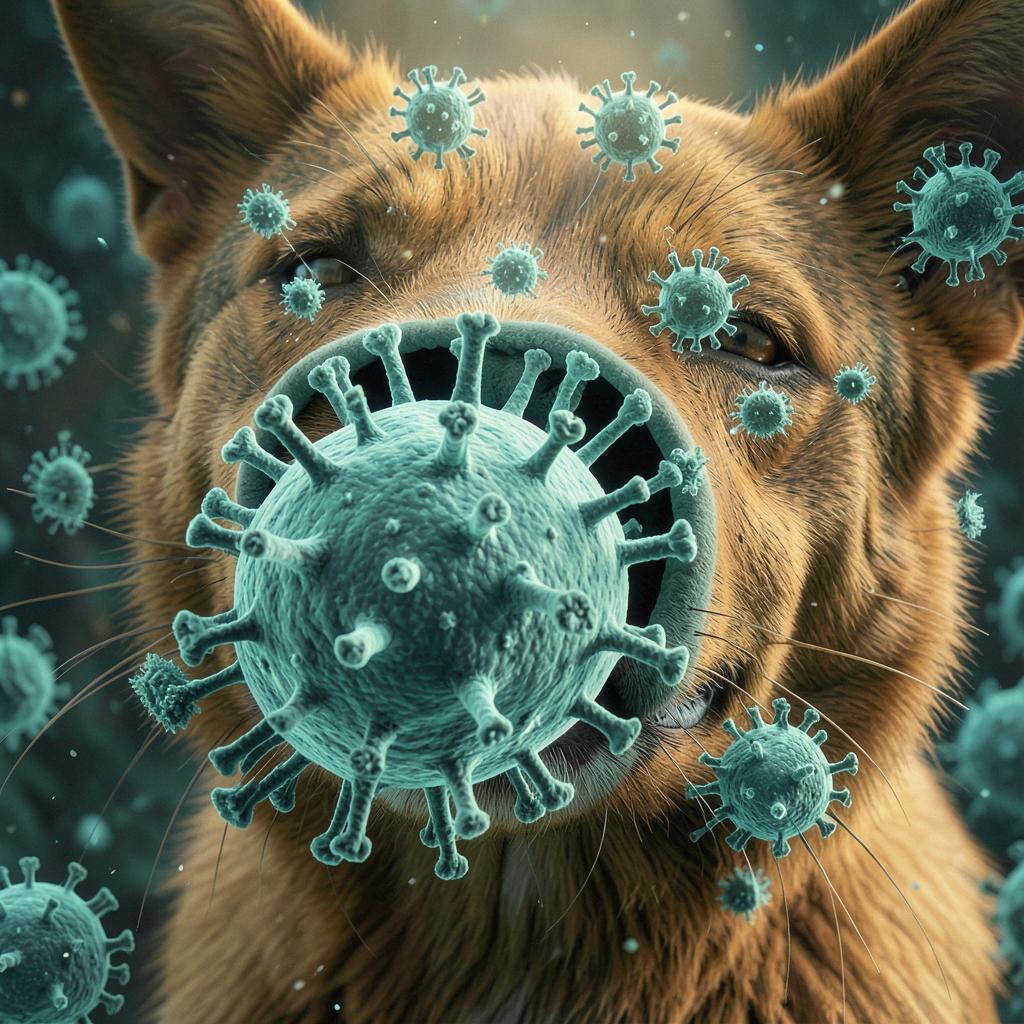
This Veterinary Quarterly study reports five complete CRCoV genomes from Chengdu dogs (PQ725948–PQ725952) that cluster with 2021–2022 Thai strains, carry unique non-coding deletions and HE mutations (P62S, S158F, L161F), and — for the first time in a decade — demonstrate canine pathogenicity with an isolate (CD1) causing respiratory disease in Beagles. The genomic findings are solid, but the docking and tropism-shift claims are computationally speculative and rest on n=3 dogs.
Long Explanation
What the paper establishes
Ren et al. sequenced five nearly complete CRCoV genomes (30,852–30,893 nt) from nasal swabs of 15 respiratory-diseased puppies at a Chengdu veterinary teaching hospital (10/15 CRCoV-positive; 5 met RNA-quality criteria for NGS) . Phylogenetically, the strains form a distinct sub-branch clustering with Thai 2021–2022 strains (closest: D140NS, 99.5–99.7% identity) and are genetically distant from the earlier Chinese BJ232 lineage . No recombination was detected, though the authors concede the sparse global genome database limits this analysis.
Two unique non-coding deletions (4 nt and 8 nt) reduce predicted core promoter elements and binding stability — an interesting but purely in-silico regulatory hypothesis requiring experimental validation, which the authors themselves flag.
The in vivo finding is the real contribution
The sole prior pathogenicity study was over a decade old . Here, CRCoV CD1 was isolated in HCT-8 cells (106 TCID50/mL; only 1 of 10 positive samples yielded CPE), and intranasal challenge of three Beagles produced nasal discharge, sneezing, and coughing peaking at 6–9 DPI, with viral RNA highest in lung, and histopathology showing alveolar septal thickening and tracheal cilia loss . The authors honestly note lung-dominant tropism contradicts prior trachea/nasal-dominant findings and label the tropism-shift hypothesis as premature — commendable restraint.
Where skepticism is warranted
Docking claims are weak evidence. The −5.8 vs −5.5 kcal/mol binding-energy difference for O-acetylated sialic acid (0.3 kcal/mol) is within typical AutoDock Vina noise, and no biochemical binding assay corroborates the S158F/L161F affinity claim. The authors acknowledge this, but the abstract still headlines it.
n=3 per group, 14-day endpoint. No early time-point tissues, so transient extra-respiratory spread cannot be excluded; the lung-highest viral load could reflect sampling timing or dose rather than a genuine tropism change.
Selection analysis inflation risk. The paper correctly cites Kryazhimskiy & Plotkin on dN/dS inflation with short evolutionary distances; several positive-selection calls rest on only one or two algorithms (site 74: MEME only), so per-site evidence is uneven.
Sampling bias. All genomes come from one hospital, three months, puppies 1–3 months old — generalizability across China is untested. Detection-rate context: recent Thai work found CRCoV in 66.7% of nasal swabs by more sensitive RT-dPCR , suggesting the 10/15 rate here is plausible but assay-dependent.
Confidence: Genome sequencing, phylogeny, isolation, and clinical signs are well-supported (direct data, controls included). Docking-based functional claims and the tropism-shift hypothesis are low-confidence and falsifiable via reverse genetics and longitudinal tissue time-courses — precisely the validation the authors propose. What would change the conclusion: independent genomes contradicting the Thai clustering, or binding assays refuting the HE affinity gain.
Feedback:
Updated: October 26, 2026
BGPT Paper Review
Study Novelty
70%
First complete Chinese CRCoV genomes since 2017, first new canine pathogenicity data in over a decade, and a novel Thai-linked clade; however, the framework (genomics + phylogeny + docking) is standard for emerging veterinary coronaviruses.
Scientific Quality
70%
Well-controlled challenge experiment with negative controls and ethics approval, transparent limitations, and data deposition. Weaknesses: docking overinterpretation in the abstract, n=3 dogs, single-site sampling, uneven per-site selection support, and minor text/typography errors (e.g., garbled citation formatting, 10,000 rpm written as '1,0000').
Study Generality
60%
Findings speak to Betacoronavirus 1 host-adaptation biology and companion-animal surveillance broadly, but conclusions are confined to one Chinese locality and five genomes.
Study Usefulness
70%
Provides isolate CD1, five reference genomes, and rare in vivo pathogenicity data that veterinary diagnosticians and coronavirus evolution researchers can directly use; docking results add little until validated.
Study Reproducibility
70%
Accessions PQ725948–PQ725952 are public, methods detailed (primers in supplement, standard tools), but isolation success is notoriously strain- and lot-dependent and no raw reads or code are deposited.
Explanatory Depth
60%
Mechanistic claims (promoter-element loss, HE affinity, tropism shift) are computationally generated hypotheses rather than experimentally resolved mechanisms; the authors largely acknowledge this gap.
Fetching the five deposited CRCoV genomes (PQ725948–PQ725952), aligning them with Thai and BJ232 references, and re-verifying the reported deletions, mutations, and Thai-cluster phylogeny independently.
Get emailed when your analysis is done!
We'll email you the results when your analysis is finished.
Hypothesis Graveyard
Recombination with Thai strains explains CD1-CD5 clustering: rejected by RDP4/SimPlot analyses finding no recombination, though low genome density keeps this only weakly falsified.
Cell-line tropism (HCT-8 restriction) explains isolation failure of 9/10 samples: the authors' own genomic mutation data cannot rule out viral-load or sample-handling factors, so this remains unproven rather than the established cause.

 Explore by Goal
 Quick Explanation
 Long Explanation
 Top Data Sources
 Ask a Follow-Up
 Key Insight
 Keep Exploring
 Analysis
 Hypothesis Graveyard
 Potential Experiments
 Discussion
