Check whether claims match experiments, exact reported results, and stated limitations.Know what the science actually supports before you trust the answer.
Press Enter ↵ to review paper
Explore by Goal
"In biology, nothing is clear, everything is too complicated, everything is a mess, and just when you think you understand something, you peel off a layer and find deeper complications beneath. Nature is anything but simple."
- Richard Preston
Quick Explanation
Copied
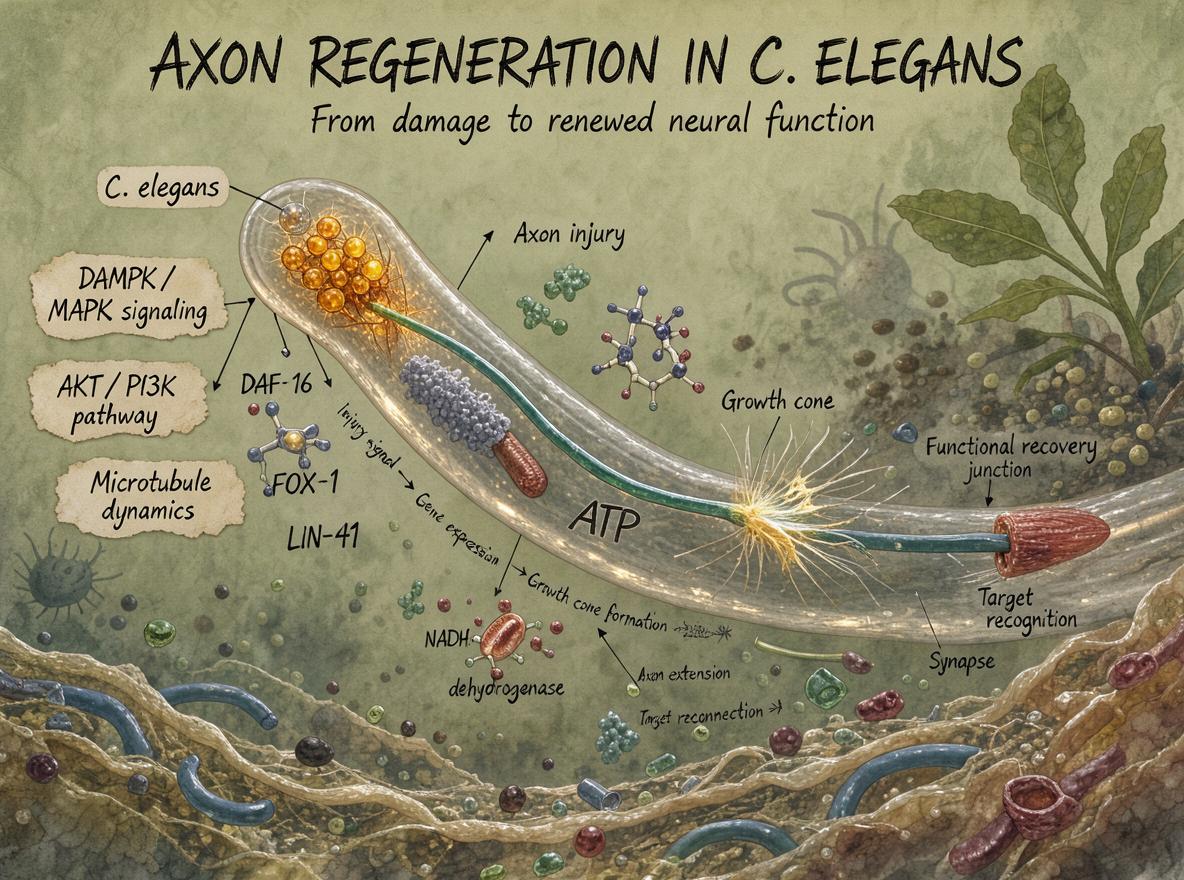
This 2016 review by Byrne and Hammarlund expertly synthesizes how C. elegans—302 invariant neurons, transparent cuticle, femtosecond laser axotomy—enables in vivo, single-neuron analysis of axon regeneration, while honestly flagging gaps: regenerative ability characterized for only a few neuron classes, undefined glial roles, and 30% of injured GABA axons failing to form growth cones .
Long Explanation
Why C. elegans is a powerful regeneration model
The review argues the worm's strengths are its invariant, fully mapped nervous system (302 neurons, 118 classes), transparent cuticle enabling single-axon laser severing and longitudinal in vivo imaging, and a ~3-day life cycle that lets mutant strains with fluorescent markers be built in ~2 weeks. About 40% of the genome is conserved with mammals, and major signaling pathways (Notch, Wnt, Insulin, TGF-beta) are shared .
Two well-characterized neuron types anchor the field: GABA motor commissures regenerate at 2-3 um/h with functional synapse restoration after injury, while mechanosensory (touch) neuron axons extend longer distances at ~7 um/h, with most growth between 24-48 h . Notably, regeneration is stochastic at the single-neuron level: only ~70% of severed GABA axons form growth cones, implicating injury-induced calcium and cAMP as key determinants of success .
Critical assessment
The review is candid about weaknesses, which strengthens its credibility: regeneration has been characterized in only a handful of the 118 neuron classes; no behavioral readout exists for touch-neuron regeneration; and glial contributions are essentially unstudied (worms have 56 glia, no myelin—useful for isolating neuronal-intrinsic mechanisms, but limiting environmental-injury realism) . A known blind spot the review does partially address: laser energy parameters matter—kHz femtosecond pulses minimize collateral damage, and surprisingly, high trains of low-energy pulses increase regeneration frequency over low trains of equal total energy, showing injury energy is not the sole determinant of success . As a 2016 snapshot, it predates later work showing adult sensory cilia also regenerate via DAF-19 and DLK-1/CEBP-1 pathways in a neuron-type-specific, glia-modulated manner , confirming one of the review's stated future directions (glia-neuron interactions) has since been validated.
Feedback:
Updated: October 27, 2026
BGPT Paper Review
Study Novelty
60%
A 2016 review synthesizing an established field (since Yanik 2004); consolidates known mechanisms rather than introducing new ones.
Scientific Quality
80%
Balanced, self-critical review with precise quantitative details (rates, success fractions) and explicit discussion of model weaknesses; limited by being a synthesis without new data.
Study Generality
80%
Explicitly frames worm findings in cross-species regeneration context and maps them to mammalian-injury relevance.
Study Usefulness
80%
Practical entry point for worm-regeneration researchers; clearly outlines techniques, gaps, and future directions.
Study Reproducibility
70%
Review cites established laser parameters and genetic tools; reproducibility of underlying studies is generally high but depends on specialized laser equipment.
Explanatory Depth
70%
Mechanistic depth is moderate: calcium/cAMP determinants and growth-cone dynamics are described, but molecular pathways (e.g., DLK-1 cascades) are covered only at summary level.
We'll email you the results when your analysis is finished.
Hypothesis Graveyard
Total laser energy determines regeneration outcome: falsified by Bourgeois and Ben-Yakar (2008) showing pulse-train pattern, not total energy, predicts success.

 Explore by Goal
 Quick Explanation
 Long Explanation
 Top Data Sources
 Ask a Follow-Up
 Key Insight
 Keep Exploring
 Hypothesis Graveyard
 Potential Experiments
 Discussion
