Check a paper's claims against linked experiments, exact results, stated scope, and limitations.Know what falsifiable science actually supports before you trust the answer.
Press Enter ↵ to search evidence
Explore by Goal
"We live in a society exquisitely dependent on science and technology, in which hardly anyone knows anything about science and technology."
- Carl Sagan
Quick Explanation
Copied
Verdict: This Journal of Neuroinflammation study (Feb 2024) is a well-executed preclinical single-cell analysis showing that clodronate-triggered emergency monopoiesis after controlled cortical impact (CCI) yields a Ly6Chi CD115+ monocyte population carrying neutrophil-like granule signatures (Elane, Prtn3, Ctsg, Mpo, Gfi1) and OXPHOS enrichment, whose adoptive transfer reduces lesion volume (). Key weaknesses: males only, CD1 strain, no public data deposition, and confounding from clodronate-induced gut LPS translocation.
Long Explanation
What the paper demonstrates (reported observations)
Clodronate liposome (Cl-LPM) pre-treatment in male CD1 mice before controlled cortical impact (CCI) reduced lesion volume at 1 and 3 days post-injury, attenuated Evans blue/IgG BBB leakage, and improved cortical blood flow by laser speckle imaging (n = 5–8/group) . Flow cytometry quantified morphological shifts of circulating CD115+/Ly6Chi monocytes: FSC-A rose from ~104,000–107,000 (sham) to ~111,000 (control CCI) and ~115,000 (Cl-LPM CCI), while SSC-A granularity rose from 27,114 ± 746 (control CCI) to 34,132 ± 1885 (Cl-LPM CCI). Cytology confirmed cell size increases from 34.9 µm³ (naïve) to 43.7 µm³ (CCI) to 67.4 µm³ (Cl-LPM CCI) .
Single-cell and mechanistic claims
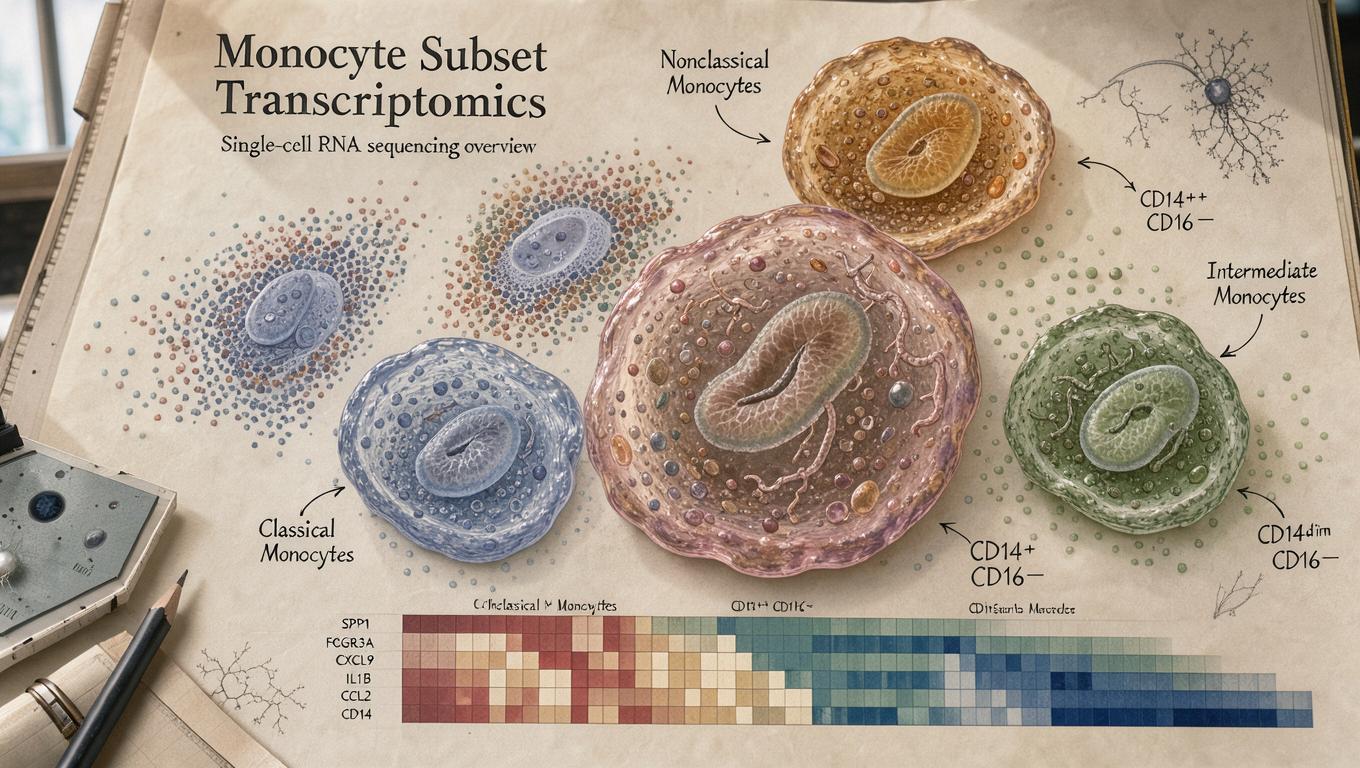
scRNA-seq of enriched blood monocytes (4,663 control vs 4,201 Cl-LPM cells; ~7,055 reads/cell) resolved 11 clusters, with Cl-LPM dominated by classical Ccr2hi/Ccr2lo, a Chil3/Ym1-Apoe immunoregulatory non-classical subtype (C4), and a neutrophil-like cluster (C9) marked by Elane, Prtn3, Mpo, Ctsg, and proliferative genes (Mki67, Hmgb2) with oxidative phosphorylation as the top GO/IPA pathway . Pseudotime suggested C9 differentiates from classical monocytes. Transfer of 150k Cl-LPM-derived peripheral monocytes reduced recipient lesion volume at 1 dpi, supporting a direct effector role. Independent literature corroborates that Gfi1 promotes the neutrophil program by repressing c-Fos/Egr-1 and dampening ERK1/2 , and that IRF8 acts in committed progenitors to favor monocyte over neutrophil output — context that plausibly explains the Gfi1-high/Nr4a1-low signature seen here, though the paper does not test these factors directly.
Critical appraisal, blind spots
Confounded effector: clodronate itself causes bacterial translocation; the authors detected serum LPS in Cl-LPM CCI mice . A matching cyclophosphamide model also produces neutrophil-like monocytes with pro-tumor, immunosuppressive activity — so "neuroprotective" is not an inherent property of this subset; the authors should not overgeneralize its clinical appeal.
Generalizability: male-only CD1 outbred mice, single injury model, hyperacute time points; no female or chronic-outcome data. Prior rat studies show opposite BBB effects of pre-injury depletion, which the paper acknowledges but does not resolve.
Reproducibility: scRNA-seq data are only "available on reasonable request", not GEO-deposited — a notable weakness for a single-cell paper relying on custom annotations.
Missing controls: whether Cl-LPM alone (no injury) produces the same transcriptomic shift is admitted as untested; adoptive transfer lacks a dose-response and fate-tracking of transferred cells in the lesion.
Confidence: moderate. The descriptive morphology/flow data are solid and internally consistent, but the causal OXPHOS → resolution narrative is inferred from pathway enrichment, not measured energetics (no Seahorse, no ex vivo functional assays), and HARKing risk applies to the emergency-monopoiesis framing built after observing Cl-LPM effects.
Feedback:
Updated: November 01, 2026
BGPT Paper Review
Study Novelty
80%
First demonstration of emergency monopoiesis yielding neutrophil-like monocytes after sterile brain injury, at 24 h, in outbred mice — building on but extending chemotherapy-induced NLM work and Ym1+ monocyte literature.
Scientific Quality
70%
Solid multi-modal workflow (flow, histology, cytokine arrays, scRNA-seq, transfer experiments) with blinding; weakened by lack of public data, inferred-not-measured OXPHOS metabolism, untested Cl-LPM-alone control, and potential clodronate/LPS confounding acknowledged but not dissected.
Study Generality
70%
Findings speak to monocyte subset biology in CNS injury broadly, but are strain-, sex-, model-, and timepoint-limited; parallel cancer/chemotherapy NLM data suggest broader relevance.
Study Usefulness
80%
Identifies a candidate surrogate monocyte signature (Chil3/Apoe/OXPHOS; granule genes) for pro-resolving innate therapy design in TBI, with direct adoptive-transfer proof-of-concept.
Study Reproducibility
50%
Methods are detailed, but scRNA-seq raw data are not publicly deposited (available only on request), preventing independent re-annotation or pipeline reproduction.
Explanatory Depth
70%
Links phenotype to ontology (pseudotime) and metabolism (GO/IPA), but mechanism is correlational; no Seahorse, lineage tracing, or perturbation of OXPHOS/Gfi1 axes in vivo.
We'll email you the results when your analysis is finished.
Hypothesis Graveyard
Non-classical monocytes are the sole effectors of post-TBI secondary damage — undermined here since Cl-LPM protection coincided with a shift away from non-classical toward classical Ccr2hi/lo states.

 Explore by Goal
 Quick Explanation
 Long Explanation
 Top Data Sources
 Ask a Follow-Up
 Key Insight
 Keep Exploring
 Hypothesis Graveyard
 Potential Experiments
 Discussion
