Retrieve specific, versioned evidence records on gene functions, mutations, and sequencing data.Know what the science actually supports before you trust the answer.
Press Enter ↵ to find evidence
Explore by Goal
"The scientist is not a person who gives the right answers, he's one who asks the right questions."
- Claude Lévi-Strauss
Quick Analysis Plan
Copied
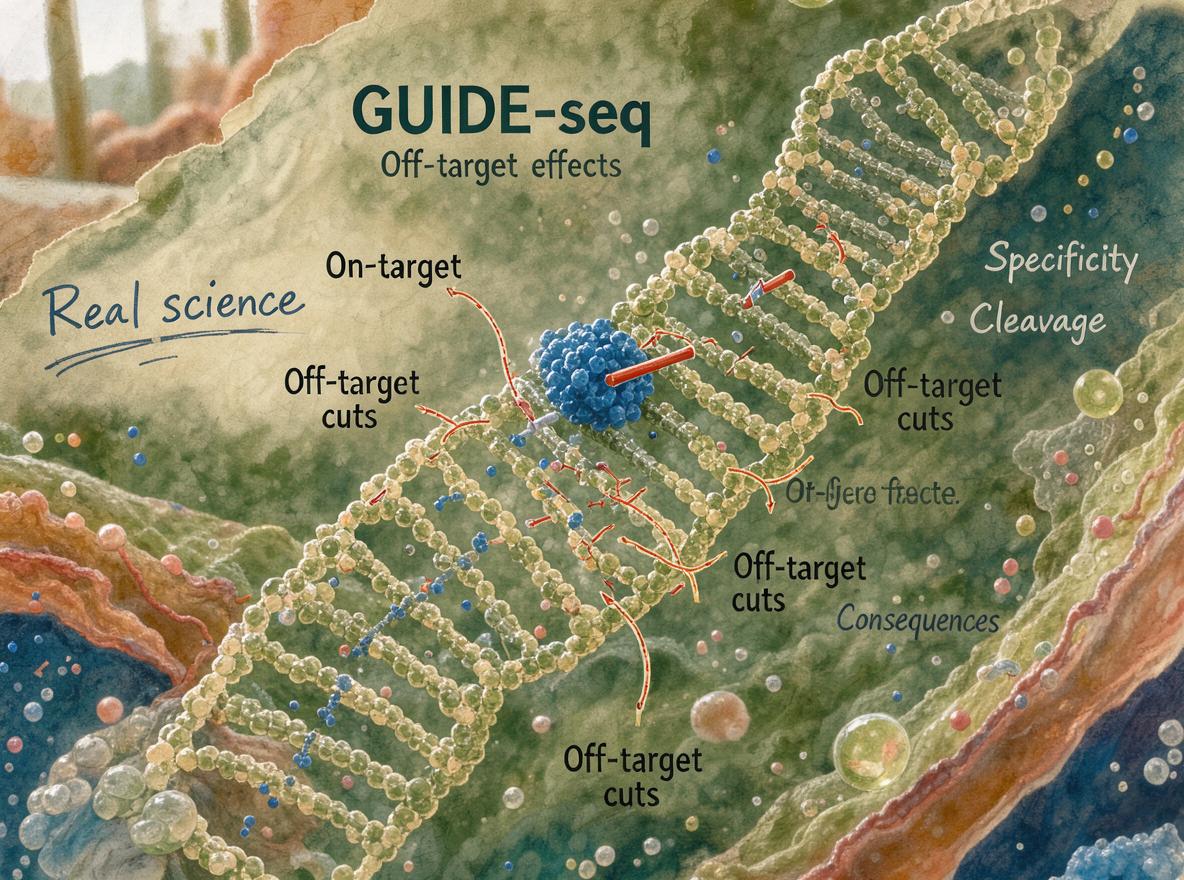
GUIDE-seq remains the most validated cell-based gold standard for CRISPR off-target discovery, but its sensitivity is bounded: it requires DSB formation and dsODN integration, depends on cell-line chromatin context, and newer in vitro methods (CIRCLE-seq) and nickase-based edits substantially reduce or escape its detection window (). Battle-testing shows concordance for known sites but systematic blind spots for single-strand nicking and low-frequency events.
Long Analysis Plan
What GUIDE-seq Directly Detects — and What It Structurally Cannot
GUIDE-seq tags double-strand breaks via dsODN integration, so its sensitivity is bounded by DSB formation, dsODN delivery efficiency, and sequencing depth; the original authors themselves flagged shallow sequencing and two-cell-line (U2OS, HEK293) reliance as sensitivity constraints (). A decisive stress test comes from spacer-nick Cas9n editing in HSPCs: off-target dsODN integrations were not detected at all in Cas9n-treated cells, and on-target GUIDE-seq reads dropped ~260-fold versus nuclease Cas9 (). This is not proof of zero off-targets — single-strand nicks do not integrate dsODN — so GUIDE-seq under-reports nickase damage by design.
When GUIDE-seq-identified sites are then quantified by amplicon sequencing in edited cells, reported frequencies can be dramatic: in β-thalassemia base editing, the IVS2-1 guide produced off-target edits at S-OT2 (90.7% ± 2.3) and three E-OT sites above 50%, while the CD39 guide stayed mostly below 10% at its detected sites (). This spread shows why GUIDE-seq discovery must be paired with orthogonal quantitative validation — discovery sensitivity does not equal measured edit frequency.
Comparative Sensitivity: In Vitro Beats In Cellulo
CIRCLE-seq, a purely in vitro circularized-DNA assay, found 156 off-target sites missed by Digenome-seq with ~180,000-fold enrichment over background, illustrating that cell-based GUIDE-seq systematically misses chromatin-inaccessible or low-activity sites (). The trade-off: CIRCLE-seq false positives require cell-based confirmation — GUIDE-seq and CIRCLE-seq are complementary, not interchangeable.
Battle-Testing Verdict and Blind Spots
Validated strength: GUIDE-seq correctly recovers known off-targets across nuclease, base-editor, and prime-editor systems (EMX1: 10 sites; FANCF: 3 sites in the SunTag-PE evaluation) ().
Structural blind spot 1: nicks and SSBs are invisible by design (Cas9n data above).
Structural blind spot 2: chromatin and cell-type dependence — K562 GUIDE-seq results may not transfer to HSPCs; the thalassemia study partially mitigates this with WES/RNA-seq orthogonal checks ().
Analysis-chain bias: off-target calling depends on pipeline assumptions (bulge handling, multi-mapper assignment); newer Snakemake pipelines address these but rely partly on in-silico validation ().
What would change this conclusion: a head-to-head study showing GUIDE-seq recovering nick-induced or low-frequency off-targets that CIRCLE-seq/amplicon validation miss would overturn the DSB-dependence blind spot; none exists in the supplied evidence. Confidence: high on reported values (all from supplied records), moderate on the generalization that GUIDE-seq under-reports genome-wide absolute off-target burden.
Computing a sensitivity matrix comparing GUIDE-seq-detected off-target frequencies across the reported CD39, IVS2-1, spacer-nick, and SunTag-PE datasets to quantify discovery-versus-quantification gaps.
Get emailed when your analysis is done!
We'll email you the results when your analysis is finished.
Hypothesis Graveyard
GUIDE-seq detects essentially all off-targets because it is called a gold standard: falsified by the spacer-nick study where zero off-target dsODN integrations were detected despite known nickase activity elsewhere, and by CIRCLE-seq's 156 previously missed sites.
Off-target frequency measured by GUIDE-seq read counts equals editing frequency: falsified by the β-thalassemia data where GUIDE-seq-discovered sites spanned 2.8%–90.7% measured edit frequency, requiring orthogonal amplicon quantification.

 Explore by Goal
 Quick Analysis Plan
 Long Analysis Plan
 Top Data Sources
 Ask a Follow-Up
 Key Insight
 Keep Exploring
 Analysis
 Hypothesis Graveyard
 Potential Experiments
 Discussion
