Ask questions across claims linked to experiments, exact results, limitations, and sources.Know what falsifiable science actually supports before you trust the answer.
Press Enter ↵ to search evidence
Explore by Goal
"The nitrogen in our DNA, the calcium in our teeth, the iron in our blood, the carbon in our apple pies were made in the interiors of collapsing stars. We are made of starstuff."
- Carl Sagan
Quick Analysis Plan
Copied
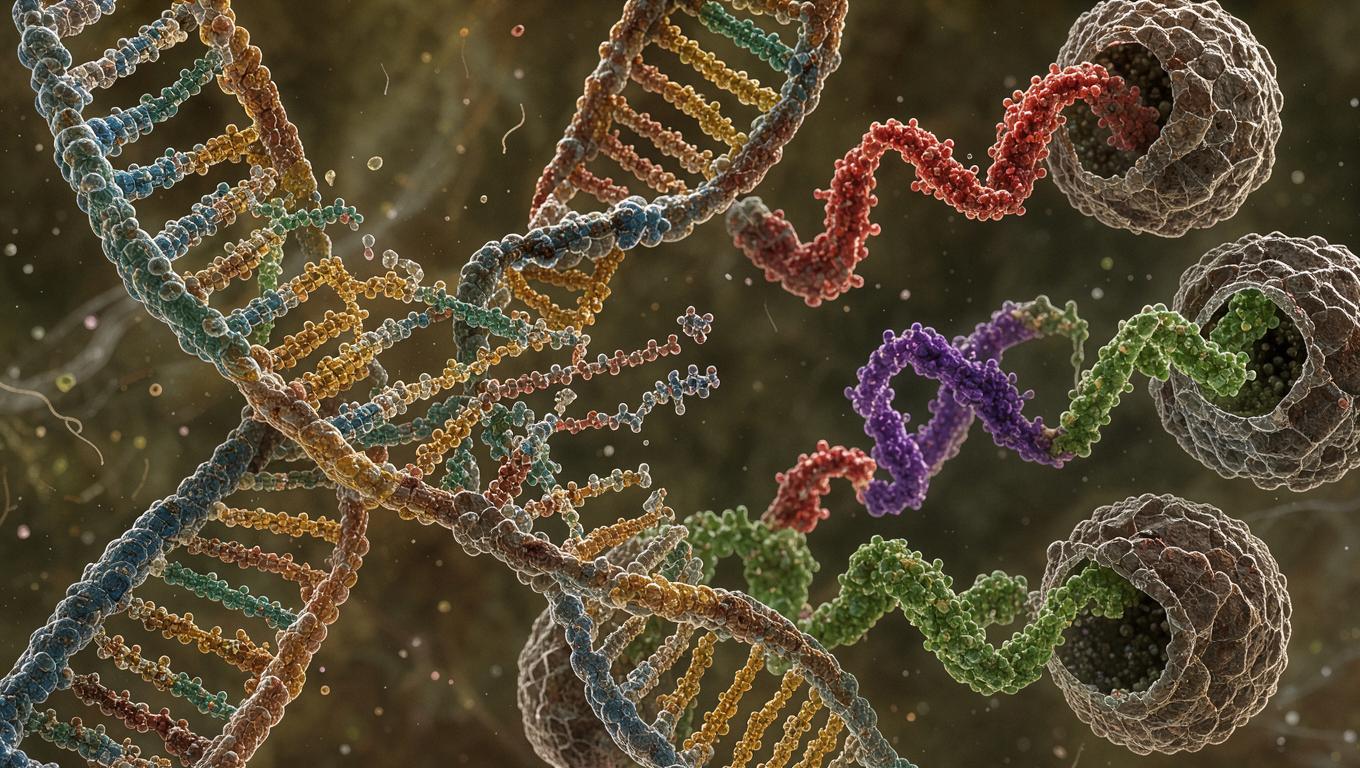
DNA recombination is a molecular process in which nucleotide sequences are physically exchanged or annealed between DNA molecules (e.g., homologous recombination repairing double-strand breaks via single-strand annealing or DSB-repair models) . DNA reassortment is a population-level process limited to segmented genomes (e.g., Rift Valley fever virus L, M, S segments), where whole genomic segments are swapped during co-infection without any intra-segment sequence exchange .
Long Analysis Plan
Core Distinction
Recombination operates within a DNA molecule: homologous sequences physically exchange via mechanisms like single-strand annealing (SSA) or double-strand-break repair. In plant protoplasts, over 90% of extrachromosomal recombination events involved flanking-marker exchange, supporting SSA over DSB repair . RecA-family mediators (e.g., RecA in bacteria, regulated by RecX) drive strand exchange .
Reassortment operates between whole genomic segments of segmented viruses. RVFV phylodynamic analysis detected seven reassortment events across L, M, and S segments with discordant phylogenies, while explicitly finding no intra-segment recombination — demonstrating the two processes are mechanistically independent .
Reported rates: L = 2.31E-4, M = 3.80E-4, S = 3.36E-4 s/s/y (HPD ranges shown); M evolves ≥1.65× faster than L, reflecting decoupled segment dynamics enabled by reassortment .
Computational Distinguishing Strategy
Recombination detection: Within-alignment tests (RDP4, phylogenetic incongruence within a single molecule); signal = mosaic sequences within one segment.
Reassortment detection: Between-segment tree discordance (GiRaF, posterior-set tree analysis); signal = each segment individually tree-like, but segment trees disagree.
Confidence: High — the distinction is well-established; RVFV evidence (E1–E4) is directly quantitative. Blind spot: reassortment is only definable for segmented genomes; applying recombination tests to non-segmented DNA conflates the two terms.
We'll email you the results when your analysis is finished.
Hypothesis Graveyard
Reassortment is a special case of recombination: falsified by RVFV data showing seven reassortment events with zero intra-segment recombination — the mechanisms are statistically and mechanistically independent.
DNA recombination is exclusively a DNA-repair process: weakened by proposed somatic recombination hypotheses in memory encoding, though these remain experimentally unvalidated.

 Explore by Goal
 Quick Analysis Plan
 Long Analysis Plan
 Top Data Sources
 Ask a Follow-Up
 Key Insight
 Keep Exploring
 Hypothesis Graveyard
 Potential Experiments
 Discussion
