Check a paper's claims against linked experiments, exact results, stated scope, and limitations.Know what falsifiable science actually supports before you trust the answer.
Press Enter ↵ to search evidence
Explore by Goal
"Science is organized knowledge. Wisdom is organized life."
- Immanuel Kant
Long Explanation
Copied
Evidence Base: What the Review Claims
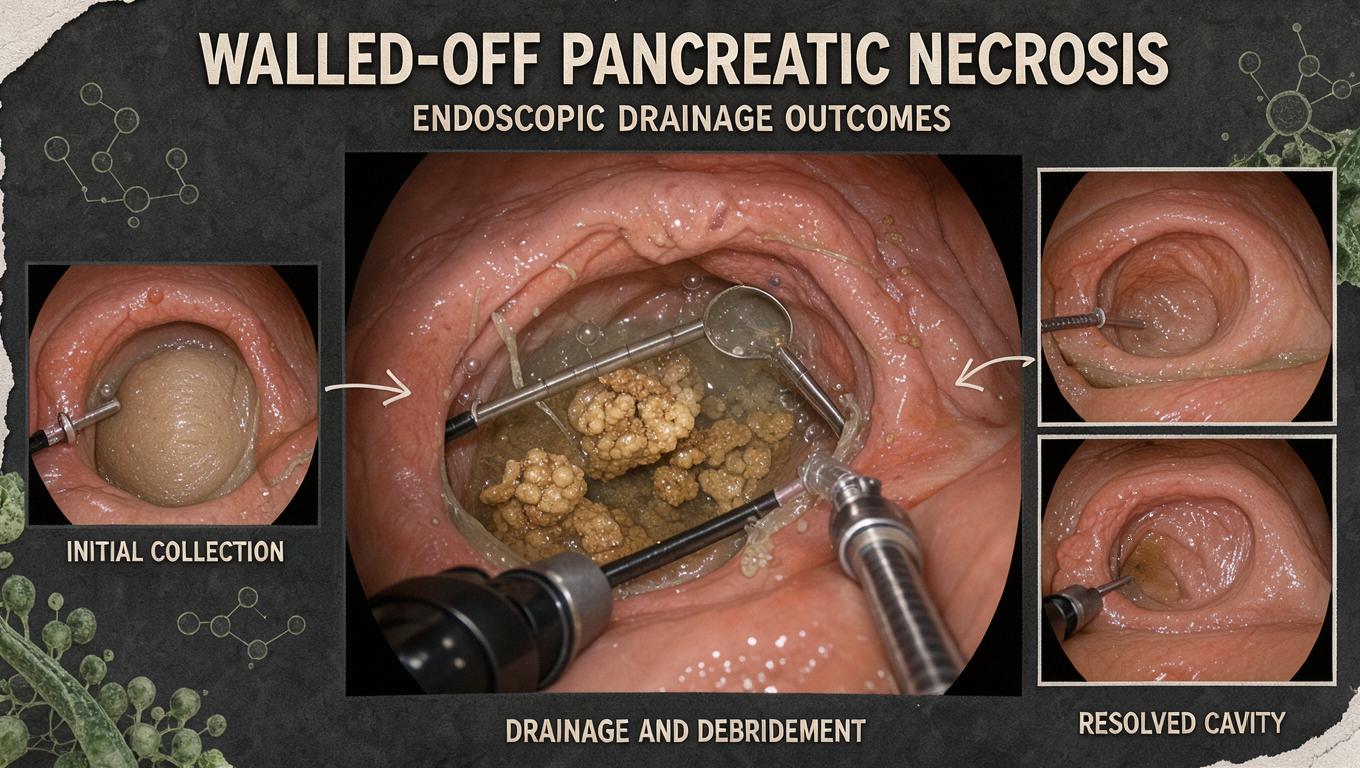
Voermans, Besselink and Fockens (Amsterdam, J Hepatobiliary Pancreat Sci, 2014) present a narrative review of endoscopic transluminal drainage and necrosectomy (ETN) for walled-off pancreatic necrosis. The core epidemiology: ~20% of acute pancreatitis cases become necrotizing, ~30% of those develop infected necrosis requiring intervention, and ~70% of necrosis remains sterile and mostly resolves conservatively. Intervention for infected necrosis should be delayed until ≥4 weeks when clinically feasible, with broad-spectrum antibiotics in the interim .
The complication figures derive from a systematic review the authors themselves scrutinize critically: 14 of 15 included studies were retrospective, methodological quality was moderate-to-low, most studies omitted disease-severity parameters (organ failure, infection status), and only ~half the pooled patients had proven infected necrosis — so the 36% complication rate likely underrepresents risk in sicker patients .
Technique and Unresolved Questions
The protocol is essentially unchanged from the authors' own 2007 series: EUS-guided puncture, tract dilation to 8–15 mm, two double-pigtail stents plus a naso-cystic catheter for 1 L/24 h lavage, escalating to necrosectomy (tract dilated to 18–20 mm) if no improvement in 48–72 h. Roughly 60% need additional necrosectomy. Honest uncertainties the authors flag: whether initial dilation plus direct ETN reduces procedures is unproven; stent-dwell duration to cover ductal disruptions rests on small studies; CO2 insufflation is recommended yet fatal CO2 gas embolism has been reported; and metal stents show migration and hemorrhage risks awaiting dedicated-design data.
Evidence Status: Honest but Thin
The review's greatest strength is epistemic candor — it repeatedly states that endoscopic superiority over minimally invasive surgery is unproven, citing only a 22-patient pilot RCT suggesting fewer major complications, and pointing to the TENSION trial (ISRCTN09186711) as the decisive test . Complementary data from a parallel review of three multicenter ETN series (Seifert n=93; Gardner n=104; Yasuda n=57) show clinical success 75–91% but complications 14–33% and mortality 1.9–11%, reinforcing the heterogeneity concern .
Critical Appraisal
Blind spots: the authors are pioneers and proponents of ETN from a single high-volume center — technique descriptions reflect their protocol, and self-citation of their own series creates potential pro-intervention framing. The narrative format precludes systematic search methodology, and innovations (H2O2, vacuum-assisted closure, dual-modality drainage) rest on case reports and small series prone to publication bias. The claim that gas embolism risk justifies CO2 is mechanistically plausible but evidence-thin. What would change the picture: a well-powered randomized trial showing ETN equal or inferior to surgical step-up — precisely what TENSION was designed to deliver. Until such data, as the authors concede, modality selection is "largely driven by local expertise and tradition."
Feedback:
Updated: November 21, 2026
BGPT Paper Review
Study Novelty
60%
A 2014 narrative review consolidating a decade-old technique; incremental synthesis rather than new data, though its timing ahead of the TENSION trial gave it currency.
Scientific Quality
60%
Honest about weak evidence base and explicitly flags systematic-review limitations; but is a non-systematic narrative review by the technique's originators, with reliance on retrospective studies and no systematic search methodology.
Study Generality
70%
Applies broadly to management of necrotizing pancreatitis across disciplines, though technique details are center-specific.
Study Usefulness
70%
Practical procedural roadmap (timing, lavage, stent strategy, complication management) useful for clinicians, with appropriately hedged evidence claims.
Study Reproducibility
30%
Narrative review with no primary data; protocol details described but evidence base heterogeneous and largely retrospective.
Explanatory Depth
50%
Procedural depth is good; mechanistic and comparative-effectiveness reasoning remains superficial, appropriately reflecting the immature evidence base.
We'll email you the results when your analysis is finished.
Hypothesis Graveyard
Immediate necrosectomy at first drainage to reduce procedures — abandoned because percutaneous catheter data showed ~40% of infected WON resolve with drainage alone, implying a substantial drainage-only responder subgroup exists.
Early intervention for infected necrosis — overturned by observational data linking delayed (>4 week) intervention with lower mortality, allowing collections to wall off.

 Explore by Goal
 Long Explanation

 Top Data Sources
 Ask a Follow-Up
 Key Insight
 Keep Exploring
 Hypothesis Graveyard
 Potential Experiments
 Discussion
