Check your hypothesis against claims and exact results linked to their experiments and sources.Know what the science actually supports before you trust the answer.
Press Enter ↵ to test hypothesis
Explore by Goal
"We live in a society exquisitely dependent on science and technology, in which hardly anyone knows anything about science and technology."
- Carl Sagan
BGPT Odds of True
78%
80% Confidence
The hypothesis predicts genre/register, not AI exposure, drives detector false positives. Direct support: a pre-LLM constitution flagged 98.5% AI (n=1 document); corroborated by L2 false-positive bias across 30 detectors and near-chance style-based human discrimination. Not yet tested via systematic multi-genre, multi-detector benchmarks, so confidence is moderate.
Hypothesis Novelty
45%
The general idea that detectors rely on stylistic/register features is widely discussed in 2023–2026 literature, but the specific prediction that pre-LLM constitutional and legal boilerplate would be flagged is a sharpened, testable framing less commonly formalized.
Quick Analysis Plan
Copied
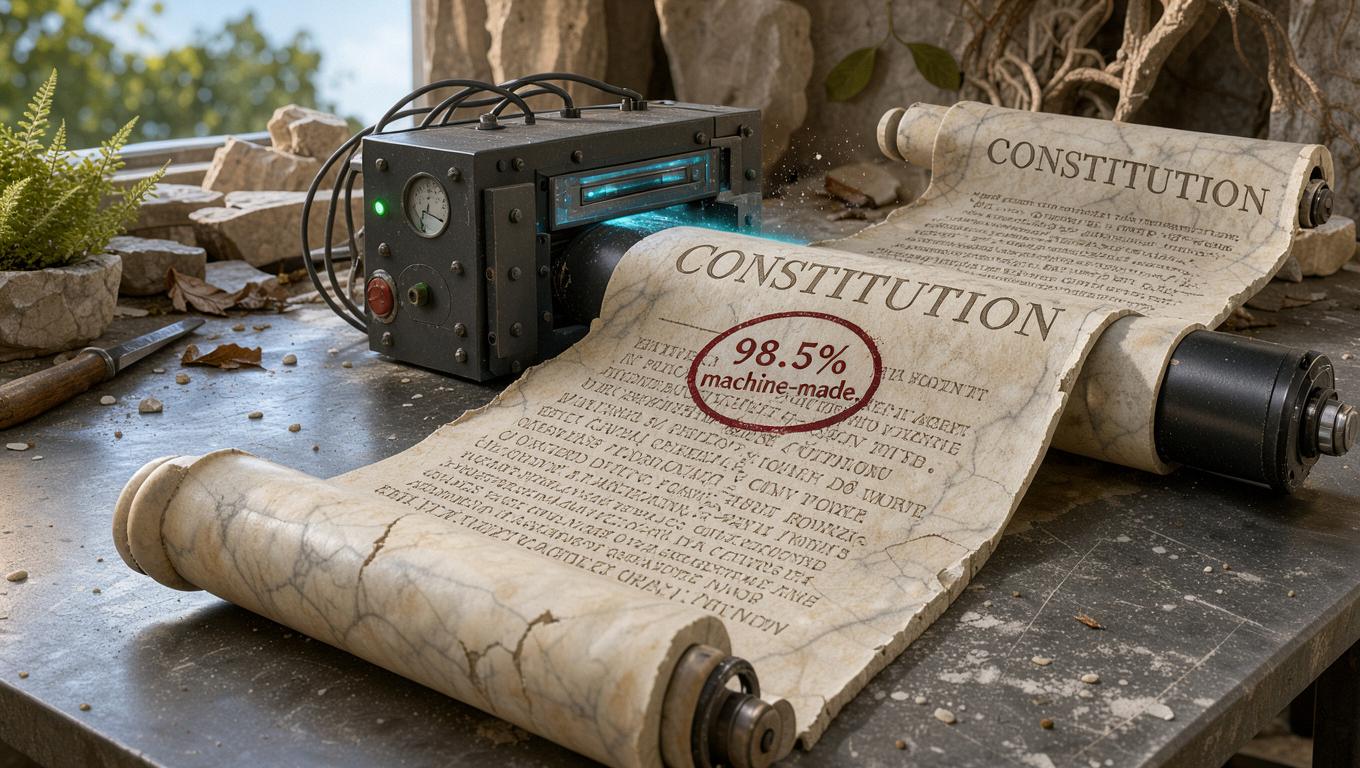
Yes—the available evidence supports the hypothesis. ZeroGPT flagged the pre-LLM 1987 Philippine Constitution as 98.5% AI-generated, a stark genre-driven false positive on a definitively human-authored legal text, while detectors also systematically over-flag English L2 writing .
Long Analysis Plan
Genre, Not Exposure, Drives False Positives
The hypothesis makes a strong, falsifiable prediction: detectors flag register (formulaic, low-perplexity institutional prose) rather than actual AI authorship. The strongest direct support is a single-document diagnostic test: ZeroGPT scored the 1987 Constitution of the Philippines—drafted and ratified decades before LLMs existed—as 98.5% AI-generated. This is a near-decisive single case because ground truth (human authorship) is certain, isolating genre/register as the only plausible driver .
Two converging lines corroborate the mechanism. First, detector error varies systematically by textual population: across 30 detectors, English L2 student essays showed consistently higher false-positive rates than L1 essays—another register-adjacent signal independent of any AI exposure . Second, in a blinded medical-school grading study, expert human assessors identified AI vs. student sources at only 53% (36/68)—near chance—with perceived "writing style" the most cited (unreliable) rationale, and one assessor using AI detection tools classified zero responses correctly. Human judgment, like detector judgment, appears keyed to surface style rather than provenance .
Note: the 98.5% value is a single-document anecdote from a narrative review (n=1 text, one detector); the 53% figure comes from a small exploratory study (10 assessors, 68 responses, one institution). Neither represents a systematic genre-vs-exposure benchmark.
What is missing: no supplied evidence systematically benchmarks constitutions, legal templates, and formulaic academic prose across multiple detectors. The Weber-Wulff paraphrase-evasion findings and near-chance human accuracy (40–55%) further suggest detectors rely on fragile stylometric cues that legal boilerplate happens to share with LLM output . Falsification would require a multi-detector, multi-genre corpus (pre-LLM vs post-LLM institutional texts) in which false positives track authorship rather than register.
Detectors identify semantic 'AI hallmarks' (content knowledge patterns): falsified indirectly—paraphrased AI text evades detection while pre-LLM formulaic text is flagged, showing the signal is surface stylometric, not semantic.
Detectors are simply low-accuracy noise: rejected because errors are structured (L2 bias, genre bias), not random—a structured error pattern implies a latent feature (register) is being detected.

 Explore by Goal

 Hypothesis Novelty
 Quick Analysis Plan
 Long Analysis Plan
 Top Data Sources
 Ask a Follow-Up
 Key Insight
 Keep Exploring
 Potential Hypothesis
 Hypothesis Graveyard
 Potential Experiments
 Discussion
