Ask questions across claims linked to experiments, exact results, limitations, and sources.Know what falsifiable science actually supports before you trust the answer.
Press Enter ↵ to search evidence
Explore by Goal
"Just like a single cell, the character of our lives is determined not by our genes but by our responses to the environmental signals that propel life."
- Bruce H. Lipton
BGPT Odds of True
12%
80% Confidence
The hypothesis bundles three claims: cervical epidural hUC-MSCs resolve post-traumatic headache, via mtDNA-ZBP1/EV immunomodulation, not local repair. Only the middle link (EV-mediated microglial modulation after TBI) has credible support; the first (headache endpoint) and third (mechanism attribution) have zero supplied evidence, and the ZBP1 timing paradox argues against simple suppression.
Hypothesis Novelty
82%
Converging cervical epidural delivery, hUC-MSCs, the newly described mtDNA-ZBP1 microglial axis, and headache as an EV-signaling outcome is an unexplored combination; individual components are established but the integrated mechanism-vs-repair framing is new.
Quick Analysis Plan
Copied
The hypothesis is mechanistically plausible but presently unsupported: supplied evidence establishes a mtDNA-ZBP1 microglial activation axis after mTBI and MSC/EV immunomodulation after TBI, yet no study links cervical epidural hUC-MSC injection to post-traumatic headache resolution or tests an EV-mediated mechanism over local cervical repair (). The mechanism-versus-repair distinction remains untested; estimated likelihood is low.
Long Analysis Plan
Evidence Bearing Directly on the Hypothesis
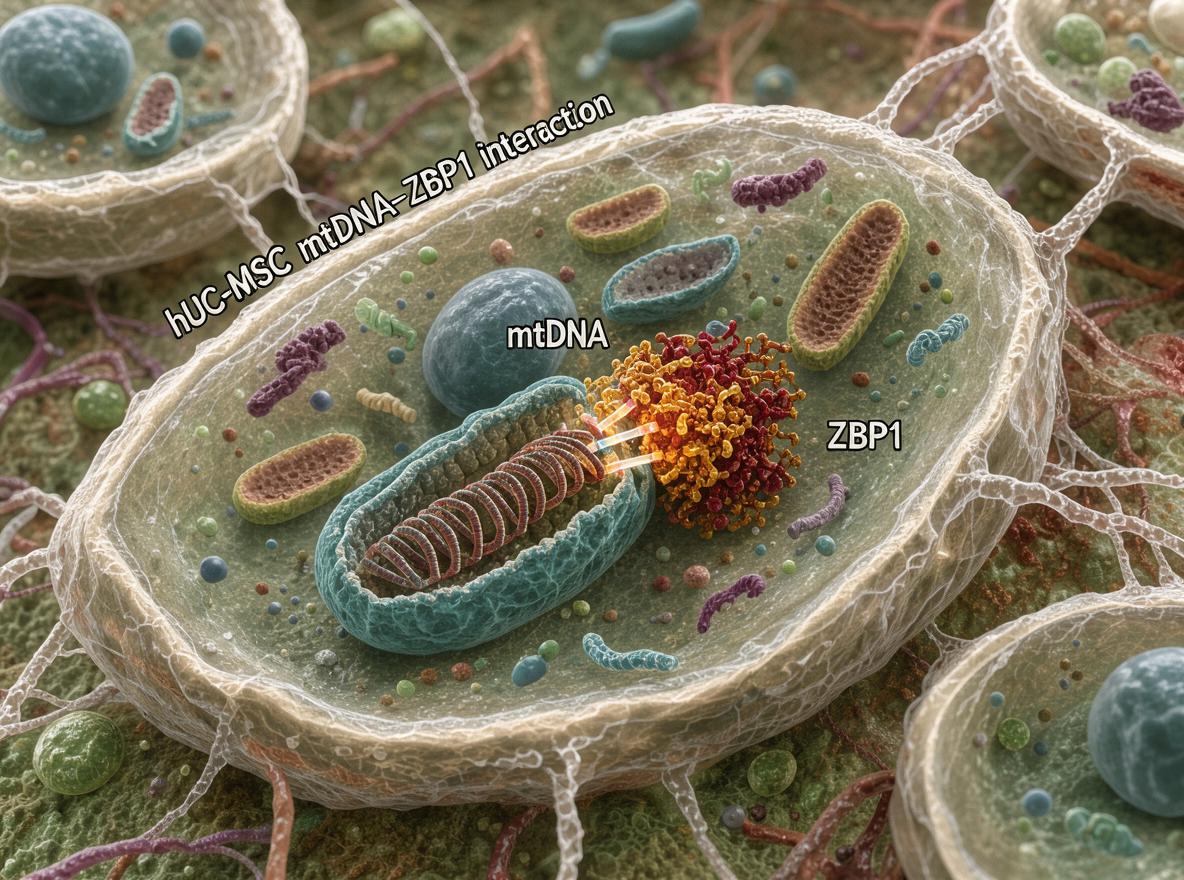
The strongest anchor is a 2026 PNAS study showing that after mild TBI, neurons release mitochondrial DNA within CD63+ extracellular vesicles, which activates microglia through ZBP1 and downstream TBK1–IRF3 signaling, elevating IL-6 and TNFα (N=10/group assays; male C57BL/6J mice) . Critically, the same study found early ZBP1 signaling appears protective: ZBP1 knockout reduced acute microglial activation but worsened later cognitive deficits. Any therapy that simply dampens the mtDNA-ZBP1 axis could therefore be counterproductive depending on timing — an unresolved temporal paradox for the hypothesis.
On the therapeutic side, a systematic review of 80 MSC/TBI studies (2015–2025) confirms a field-wide shift toward cell-free EV/secretome approaches and documents the only sizable randomized trial (STEMTRA, n=61–63, SB623 intracerebral MSCs): Fugl-Meyer Motor +8.3 vs +2.3 (P=0.040), clinically meaningful response 39.1% vs 6.7%, low immunogenicity — but no headache outcome and no cervical route .
Direct EV-microglia modulation evidence exists but in different routes and species: intranasal hypoxia-preconditioned rat BMSC-EVs shifted microglia toward an anti-inflammatory phenotype via miR-145-5p targeting SP1/NF-κB (rats, n=5/group behavioral assays; reversal with antagomir) , and EV miRNAs (miR-124-3p, miR-21-5p, miR-873a-5p) demonstrably transfer microglial polarization states between animals .
What the Evidence Cannot Support
1. Headache as an endpoint is absent. No supplied study measures post-traumatic headache; all outcomes are motor, cognitive, or neuroinflammatory. 2. Cervical epidural hUC-MSC route is untested. The closest routes are intracerebral (STEMTRA) and intranasal (rat); biodistribution from a cervical epidural depot to brain microglia is unknown. 3. Mechanism vs. local repair is undecidable with current data — no study isolates the two mechanisms. 4. The ZBP1 timing paradox (acute activation protective, later loss harmful) means "resolving" microglial activation could harm recovery . 5. Species/sex limits: all mechanistic data are male mice/rodent cell lines with acknowledged generalizability gaps.
Falsification Path
Decisive tests: (a) hUC-MSC-derived EVs should neutralize neuron-EV-carried mtDNA-induced ZBP1/TBK1-IRF3 activation in HMC3 microglia; (b) in mTBI mice, cervical-epidural vs distant-route hUC-MSC should yield equivalent headache-relevant and microglial outcomes if the mechanism is systemic EV signaling, but divergent outcomes if local repair dominates; (c) abolishing EV cargo (e.g., GW4869 or miRNA-depleted EVs) should abolish benefit.
Simulating predicted cervical-epidural EV biodistribution fractions reaching brain microglia versus local cervical tissue across routes, using published route assumptions, to visualize which mechanism the evidence can currently discriminate.
Get emailed when your analysis is done!
We'll email you the results when your analysis is finished.
Hypothesis Graveyard
Local cervical repair alone fully explains PTHA resolution: unsupported because PTHA after mTBI involves central neuroinflammatory mechanisms (mtDNA-ZBP1 axis) documented in brain tissue, not cervical structures.
Simple anti-inflammatory suppression of microglia cures post-TBI sequelae: contradicted by ZBP1-KO mice showing worse late outcomes despite reduced acute activation.
Science Art
Science Movie
Make a narrated HD Science movie for this answer ($64 per minute)

 Explore by Goal

 Hypothesis Novelty
 Quick Analysis Plan
 Long Analysis Plan
 Top Data Sources
 Ask a Follow-Up
 Key Insight
 Keep Exploring
 Analysis
 Hypothesis Graveyard
 Discussion
