Analyze how experimental results and claims are presented, scoped, and limited in a paper.Know what the science actually supports before you trust the answer.
Press Enter ↵ to analyze
Explore by Goal
"Imagination is more important than knowledge. Knowledge is limited. Imagination encircles the world."
- Albert Einstein
Quick Explanation
Copied
This 2017 Bulletin of the WHO meta-analysis of 38 studies (20,043 Indian mothers) pooled a postpartum depression prevalence of 22% (95% CI: 19–25), falling to 19% (95% CI: 17–22) after excluding assessments within 2 weeks postpartum . The estimate is broadly consistent with LMIC benchmarks (~19.2%) , but extreme heterogeneity (I²=96.8%), confirmed publication bias, varied screening instruments/cut-offs, and unexplained heterogeneity (meta-regression explaining <10%) mean the pooled point estimate should be treated as a range, not a precise national figure.
Long Explanation
Evidence Base and Pooled Findings
The authors searched PubMed, Google Scholar and Embase (2000–31 March 2016), screened 1,248 titles, and included 38 cross-sectional studies covering 20,043 women; 26 of 38 studies were published 2011–2015 . Random-effects pooling gave 22% (95% CI: 19–25); excluding 8 studies assessing depression within 2 weeks postpartum (to avoid conflating postpartum blues) gave 19% (95% CI: 17–22) from 11,257 women. Reported risk factors were narrative only — financial difficulties (19/21 studies), female infant birth (16/25), marital conflict (10/14), domestic violence (6/8) — because effect sizes could not be pooled .
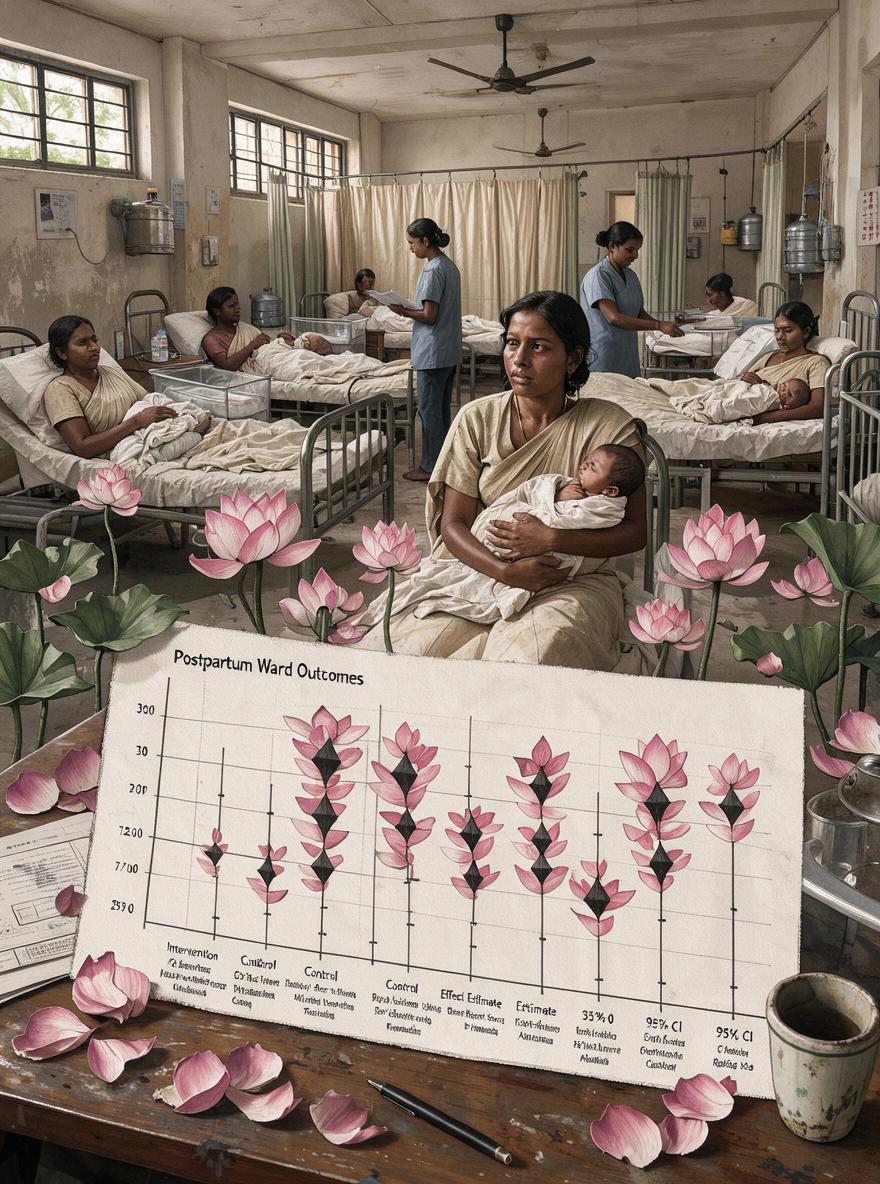
Subgroup point estimates and 95% CI half-widths as reported in Table 2 of the paper; CI bars approximate symmetric halves.
Critical Appraisal
Heterogeneity dominates: I² = 96.8% (all studies) and 92.0% (sensitivity set); meta-regression explained <10%, so the pooled estimate aggregates genuinely different populations, instruments and cut-offs . Individual estimates ranged from 3% to 59%.
Publication bias confirmed: Egger bias 2.58 (95% CI: 0.83–4.33) — the interval excludes zero, so smaller studies likely inflate the pooled estimate; the authors transparently report this.
Measurement inconsistency: most studies used the EPDS with varying cut-offs; the authors acknowledge this limits internal validity. Instrument choice alone shifted pooled prevalence (24% EPDS vs 17% other tools).
Design limits: most included studies were hospital-based (29/38), which the authors correctly flag as inflating estimates via illness-driven care-seeking; vote-counting of risk factors cannot establish effect magnitude or causality (confounding unaddressed).
Counterpoint: the 2-week exclusion is a defensible sensitivity analysis, and the authors preempted the EPDS false-positive concern. The main residual blind spot is the absence of any diagnostic-interview gold-standard pooling and no data on intervention effectiveness or care access — noted by the authors as gaps for policy.
Bottom Line
A rigorous, transparent first national synthesis: high-quality reporting of its own limitations, reasonable LMIC external consistency, but a pooled figure that should be quoted with its heterogeneity caveat. Findings would be overturned by high-quality, nationally representative studies using standardized diagnostic interviews showing materially different prevalence, or by analyses showing that publication-bias adjustment substantially lowers the pooled estimate.
Confidence: moderate — conclusions rest on cross-sectional studies of variable quality (median Newcastle-Ottawa score 5), with acknowledged publication bias.
Feedback:
Updated: October 29, 2026
BGPT Paper Review
Study Novelty
60%
First country-wide pooled prevalence estimate for India at the time, but methodologically a conventional random-effects prevalence meta-analysis; novelty is contextual (policy relevance) rather than methodological.
Scientific Quality
70%
Transparent search, quality scoring, sensitivity analysis for early-postpartum assessments, Egger test, and explicit acknowledgment of heterogeneity and EPDS cut-off variability. Major weakness: I²=96.8% with <10% of heterogeneity explained makes the pooled estimate fragile, and vote-counting of risk factors cannot support causal inference.
Study Generality
70%
National scope with regional, setting, age and instrument subgroups; findings generalize to LMIC perinatal mental health contexts, though India-specific sociocultural factors (e.g., female infant birth as a risk factor) limit transferability.
Study Usefulness
80%
Directly actionable for policy: quantifies an unmeasured national burden and supports resource allocation for maternal mental health capacity; widely cited baseline for subsequent Indian PPD research.
Study Reproducibility
70%
Search strategy, databases, inclusion criteria, NOS scoring, and software (Stata 14) are documented; individual study data are tabulated, enabling reanalysis, though no raw dataset or protocol registration is provided.
We'll email you the results when your analysis is finished.
Hypothesis Graveyard
'PPD prevalence in India is much higher than in high-income countries' — the paper's own comparison shows 22% (India) vs 19.2% (LMIC) vs ~12.9% (HIC at 3 months), but instrument and cut-off differences plausibly account for most of the India-HIC gap; the excess is not established as real disease difference.
'South India's higher prevalence (26%) reflects true regional risk' — not significant on meta-regression (P=0.63 for East, reference South), and may simply reflect more studies, better screening infrastructure, and greater urban slum concentration.

 Explore by Goal
 Quick Explanation
 Long Explanation
 Top Data Sources
 Ask a Follow-Up
 Key Insight
 Keep Exploring
 Hypothesis Graveyard
 Potential Experiments
 Discussion
