Use claims, exact reported results, scope, limitations, and falsification criteria to shape your next experiment.Know what falsifiable science actually supports before you trust the answer.
Press Enter ↵ to search evidence
Explore by Goal
"I would rather have questions that can't be answered than answers that can't be questioned."
- Richard Feynman
Quick Analysis Plan
Copied
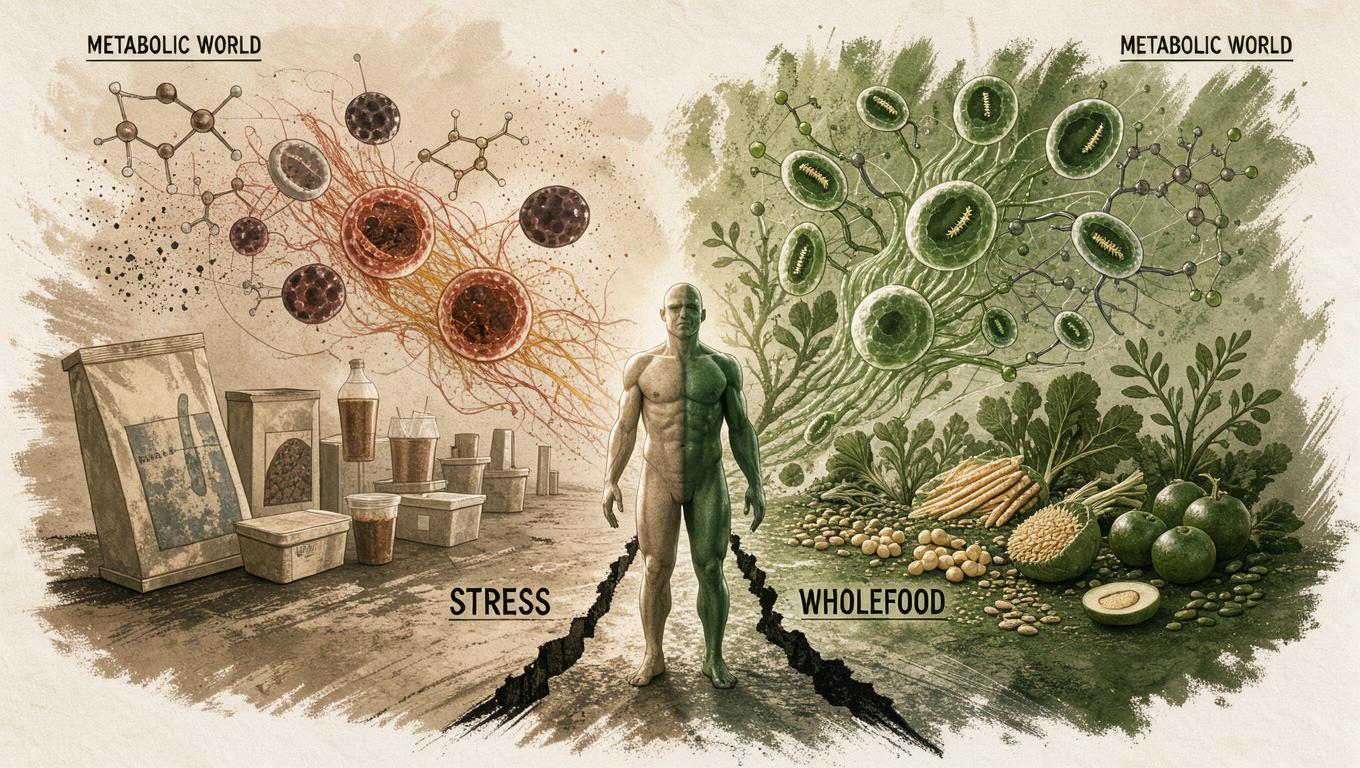
A 2×2 crossover (UPF vs minimally processed, 14 d each) stratified by basal perceived stress (e.g., PSS median split) is powered to test the stress×diet interaction on ad libitum energy intake and CGM/inflammatory outcomes; primary analysis should be a mixed-effects model with carryover and period terms, and the 14-day arm length is short enough that microbiome/SCFA shifts may be incomplete—a key limitation to state up front.
Long Analysis Plan
Design Architecture
Randomize n=40 (target 32 completers after 20% dropout) with 1:1 sequence allocation, stratified by baseline PSS-10 (low vs high, median split confirmed before randomization). Each arm lasts 14 days with a ≥7-day washout; arm order counterbalanced. Both diets are matched for calories presented, macronutrient ratio, fiber, and sodium where feasible—note that perfect matching is impossible because processing itself changes food structure; report residual differences explicitly.
Primary Endpoint and Model
Primary outcome: ad libitum energy intake (kcal/day, weighed food + 24h recalls). Analysis: linear mixed model outcome ~ diet × stress_stratum + period + carryover + baseline_value with participant random intercept; the stress×diet interaction is the pre-specified test of interest (α=0.05, two-sided). Secondary outcomes: CGM (mean glucose, TIR, glycemic variability), GLP-1/PYY/ghrelin (fasting + postprandial AUC), salivary cortisol (waking, CAR, evening), hsCRP/IL-6/TNF-α, fecal SCFAs (GC-MS), and 16S/shotgun microbiome diversity and butyrate-pathway gene abundance.
Power at these stratum sizes assumes a moderate interaction effect (d≈0.5) and is illustrative, not observed—formal power should use pilot SDs.
Sample Collection Schedule
Days −7 to 0 (each arm): baseline PSS-10, salivary cortisol ×4/day (2 days), stool, fasting blood.
Days 1–14: continuous CGM; daily ad libitum buffet meals days 8, 11, 14 for weighed intake; daily evening saliva.
Day 14: fasting GLP-1, PYY, ghrelin, hsCRP, IL-6, TNF-α; stool for SCFA + 16S/shotgun.
Bioinformatics / Coding Plan
CGM: preprocess with pandas; compute TIR, TAR, TBR, CV per participant per arm; mixed model via statsmodels MixedLM.
16S/shotgun:QIIME 2 or scikit-bio for diversity; MaAsLin2 for differential abundance testing diet × stress interaction; anndata if multiomic.
SCFA: GC-MS peak integration with scipy; log-transform; same mixed-model framework.
Microbiome functional inference: PICRUSt2 for butyrate (K00248, K01034) and propionate pathway gene abundance if shotgun not feasible.
Power/simulation:Monte Carlo via numpy to confirm power under assumed effect sizes before launch.
Known Limitations and Blindspots
14-day arms may be insufficient for stable microbiome/SCFA shifts; interpret microbiome endpoints as exploratory.
Carryover: microbiome can persist >7 days; a longer washout (e.g., 14 days) would strengthen inference but adds dropout risk.
n=40 stratified yields small strata; interaction tests have limited power—pre-register a directional hypothesis.
Ad libitum intake is subject to Hawthorne/re-activity effects when participants know they are being observed for intake.
Diet matching residual confounding (food matrix, emulsifiers, additives) is inherent and should be listed as a studied exposure, not a nuisance.
Building a reproducible pipeline that ingests CGM, SCFA, microbiome, hormone, and intake data from this crossover trial, computes the pre-specified stress × diet interaction via mixed-effects models, and returns effect sizes with confidence intervals.
Get emailed when your analysis is done!
We'll email you the results when your analysis is finished.
Hypothesis Graveyard
UPF causes weight gain purely via passive overconsumption independent of stress — this crossover design exists precisely because overconsumption may be stress-moderated, not universal.

 Explore by Goal
 Quick Analysis Plan
 Long Analysis Plan
 Top Data Sources
 Ask a Follow-Up
 Key Insight
 Keep Exploring
 Analysis
 Hypothesis Graveyard
 Potential Experiments
 Discussion
