Check each claim against its experiments, reported results, scope, and stated limitations.Know what the science actually supports before you trust the answer.
Press Enter ↵ to start review
Explore by Goal
"The most important scientific revolutions all include, as their only common feature, the dethronement of human arrogance from one pedestal after another of previous convictions about our centrality in the cosmos."
- Stephen Jay Gould
Quick Explanation
Copied
This 2019 Comprehensive Physiology review (308 references) argues that multicomponent exercise—mainly aerobic plus resistance training—preserves intrinsic capacity in the oldest old (80–85+ years), including frail and hospitalized individuals, while evidence for passive strategies (NMES, vibration) remains insufficient. The synthesis is broad, well-organized, and mechanistically detailed, but as a narrative review it inherits publication bias, small-sample trials in the underlying literature, and largely observational longevity data.
Long Explanation
Verdict and Evidence Base
The paper is a 308-reference narrative review, funded by Spanish public agencies, with authors declaring no conflicts of interest . Its three-part structure—mechanisms of decline, assessment tools (handgrip, gait speed, SPPB, TUG, Barthel/Katz, EWGSOP sarcopenia algorithm), and exercise benefits—is skimmable and clinically practical. The review is careful about its weakest area: it explicitly states evidence is still needed for NMES and vibration as passive strategies when volitional exercise is infeasible, an honest caveat rare in exercise reviews .
Strength of Underlying Trials Supporting the Review's Claims
Primary-trial evidence triangulates the review's central claims. A randomized pilot in 20 frail long-term-care residents (aged 75–99) showed group strength/flexibility exercise reduced TUG time by 18 s vs a 5.5-s worsening in controls, and raised MMSE by 2.0 vs a 2.2 decline . In nine frail obese older adults, a 3-month multicomponent program cut fat mass (46.8→45.1 kg, p=0.03), raised fat-free mass (58.5→59.9 kg, p=0.03), improved VO2peak (17.4→19.5 ml/kg/min, p<0.001) and all strength measures, though inflammatory markers did not change significantly . Whole-body vibration in 44 frail elders (mean 85.3 y) improved TUG (40.5→21.3 s), knee extensor strength (7.0→11.3 kg), and balance —interesting because the review downplays vibration evidence while this pilot trial supports feasibility. In 191 ADL-dependent elders (mean 84.7 y), a 2×2 factorial cluster RCT found exercise improved gait speed (+0.05 m/s, p=0.009) and Berg balance (+1.9 points, p=0.05) at 6 months with no added benefit from protein supplementation—a nuance the review does not emphasize .
Critical Appraisal
Blind spots and biases: (1) The longevity claims rest heavily on observational cohorts and master-athlete comparisons—healthy user bias and reverse causation are serious threats; the review acknowledges this only implicitly. (2) Many supporting trials have sample sizes of 9–44, so the "benefits in the frail and hospitalized" conclusion rests on fragile foundations; hospital-discharge outcomes in larger inpatient trials are cited but underweighted. (3) Exercise's effect sizes in the frail trials cited above are real but modest (e.g., +0.05 m/s gait speed); the review's framing sometimes overstates translational certainty. (4) Interventions beyond exercise (nutrition, social factors) are excluded by scope, yet the protein-supplement null result above suggests non-exercise moderators deserve attention. (5) BIA equations are flagged as unvalidated above age 85—exactly the population of focus—an internally acknowledged blind spot .
What would change the conclusion: large RCTs showing no functional benefit of multicomponent exercise in 80+ frail or hospitalized cohorts, or pharmacological agents matching exercise benefits, would falsify the central thesis. A systematic frailty-intervention review likewise found exercise effective while nutritional and individualized-management interventions were inconsistent, consistent with—but also dependent on—non-blinded designs typical in this field . Confidence in the review's core message is high (multiple converging trial types); confidence in its mechanistic narratives is moderate (many claims are pathway-level inference rather than tested mediators in 80+ humans).
Author reviews:
Feedback:
Updated: October 11, 2026
BGPT Paper Review
Study Novelty
60%
A comprehensive 2019 synthesis integrating hallmarks of aging with oldest-old-specific physiology and assessment, but the core message (exercise helps aging) was well established; the hospitalization/disuse framing adds partial novelty.
Scientific Quality
70%
Thorough, well-structured, self-critical about passive-strategy and BIA-validation gaps, and free of declared conflicts. Weaknesses: narrative (not systematic) methodology, reliance on observational longevity data, small underpinning trials, and no formal risk-of-bias assessment.
Study Generality
90%
Covers multisystem aging biology, clinical assessment, and intervention for a rapidly growing population segment; principles transfer broadly to geriatric medicine and physiology.
Study Usefulness
90%
Provides clinicians with concrete assessment tools (handgrip cutoffs, SPPB, TUG, Barthel/Katz) and actionable program recommendations (multicomponent AET+RET, especially during hospitalization).
Study Reproducibility
70%
As a review it cites 308 traceable references with defined cutoffs and protocols, but offers no raw data, code, or registered search strategy.
Explanatory Depth
80%
Details mechanisms from hallmarks of aging to mTOR/PGC-1α signaling, anabolic resistance, motor-unit loss, and MPS/MPB imbalance, though much is pathway-level inference not directly verified in 80+ humans.
We'll email you the results when your analysis is finished.
Hypothesis Graveyard
'Muscle mass loss is the primary driver of functional decline in the oldest old'—undermined by evidence that muscle power (not mass or strength) is the stronger predictor of disability and that strength gains from training are partly neural, independent of hypertrophy.
'Aging unavoidably causes slow-twitch fiber shifts that preclude power training'—falsified by feasibility of high-speed resistance training in institutionalized nonagenarians and superior functional gains vs low-speed programs.

 Explore by Goal
 Quick Explanation
 Long Explanation
 Top Data Sources
 Ask a Follow-Up
 Key Insight
 Keep Exploring
 Hypothesis Graveyard
 Potential Experiments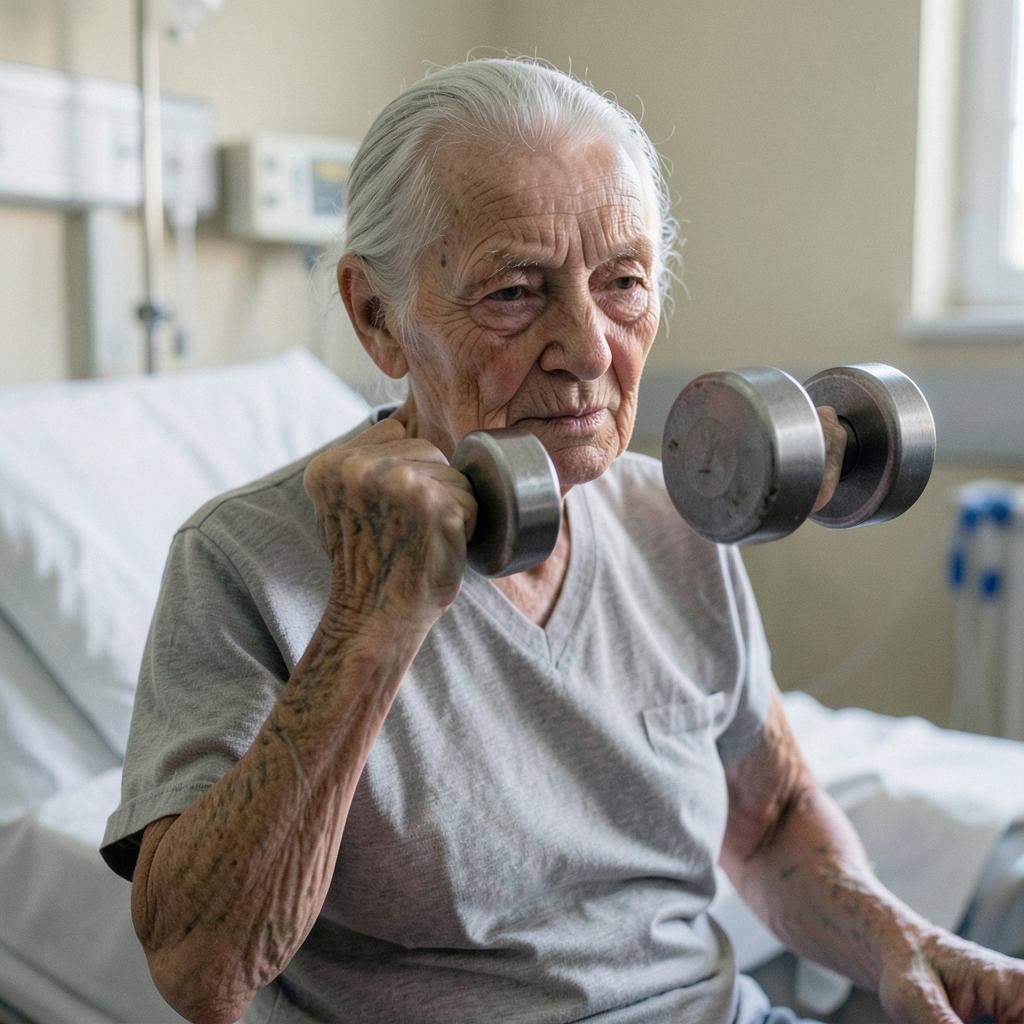
 Discussion