Check each claim against its linked experiments, results, and falsification criteria.Know what the science actually supports before you trust the answer.
Press Enter ↵ to check claims
Explore by Goal
"Imagination is more important than knowledge. Knowledge is limited. Imagination encircles the world."
- Albert Einstein
Quick Explanation
Copied
Kupper & Fuhlbrigge's 2004 Nature Reviews Immunology review is a landmark synthesis that framed cutaneous immune surveillance as a three-tiered (primary, secondary, tertiary) innate–adaptive circuit, using CLA/CCL17/ICAM1-dependent homing to explain psoriasis, atopic dermatitis, ACD, GVHD, and CTCL .
Long Explanation
What the paper established
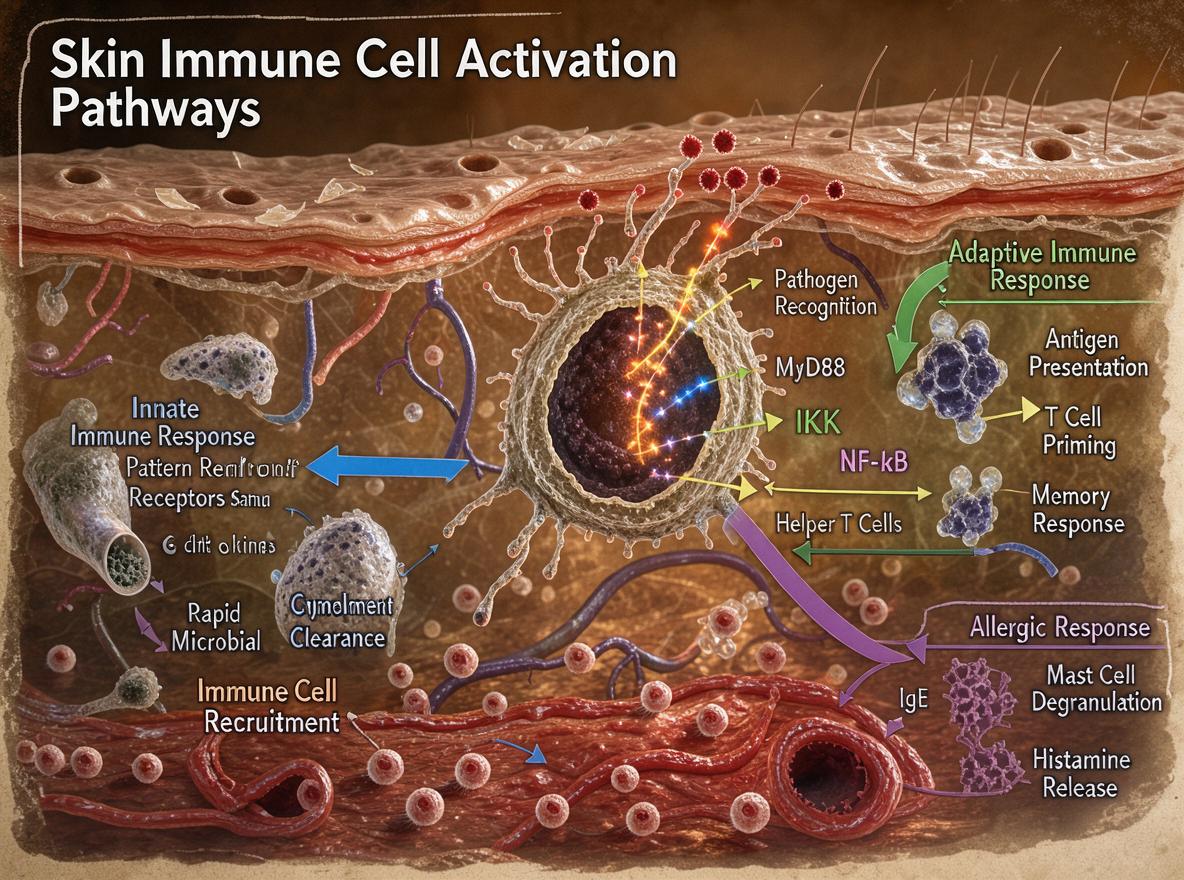
This 2004 review (162 references) reframed skin as an active immunological organ rather than a passive barrier, organizing cutaneous defense into a coherent model : (1) innate sentinels — keratinocytes releasing IL-1α/TNF/β-defensins, Langerhans cells migrating to draining nodes via TLR/NF-κB signaling, and mast cells producing distinct mediator sets per TLR ligand; (2) primary surveillance — DC-mediated antigen transport to skin-draining lymph nodes; (3) secondary surveillance — CLA+CCR4+ effector-memory T cells recruited by E-selectin, CCL17, and ICAM1 on dermal post-capillary venules (~30% of circulating memory T cells are CLA+, enriched in nearly all cutaneous inflammatory lesions); (4) tertiary surveillance — CCR7+ central-memory cells recirculating systemically to hedge against re-encounter at other epithelial interfaces.
Epidemiological scale motivating the model
The figures above are as reported by the authors (psoriasis 1–2%, atopic dermatitis 7–17% in children with ≥60% persistence, vitiligo 1–2%) .
Clinical translations the review predicted
The mechanistic model maps onto disease: the Koebner phenomenon (trauma → IL-1/TNF → E-selectin/ICAM1 upregulation → CLA+ T-cell recruitment) explains psoriatic plaque induction; IL-4 blockade of β-defensin/cathelicidin induction in atopic skin explains S. aureus susceptibility and innate–adaptive loop perpetuation; regulatory T-cell imbalance is proposed for nickel tolerance loss . The smallpox-vaccination-in-atopy Box 1 is the boldest translational inference — predicting route-dependent homing outcomes later supported by transcutaneous immunization work showing stronger responses than intramuscular delivery .
Critical assessment
Strengths: synthesis quality (162 sources), dual expertise (Kupper is a discoverer of keratinocyte IL-1 biology; Fuhlbrigge of CLA homing), and a model that anticipated later work — e.g., subsequent cutaneous-innate-immunity reviews and keratinocyte-centered epithelial immunity/skin-tumor work trace directly to this framing .
Limitations and blindspots: as a review, it has no primary data, no effect sizes, and relies heavily on murine models (e.g., Peyer's-patch DC imprinting, psoriasis xenografts) whose human translatability is unproven; some claims are explicitly flagged as untested by the authors themselves (e.g., the gut-vs-skin-homing hypothesis in GVHD — "has not been formally tested"). The Th1/Th2 dichotomy it leans on is now known to be incomplete (Th17/IL-17 was being defined concurrently, and psoriasis is now understood as largely IL-23/Th17-driven — a major later correction not anticipated here). Several therapeutic predictions aged unevenly: efalizumab was later withdrawn for PML, which the review could not foresee. Mast-cell/neuroimmune contributions to itch and stress-triggered flares, which the review touches only glancingly, were later developed substantially .
What would change the model: demonstration that CLA is neither necessary nor sufficient for skin homing in vivo, or that central-memory cells do not confer cross-interface protection, would falsify the two-tier tissue-homing core. Confidence in the structural framework is high; confidence in specific receptor-ligand assignments (CCR10/CCL27, CCR6) is moderate, as the authors themselves hedge.
Feedback:
Updated: November 08, 2026
BGPT Paper Review
Study Novelty
80%
The primary/secondary/tertiary surveillance framework and the constitutive-homing ('resident sentinel T cell') concept were novel syntheses for 2004, though built from established CLA/chemokine literature.
Scientific Quality
80%
Authoritative synthesis by field-originating authors with 162 references and explicit labeling of untested claims; deductions from murine data and the now-outdated Th1/Th2 framing reduce quality slightly.
Study Generality
90%
Explicitly generalizes to gut, lung, and other epithelial interfaces; the tissue-homing paradigm it codified now underpins organ-resident immunology broadly.
Study Usefulness
80%
Clinically consequential: framed psoriasis/AD as surveillance dysregulation, justified T-cell-targeted biologics, and predicted route-dependent vaccine design — validated by later transcutaneous immunization studies.
Study Reproducibility
50%
As a narrative review it contains no primary methods; reproducibility rests on the cited primary studies, some murine-only and not independently reproduced at the time.
Explanatory Depth
80%
Provides mechanistic depth (TLR→NF-κB→adhesion/chemokine cascades; CLA/CCR4/CCL17 axis; IL-1 agonist/antagonist balance), though several regulatory mechanisms are acknowledged as unresolved.
We'll email you the results when your analysis is finished.
Hypothesis Graveyard
'Skin is a passive barrier' — falsified by increased infections/malignancies under immunosuppression and T-cell dependence of psoriasis xenograft induction.
'Homing is antigen-driven first' — falsified by constitutive rolling/tethering on un-inflamed skin venules showing recruitment precedes antigen recognition.

 Explore by Goal
 Quick Explanation
 Long Explanation
 Top Data Sources
 Ask a Follow-Up
 Key Insight
 Keep Exploring
 Hypothesis Graveyard
 Potential Experiments
 Discussion
