Check a paper's claims against linked experiments, exact results, stated scope, and limitations.Know what falsifiable science actually supports before you trust the answer.
Press Enter ↵ to search evidence
Explore by Goal
"The greatest enemy of knowledge is not ignorance, it is the illusion of knowledge."
- Stephen Hawking
Quick Explanation
Copied
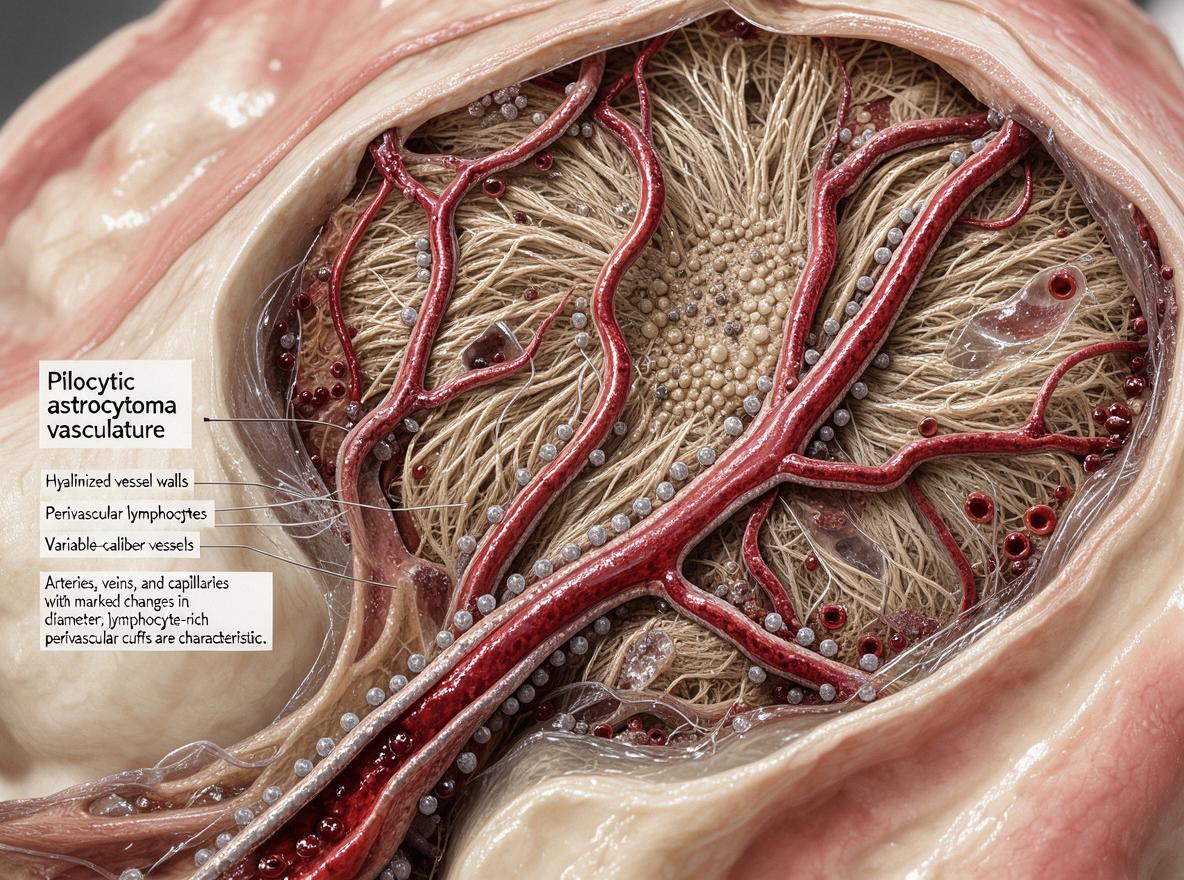
Gesundheit et al. (2003) report that pediatric pilocytic astrocytomas are dominated by large, mature, α-SMA–positive vessels (vessel maturation index 54.5% small-vessel maturity) while anaplastic astrocytomas contain mainly small, immature, α-SMA–negative vessels (VMI 6.1%), with anaplastic tumors uniquely co-expressing VEGF and flt-1 in tumor cells, suggesting autocrine VEGF signaling and greater susceptibility to anti-angiogenic therapy
Long Explanation
Core findings. In 12 archival pediatric tumors (6 pilocytic astrocytoma, PA; 6 anaplastic astrocytoma, AA), Factor VIII staining counted a mean of 3.9 large and 7.8 small vessels per HPF in PA versus 0.9 large and 29.8 small vessels in AA — a ~4.3-fold excess of large vessels in PA and ~3.8-fold excess of small capillaries in AA, yielding small:large ratios of 2:1 (PA) and 33:1 (AA) . α-SMA pericyte staining gave a vessel maturation index of 54.5% for small PA vessels versus 6.1% for small AA vessels (large-vessel maturity 71.5% vs 56%), supporting the authors' interpretation that AA harbors actively sprouting, immature vasculature .
Molecular correlate (author interpretation). VEGF localized to astrocytic foot processes in PA but to tumor-cell cytoplasm in AA; flt-1/VEGFR-1 was restricted to endothelial cells in PA but detected in AA tumor cells as well — a pattern not previously reported, from which the authors infer a possible autocrine VEGF loop in AA .
Critical appraisal. Strengths: dual-observer counting with concordance required, predefined counting rules, matched cohort design, and explicit discussion that the 15 µm small/large cutoff was arbitrary . Weaknesses: n=6 per group; retrospective archival tissue; only two normal-brain controls and a hemangioblastoma surrogate positive control; semi-quantitative (not blinded) VEGF/flt-1 grading; hotspot sampling may bias toward angiogenic regions; no multivariate adjustment or validation cohort; proposed autocrine VEGF mechanism is inferred from IHC colocalization, not functional assay. Statistical P-values rest on small samples without non-parametric correction despite heterogeneous distributions. The therapeutic prediction (AA's low VMI predicting anti-angiogenic sensitivity) remained untested here.
Context and falsifiability. The reported 4-year PA survival versus ~12-month AA survival frames the counterintuitive observation that the "more vascular" PA carries the better prognosis; the paper argues maturity, not density, predicts behavior . The claim would be falsified if larger, blinded cohorts show no VMI difference between PA and AA, or if α-SMA negativity does not predict anti-angiogenic response prospectively.
Feedback:
Updated: November 22, 2026
BGPT Paper Review
Study Novelty
70%
First demonstration of distinct vascular maturation patterns (VMI via α-SMA/FVIII) and tumor-cell flt-1 expression distinguishing pediatric PA from AA; conceptually reframed vessel "maturity" rather than MVD as prognostically relevant, ahead of the vascular-normalization era.
Scientific Quality
60%
Careful dual-observer IHC with matched cohorts and transparent counting rules, but n=6/group, arbitrary vessel-size thresholds, semi-quantitative unblinded VEGF grading, no functional validation of the autocrine VEGF claim, and small-sample t-tests; self-acknowledged methodological arbitrariness is honest but limits inferential strength.
Study Generality
60%
Findings are tumor- and age-specific (pediatric PA vs AA) but introduced the VMI concept broadly applicable to tumor angiogenesis and anti-angiogenic stratification across cancers.
Study Usefulness
70%
Clinically useful reframing: explains why radiologically "more vascular" PA has better prognosis, and rationalizes anti-angiogenic trials in malignant pediatric glioma via immature-vessel susceptibility and vascular normalization.
Study Reproducibility
60%
Antibodies, dilutions, platforms (Ventana Gen II), counting rules, and VMI formula are fully reported, enabling replication; but dependence on observer hotspot selection and small archival blocks reduce consistency.
Explanatory Depth
60%
Mechanistic narrative (sprouting angiogenesis, pericyte recruitment, hypoxia-driven VEGF, autocrine flt-1) is coherent and grounded in the era's literature, but rests on descriptive IHC without in situ hybridization, functional blockade, or imaging-perfusion corroboration.
We'll email you the results when your analysis is finished.
Hypothesis Graveyard
"Higher MVD implies worse prognosis": falsified for PA by this study — PA shows denser hyalinized vasculature yet near-normal survival; density conflates stable mature vessels with proliferative neoangiogenesis.
"AA's small vessels simply reflect tissue hypoxia": unlikely to be the full explanation, since PA's large vessels coexist with comparable vascularity; pericyte recruitment failure points to angiopoietin/VEGF balance dysregulation rather than hypoxia alone.

 Explore by Goal
 Quick Explanation
 Long Explanation
 Top Data Sources
 Ask a Follow-Up
 Key Insight
 Keep Exploring
 Hypothesis Graveyard
 Potential Experiments
 Discussion
