Check each claim against its linked experiments, results, and falsification criteria.Know what the science actually supports before you trust the answer.
Press Enter ↵ to check claims
Explore by Goal
"The universe is not only queerer than we suppose, but queerer than we can suppose."
- J.B.S. Haldane
Quick Explanation
Copied
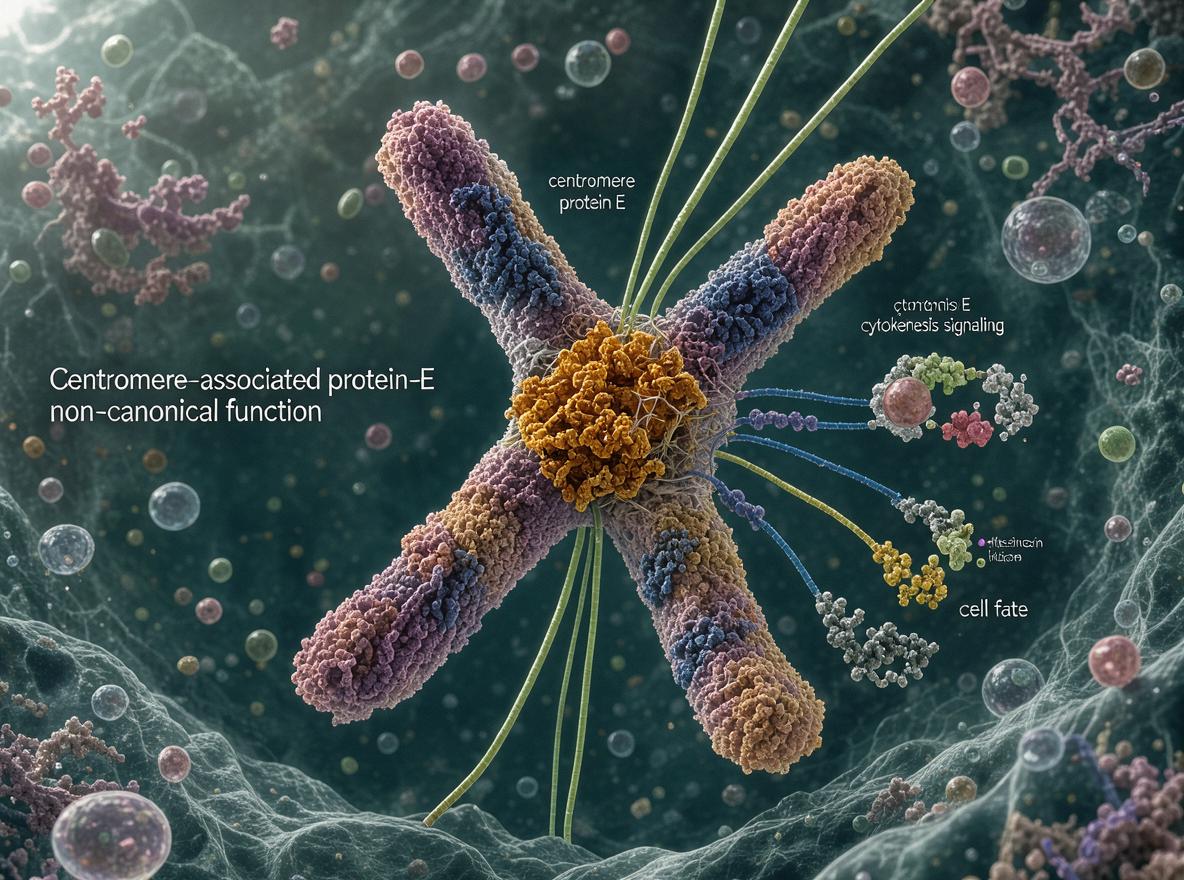
This paper demonstrates that CENP-E has a previously unknown interphase role: in G2 it transports PCM1 away from centrosomes, enabling centrosomal Plk1 recruitment and PCNT phosphorylation required for PCM integrity and proper spindle orientation. Acute CENP-E degradation via auxin-inducible degron revealed PCM fragmentation (55%), shortened astral microtubules, and oblique divisions (41%), phenotypes mirrored in CENPE-mutant patient cells (41% oblique divisions vs 13% control) .
Long Explanation
Core Discovery: A Second, Interphase Function for CENP-E
CENP-E is classically a kinetochore kinesin required for metaphase chromosome alignment . Owa and Dynlacht circumvented the confounding mitotic-arrest problem by generating a CRISPR-based auxin-inducible degron (AID) CENP-E knockout in hTERT-RPE1 cells, achieving degradation within 1 hour. This technical choice is the paper's key strength: it permitted observing immediate consequences of CENP-E loss in interphase, which siRNA or antibody-injection approaches could not isolate .
The mechanistic chain reported: CENP-E accumulates around centrosomes in late S/early G2, physically interacts with PCM1 (co-IP peaks 6-10 h after G1 release, absent by 12 h/M phase), and transports PCM1 away from the peri-centrosomal region by prophase. Without CENP-E, PCM1 accumulates at centrosomes, centrosomal Plk1 and PCNT-pS1241 drop, PCM fragments (55% of KO cells vs 12% with noscapine-induced mitotic arrest, arguing against a mere delay artifact), astral MTs shorten, and 41% of divisions are oblique. Crucially, PCM1 depletion rescued Plk1 recruitment, pS1241, PCM fragmentation, and astral MTs, but not chromosome misalignment, separating the interphase pathway from the kinetochore pathway .
The LCL data strengthen the clinical link: CENPE-mutant patient cells (D933N/K1355E) show reduced centrosomal PCNT and pS1241, PCM1 accumulation, and 41% oblique divisions versus 13% in controls, with failed CENP-E/PCM1 co-IP .
Critical Assessment and Blind Spots
Strengths: Clean genetic separation of pathways via bidirectional rescue (Plk1-T210D rescues PCM but not chromosomes; PCM1 siRNA rescues PCM but not chromosomes); noscapine control ruling out mitotic-delay artifact; reversible GSK washout showing direct transport dependency; three biological replicates, N=90-104 cells/condition.
Limitations the authors partly acknowledge: (1) 45% of KO cells retained normal PCM, implying redundant motors (identity unknown). (2) All mechanistic work is in RPE-1 cells and LCLs; the microcephaly connection is inferential—no neural progenitor or in vivo data demonstrate that oblique divisions cause premature differentiation during brain development . (3) Patient phenotype differs from KO (reduced PCM mass rather than fragmentation), attributed to cell-type differences—plausible but untested. (4) Whether CENP-E directly moves PCM1 or affects dynein/dynactin-mediated retrograde transport is not resolved. (5) Single patient LCL pair limits genetic generalizability. Contextually, PCM1's role in centrosome asymmetry and progenitor fate and microcephaly gene networks are consistent with this mechanism being developmentally relevant, but the direct causal link remains open.
Falsification paths: If a redundant kinesin were identified and double depletion eliminated PCM phenotypes; if neural progenitor-specific CENPE loss failed to alter spindle orientation in vivo; or if patient LCL defects arose from unrelated B-cell transformation effects, the model would require revision.
Feedback:
Updated: October 27, 2026
BGPT Paper Review
Study Novelty
80%
First demonstration of a kinetochore-independent, interphase role for CENP-E as a centriolar-satellite/PCM1 transporter; conceptually new, though it builds on prior proteomic identification of the CENP-E–PCM1 interaction.
Scientific Quality
80%
Rigorous controls (noscapine arrest control, GSK washout, bidirectional rescue separating pathways), 3 replicates, defined statistics. Weakened by single patient LCL pair, incomplete degradation checks, and largely inferential microcephaly link.
Study Generality
70%
The PCM1–Plk1–PCM integrity axis likely applies broadly to dividing cells and connects to microcephaly genetics, but evidence is confined to two human cell types; in vivo generality is untested.
Study Usefulness
80%
Reframes CENP-E as a dual-function motor, explains microcephaly patient phenotypes mechanistically, and provides a testable pathway (PCM1–Plk1–PCNT) relevant to centrosome diseases and spindle orientation biology.
Study Reproducibility
80%
Detailed methods (AID construct sequences, drug concentrations, imaging parameters), source data available; but key reagents (patient LCLs, some antibodies) require third-party requests, limiting independent replication.
Explanatory Depth
80%
A complete cell-cycle-resolved mechanistic chain from cargo interaction through phosphorylation to phenotype, with epistasis-style rescue logic; gaps remain in direct motor-cargo transport demonstration and redundant motor identity.
Mining centrosome-proteome interaction datasets to identify candidate kinesins redundantly transporting PCM1, ranking by co-expression with CENP-E and centrosomal enrichment.
Get emailed when your analysis is done!
We'll email you the results when your analysis is finished.
Hypothesis Graveyard
PCM fragmentation in CENP-E KO is a separase-driven byproduct of prolonged prometaphase — falsified by the noscapine control (12% vs 55%) and absence of centriole disengagement.
PCM defects arise from centromere/kinetochore dysfunction dispersing spindle poles — falsified by differential rescue: Plk1/PCM1 manipulations fix PCM but not chromosome alignment, and phenotype distribution differs from kinetochore-disruption studies.

 Explore by Goal
 Quick Explanation
 Long Explanation
 Top Data Sources
 Ask a Follow-Up
 Key Insight
 Keep Exploring
 Analysis
 Hypothesis Graveyard
 Potential Experiments
 Discussion
