Ask questions across claims linked to experiments, exact results, limitations, and sources.Know what the science actually supports before you trust the answer.
Press Enter ↵ to search evidence
Explore by Goal
"Be less curious about people and more curious about ideas."
- Marie Curie
Quick Explanation
Copied
The strongest evidence supports whole plant-rich dietary patterns: higher carotenoid status was linked to ~29% lower infection risk in 652 elderly adults, and increasing vegetable/fruit intake to 5–8 servings/day reduced CRP in trials . Key nutrients include vitamins C/E, carotenoids, zinc, selenium, and omega-3s, though high-dose supplements often show null effects in healthy adults .
Long Explanation
What the evidence actually shows
No single “immune-boosting” food is proven; the best-supported strategy is a dietary pattern rich in vegetables, fruit, fish and phytochemicals. In a cross-sectional study of 652 elderly subjects, high plasma carotenoid status (~0.8 µM range reported) was associated with a 29% reduction in infection risk, with no such association for retinol . In a dietary intervention, healthy men increasing from 2 to 5 or 8 daily vegetable/fruit servings raised plasma carotenoids and lowered CRP . Large cohorts (~5,000) similarly link “prudent” diets to lower CRP/IL-6 and Western diets to higher inflammatory markers .
Specific foods and components with reported activity
Carotenoid-rich produce (carrots, tomatoes, juices delivering ~30–40 mg lycopene/beta-carotene daily): depletion-repletion trials increased IL-2, TNF-alpha and NK cell lytic function, though effects were attenuated in people with high baseline status .
Flavonoid/anthocyanin foods (berries, cherries, grapes): cherry intake (~280 g/day) cut CRP ~25% in a 64-day trial; flavonoid intake inversely associates with CRP and anthocyanin extracts reduced NF-kB-related cytokines, with mixed short-trial results .
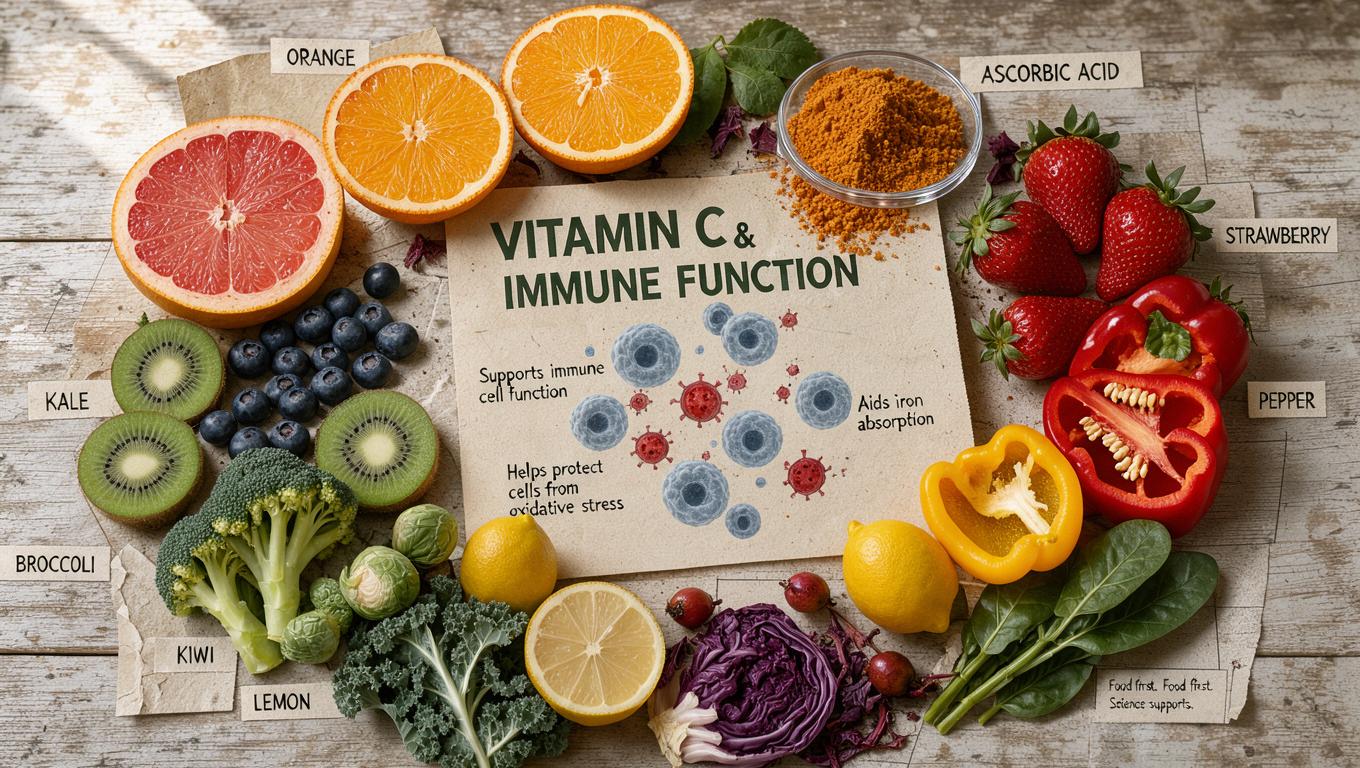
Vitamin-C-rich fruits such as camu-camu show antioxidant/anti-inflammatory potential in rodent, cell and small human studies, but robust human trials are lacking .
Broad nutrient adequacy: reviews list vitamins A, C, D, E, folate, zinc, iron, selenium, omega-3s and phytochemicals as immune-relevant, but evidence is largely mechanistic/observational . Notably, 1500 mg/day vitamin C for 4 weeks in 14 healthy adults raised plasma vitamin C but did not significantly change complement C1q (+18%, P=0.12) — a null result cautioning against megadoses .
Specialized milks: donkey milk (1.4–1.8 g/100 mL protein, 55–65% whey, lactoferrin, ~4.75x cow-milk vitamin C) shows immunomodulatory and anti-inflammatory activity in preclinical work, but human evidence is limited and production is non-standardized . Propolis polyphenols show immunomodulatory, antimicrobial and antiviral activities varying strongly by geographic origin, with no standardization .
Confidence, blind spots and what would change this
Confidence is moderate: the dietary-pattern and carotenoid findings come from observational and small intervention studies vulnerable to healthy-user bias, confounding, and publication bias, and immune biomarker changes may not translate into fewer infections. Elderly or nutrient-deficient people likely benefit more from correction than well-nourished adults, where supplement trials are often null . Large, adequately powered RCTs with standardized foods/doses showing no reduction in infection rates would weaken these conclusions.
We'll email you the results when your analysis is finished.
Hypothesis Graveyard
High-dose vitamin C broadly “upgrades” innate immunity: falsified for complement C1q in healthy adults (null at 1500 mg/day, P=0.12); effects likely only correct deficiency.
Single “superfoods” (e.g., camu-camu) materially reduce infection in well-nourished people: unsupported — evidence is preclinical/small-human, and effects likely reflect nutrient repletion already achievable from common produce.

 Explore by Goal
 Quick Explanation
 Long Explanation
 Top Data Sources
 Ask a Follow-Up
 Key Insight
 Keep Exploring
 Hypothesis Graveyard
 Potential Experiments
 Discussion
