Check a paper's claims against linked experiments, exact results, stated scope, and limitations.Know what falsifiable science actually supports before you trust the answer.
Press Enter ↵ to search evidence
Explore by Goal
"I think it's much more interesting to live not knowing than to have answers which might be wrong."
- Richard Feynman
Quick Explanation
Copied
Walker's 1983 'Fats in nutrition' perspective (10.1139/y83-040) impressively anticipated trans-fat safety controversy, n-3 brain development, and prostaglandin-mediated immunity, though its own author admitted the hydrogenated-fat/CHD question was unresolved; a skeptical 1983 review whose predictions largely validated over the next four decades .
Long Explanation
What the 1983 Paper Actually Claimed
B.L. Walker (University of Guelph) surveyed 25 years of lipid nutritional biochemistry dominated by the diet-heart hypothesis, then forecast the next quarter-century. Notably, Walker flagged that most hydrogenated-fat studies were confounded by diets marginally deficient in essential fatty acids and by use of "hydrogenated fat" as a synonym for trans-fatty acids when positional cis-isomers were also present . His own rat data showed cis-vaccenic (Δ11-18:1) reaching 60–70% of heart phospholipid 18:1 even on stock diets, and tissue-specific preferential incorporation of "atypical" isomers.
Retrospective Validation of Predictions
Walker predicted trans-fatty acids would be "the cholesterol-polyunsaturated fatty acid story of the 1980s" — this proved correct, with industrial trans fats later becoming one of the few dietary components subject to near-global regulatory elimination. He also predicted n-3 acid roles in central nervous system function based on Holman's linolenic-deficiency case and his own rat maze-learning data correlating brain EGP 22:6 n-3 with learning — an anticipation of modern DHA neurodevelopment science . However, his caution that hydrogenated-fat/CHD evidence was inadequate was ultimately superseded: later consensus shifted, though even 2020 reanalysis argued saturated-fat effects depend on food matrix rather than universal limits .
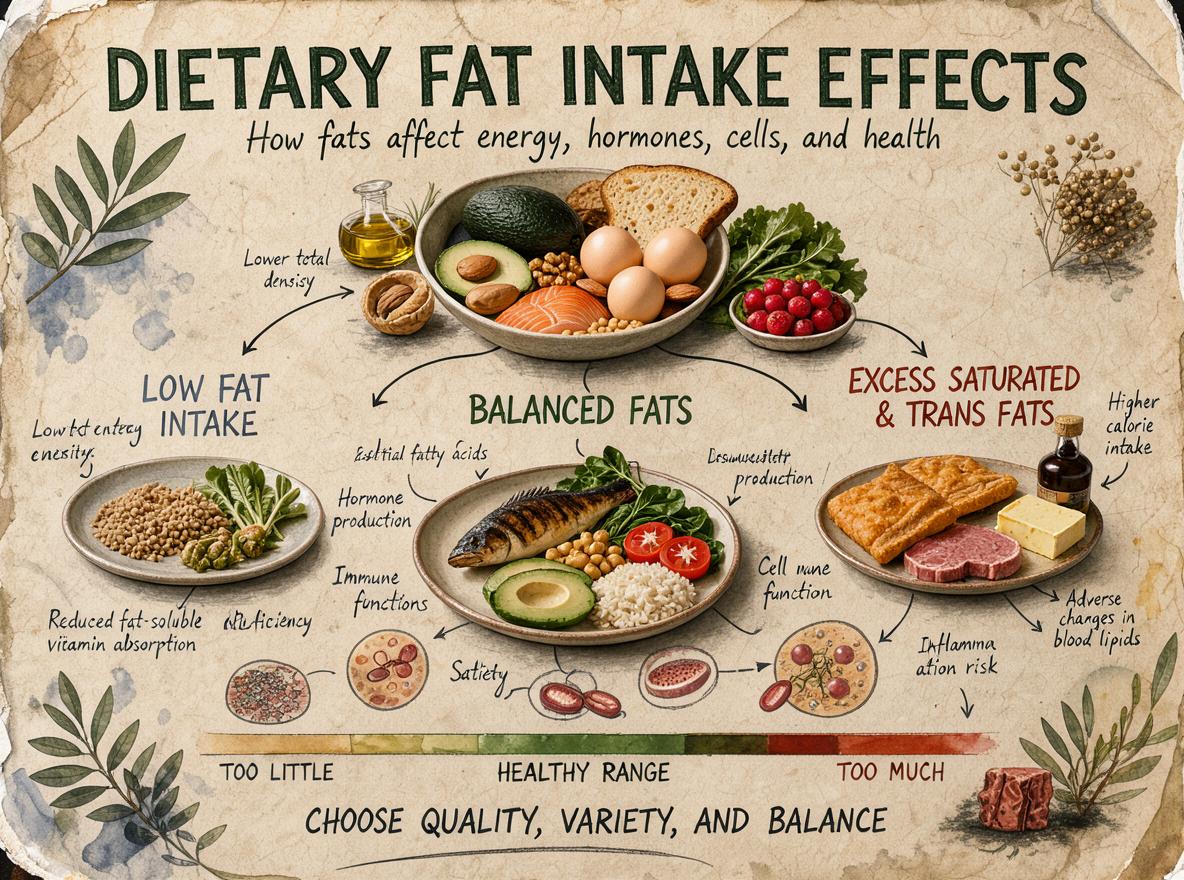
This graph shows sourced values from the Osteoarthritis Initiative (JSW loss rising with total-fat and SFA quartiles, with a non-monotonic PUFA pattern) — illustrating Walker's broader point that fat type, not just amount, matters.
Critical Assessment
Strengths: Epistemically honest (explicitly stated no safety assessment was possible); identified the EFA-deficiency confound before it was widely appreciated; provided primary rat isomer-incorporation data; correctly ranked technique-driven progress (capillary GC, HPLC). Weaknesses: Heavy over-generalization from rats to humans; no quantitative meta-synthesis; the C57 mouse hypercholesterolemia result cited is a single strain; the prostaglandin immune-modulation prediction leaned on one abstract-level reference . Blind spots Walker could not have seen: the food-matrix nuance now central to fat science , and region-dependent macronutrient effects seen in PURE (summary estimate 0.059, 95% CI 0.041–0.078) .
Feedback:
Updated: November 21, 2026
BGPT Paper Review
Study Novelty
60%
A 1983 perspective that correctly forecast trans-fat controversy, n-3 neurobiology, and prostaglandin immunity; novel for its era, but a perspective article synthesizing known work rather than presenting new discoveries.
Scientific Quality
50%
Skeptical self-assessment and useful primary rat data, but no systematic evidence synthesis, heavy animal-to-human extrapolation, and OCR-extracted references contain errors; predictive reasoning rather than rigorous hypothesis testing.
Study Generality
70%
Covers the whole field of lipid nutrition — cardiovascular, immune, neurological, analytical — with broad cross-domain relevance, though grounded in the specific diet-heart era.
Study Usefulness
60%
Valuable historically and as a documented prediction record; practically useful for understanding why early trans-fat studies were confounded, but contains no actionable modern protocols.
Study Reproducibility
30%
A perspective article with no primary dataset; embedded rat experiments cite an M.Sc. thesis and lack deposited data, so claims are not directly reproducible.
Explanatory Depth
60%
Detailed pathway-level reasoning (desaturation/elongation, isomerization in situ, phospholipid positional preference) shows real depth, though hypotheses were left untested.
We'll email you the results when your analysis is finished.
Hypothesis Graveyard
Trans-fatty acids act like saturated fats on cholesterol — Walker's own mouse data questioned this, and later work showed isomer-specific and matrix-dependent effects rather than a uniform SFA-like behavior.
Fish-oil antiaggregation works solely via PGI3/TxA3 formation — contemporaneous work (cited in the paper) repudiated this in favor of inhibited arachidonic acid production, which is closer to the modern view.

 Explore by Goal
 Quick Explanation
 Long Explanation
 Top Data Sources
 Ask a Follow-Up
 Key Insight
 Keep Exploring
 Hypothesis Graveyard
 Potential Experiments
 Discussion
